Butter Stone, Cotherstone Moor
High on Cotherstone Moor, beside the road between Cotherstone and Bowes, sits a small weathered boulder with an extraordinary local story attached to it. Known as the Butter Stone, this simple grooved stone is remembered as a plague time exchange point, where farmers and townspeople could trade food without ever meeting face to face.
At first glance it looks like nothing more than a rough roadside rock. But when you stop beside it and look out across the open moor, it becomes easier to imagine how important a place like this once was.
Local tradition says that during plague outbreaks in Teesdale, butter, eggs and other produce were left here by farmers. Buyers from Barnard Castle would later collect the goods and leave payment behind, avoiding direct contact and helping prevent the spread of disease.
It is a small landmark, but one that quietly connects the landscape around Cotherstone with some of the most difficult years in the region’s history.

Where is the Butter Stone
The Butter Stone sits on Moor Road between Cotherstone and Bowes, around 5 miles from Barnard Castle and about 1 mile from Cotherstone village.
There is a large layby at:
54.558330, -2.004384
Nearest postcode: DL12 9UN
From the layby, walk downhill along the road for roughly 900 feet. You will pass one public footpath sign first, but keep going. The Butter Stone is beside the second sign, sitting close to the roadside.
It is surprisingly easy to miss when driving past, but once you know where to look the stone becomes obvious against the grass of the moor.
Historic England records the Butter Stone as a Grade II listed structure, describing it as a grooved, roughly pyramidal boulder about 0.75 metres high, listed for its historical interest.
The Plague Story
The Butter Stone is most closely linked to the plague outbreaks that affected Teesdale during the mid 17th century.
When disease spread through nearby communities, markets and gatherings were often cancelled to slow infection. But people still needed to buy and sell food.
Local tradition says that farmers from surrounding villages brought butter, eggs and other produce to this stone on Cotherstone Moor. The goods were placed on the stone and the farmers would step away.
Later, buyers from Barnard Castle, Cotherstone and Bowes would approach the stone, take the produce and leave their payment behind.
Some accounts describe a bowl of vinegar or water placed on the stone so coins could be disinfected before being handled. Whether that detail is exact or not, the story shows that people were already thinking about ways to reduce infection long before modern medicine understood how diseases spread.
Different historical sources give slightly different dates for the event, with some linking the stone to the 1636 plague in Romaldkirk and others connecting it to the 1663 to 1665 plague affecting Barnard Castle. What they all agree on is that the Butter Stone became a safe meeting point during a time when direct contact could mean death.
A Stone Beside an Old Teesdale Route
The Butter Stone was not placed randomly on the moor.
Historical accounts of Teesdale footpaths and trade routes describe an old route running from Barnard Castle through Lartington, across Cotherstone Moor, and on towards Briscoe and Baldersdale.
This path passed directly by the Butter Stone.
Long before modern roads existed, goods were often transported across the dale by pack animals travelling in single file, carrying produce, wool, lead and other goods between settlements. These routes connected isolated farms and villages with market towns.
Standing beside the stone today, it is easy to imagine those routes crossing the moor long before the modern road arrived.
The Butter Stone Today
Today the Butter Stone sits quietly beside the roadside grass on Cotherstone Moor.
There are no fences or signs drawing attention to it. If you didn’t know the story, you might drive straight past without noticing it.
But that quietness is part of what makes the place special. The stone still sits in the same open landscape where it has stood for centuries, surrounded by wide skies and views across Teesdale.
It is a reminder that some of the most fascinating pieces of local history are not castles or ruins, but simple objects that once played an important role in everyday life.
A Quiet Reminder of Teesdale’s Past
Standing beside the Butter Stone today, with open views stretching across the moor, it is easy to imagine the silence that must have surrounded this place during the plague years.
Farmers leaving produce.
Townspeople approaching cautiously.
Coins dropped into a bowl of vinegar before being handled.
Small moments like this helped communities survive some of the hardest years in their history.
The Butter Stone might only be a small boulder beside a road, but it carries a story that connects the landscape of Teesdale with the people who lived through those uncertain times.
Sometimes the simplest places hold the most powerful history.

Open Moorland Landscape
Looking out across Cotherstone Moor near the Butter Stone, where the wide landscape helps explain why this remote place was chosen.

Moor Road Through Teesdale
The road running across Cotherstone Moor gives a sense of the landscape travellers would have crossed long before modern transport.

Bridleway Sign on the Moor
The public bridleway sign near the stone shows how this area still carries old routes across the moor.
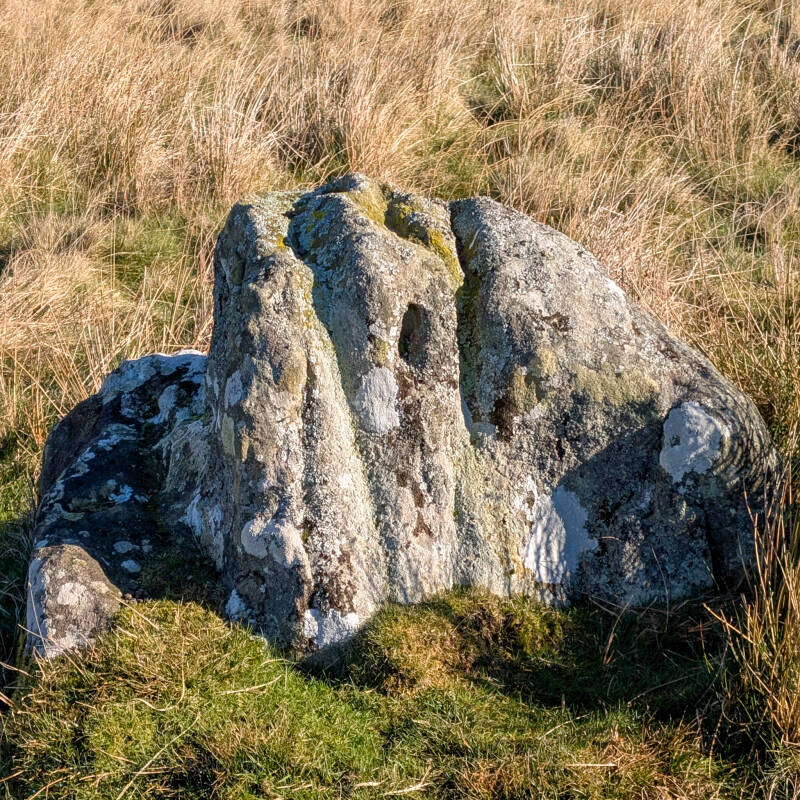
The Butter Stone on Cotherstone Moor
A close view of the Butter Stone itself, showing the rough surface and deep grooves that give the stone its distinctive appearance.

Coin Resting in the Stone
A coin resting in one of the hollows of the stone, echoing the historic stories of money once left here during plague time exchanges.

Grooves in the Butter Stone
A closer look at the grooves and weathered surface of the stone, which may once have supported a bowl used during plague time trading.
The Butter Stone can also be visited as part of our Cotherstone Moor Walk, which explores several historic features across the moor including old farmsteads, rock carvings and lime kiln remains.
Discover more of Teesdale
The Butter Stone is just one of many small but fascinating historic places scattered across the landscape of Teesdale. From abandoned moorland farmsteads and prehistoric rock carvings to old lead mines and waterfalls, the dale is full of quiet landmarks that reveal how people once lived and worked in this remote corner of northern England.
You can explore more walks, hidden places and local history in our guide to Discover Teesdale