The Monk’s Head in Deepdale Woods, Teesdale
Deepdale Woods is one of the most interesting places to explore in Barnard Castle. Following the line of Deepdale Beck, the woodland is home to peaceful walking paths, the Great Stone, remains of the old rifle range, railway history and one of Teesdale's most unusual carvings, the Monk's Head.
Tucked away among the rocks between Cat Castle and Crag Pond is a mysterious carved face known locally as the Monk's Head. Nobody knows exactly who created it or when it first appeared, yet for years walkers have quietly searched for it among the trees.
The Monk's Head is not signposted and many visitors walk straight past without ever noticing it. That sense of discovery is part of what makes finding it so memorable.
Whether you're exploring Deepdale Woods for the first time or returning to discover something new, the Monk's Head adds an extra layer of mystery to one of Teesdale's most atmospheric woodland walks.
* marks affiliate links. If you buy or sign up, we earn commission at no extra cost to you.
It helps cover website costs and keeps our guides free.
Quick Facts
Distance: 5.07 miles there and back
Route type: There and back
Terrain: Woodland paths and riverside tracks
Difficulty: Easy
Dog friendly: Yes, on leads
Pushchair friendly: No
Parking: Deepdale Nature Reserve car park, DL12 9AZ
Start point: Deepdale Nature Reserve car park
OS Map: Explorer OL31 North Pennines*
Digital route: View the route*
GPX files: Free download here

Parking & Access
The small Deepdale Nature Reserve car park (postcode DL12 9AZ) sits quietly on the Startforth side of Barnard Castle.
It is an unpaved woodland parking area with space for around five cars if visitors park considerately. The car park is free to use and provides direct access into Deepdale Woods.
From here, a network of paths follows Deepdale Beck through one of the most peaceful corners of Teesdale. Benches are dotted along the route, making it easy to stop and enjoy the surroundings, while the woodland itself provides welcome shade during the warmer months.
Suitable footwear is recommended as sections of the path can become muddy after wet weather. Deepdale Beck can also rise quickly after heavy rain, so if water is high or has spread across the path, turn back and save the walk for another day.

Route to the Monk's Head
From the car park, follow the woodland path alongside Deepdale Beck as it winds deeper into the valley. The route is easy to follow, crossing several small bridges while the beck stays close by on your left.
On the opposite side of the water, you'll pass the remains of the old rifle range, where stone walls and earth mounds still hint at Deepdale's military past. Further along, the woodland begins to feel more secluded, with the sound of the beck becoming one of the few reminders of the modern world.
As you continue towards Crag Pond, the character of the valley gradually changes. Roughly halfway between Cat Castle and Crag Pond, the dale narrows noticeably and large boulders begin to appear beneath the crags, scattered across the woodland floor as though they have tumbled from the hillside above.
That's usually the sign you're getting close.
Keep an eye on the trees to your right. Just before the beck makes a sharp left-hand bend, you'll spot a bird box marked "B2" attached to a tree beside the path. A few steps beyond it, hidden among the rocks at around waist height, sits the Monk's Head.
The carving quietly watches over the beck, easy to miss if you're not looking carefully. Many walkers pass straight by without noticing it, but once you've spotted the face emerging from the stone, it's difficult to forget.


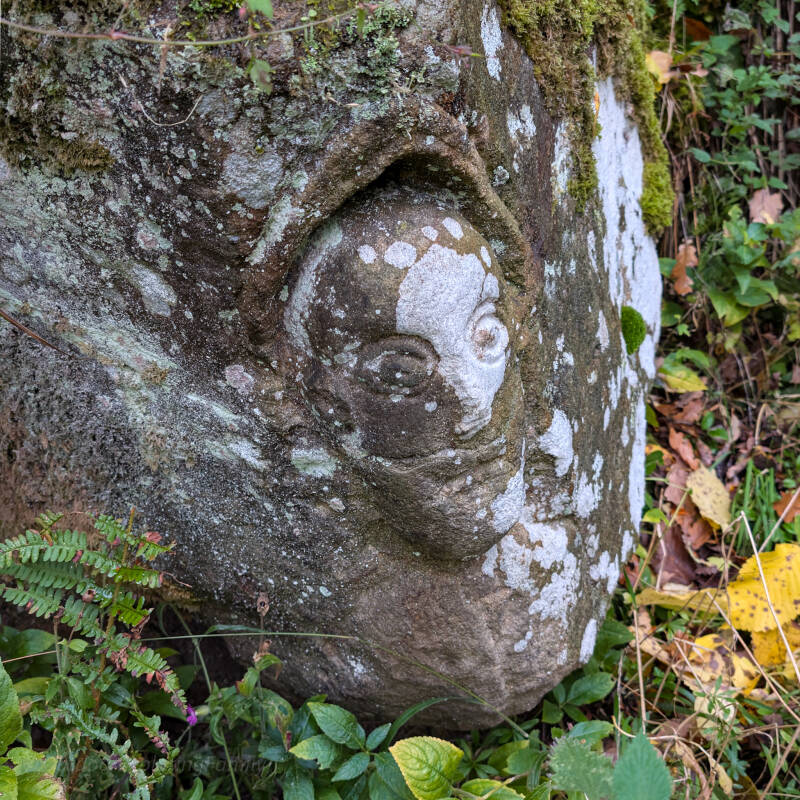
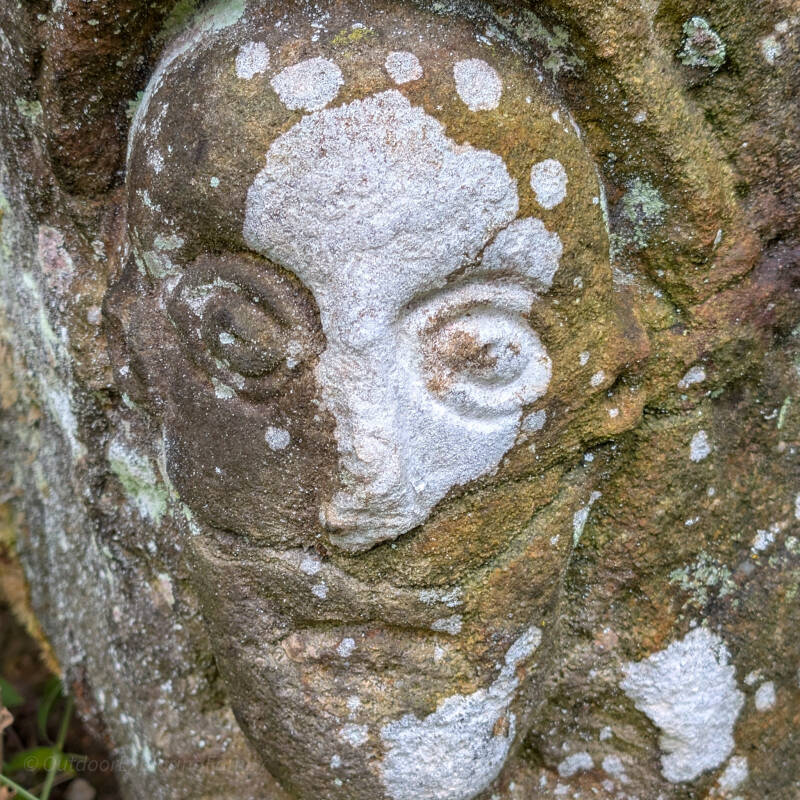
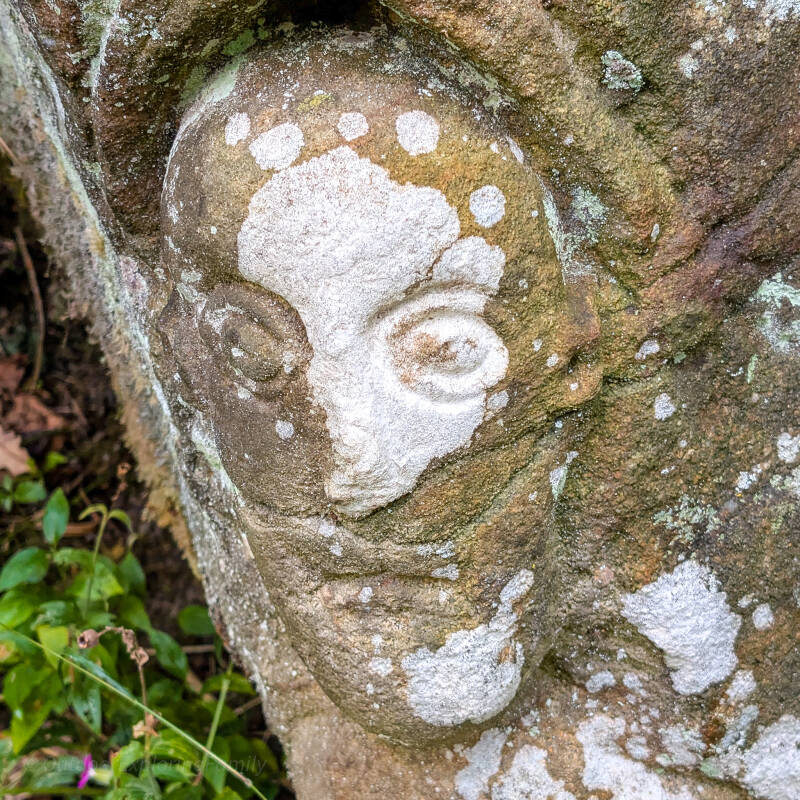
The Monk's Head
Carved directly into a stone beside the path, the Monk's Head appears almost as if it has emerged naturally from the rock itself.
Weather, moss and lichen have gradually softened the carving over time, giving it an appearance that feels perfectly at home within the woodland surroundings. The face is simple but striking, with rounded features that seem to watch silently over Deepdale Beck.
Unlike many landmarks, there is no information board, interpretation panel or official explanation. The Monk's Head simply waits among the trees to be discovered.
That mystery is a large part of its appeal.
Who Carved the Monk's Head?
Despite searching local history sources, newspapers and historical references, we have found no confirmed record explaining who carved the Monk's Head or when it first appeared in Deepdale Woods.
Over the years several theories have emerged.
One suggestion is that the face was carved by a stonemason practising their craft while working on local bridges, buildings or railway structures during the nineteenth century.
Another theory links the carving to the rifle range and military activity once found within Deepdale Woods. Perhaps a soldier used the quiet woodland to leave a lasting reminder of their time here.
Others believe the carving may be connected to local folklore and the religious history of the dales, giving rise to the name "Monk's Head" itself.
Of course, it may simply have been the work of a local artist who wanted to leave something unusual hidden among the trees.
For now, nobody knows for certain.
More Than Just a Stone Face
The Monk's Head is only one reason to explore Deepdale Woods.
Along the route you'll also discover the Great Stone, a huge glacial boulder left behind during the last Ice Age. The distinctive pink granite is thought to have been carried here from what is now Cumbria thousands of years ago. Look closely and you'll often see small crystals sparkling within the rock.
Alongside the Great Stone, you'll find Deepdale Beck's rocky riverbanks, traces of the old rifle range and reminders of the area's railway history.
Together they create a walk that feels far richer than its distance suggests.
A Place Full of Stories
Deepdale Woods has a special kind of atmosphere. It feels close to Barnard Castle, yet somehow separate from it at the same time.
The Monk's Head perfectly captures that feeling.
Whether it was carved by a stonemason, a soldier, an artist or somebody whose name has long since been forgotten, it has become part of the woodland itself.
If you visit, take your time. Listen to the beck, look closely among the rocks and enjoy the sense of discovery that comes with finding one of Teesdale's most unusual hidden landmarks.
Explore More in Deepdale Woods and Around Barnard Castle
The Monk’s Head is only one part of Deepdale’s story. This quiet woodland near Barnard Castle is full of natural features, old railway remains, military history and peaceful places to slow down.
The Great Stone, Deepdale Woods
Discover the huge glacial boulder carried to Teesdale during the last Ice Age.
Deepdale Woods
Learn more about the history, wildlife, Miles Without Stiles route and hidden features of one of Barnard Castle’s most fascinating woodlands.
Deepdale Viaduct, Barnard Castle
Explore the story of the lost iron railway viaduct that once crossed high above Deepdale Beck.
Deepdale Rifle Range
Read about the former rifle range used by local soldiers and the military history still hidden among the trees.
Flatts Wood, Barnard Castle
Explore another historic woodland shaped by Dr George Edwards and Barnard Castle’s past.
Red Well Spring
Explore the iron-rich spring that once attracted Victorian visitors to Barnard Castle.
Walks in and Around Barnard Castle
Find more riverside walks, woodland routes and historic places around the town.