The Tale of the Market Cross Bullet Holes
Welcome to another of our Teesdale Tales, where local folklore, history and the small details of the dale come together.
This page tells the story of the two mysterious holes in the weather vane on top of Barnard Castle Market Cross. For generations, they have been linked with a daring shooting contest between skilled marksmen in the early nineteenth century.
The story belongs somewhere between history, local memory and folklore. The holes are real. The building is real. The old accounts are real too. But like many good Teesdale tales, the details change depending on who is telling it.
So, look up towards the Market Cross and let the story carry you back to a time when Barnard Castle was a busy market town, local Volunteers drilled in fear of war with France, old inns stood around the Market Place, and two small holes high above the street became part of the town’s memory.
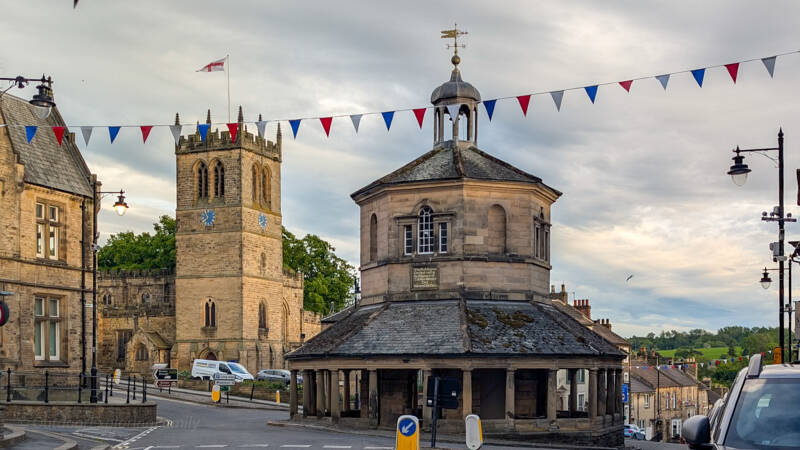
The Story of the Market Cross Bullet Holes
Stand in the middle of Barnard Castle Market Place and look towards the old Market Cross. The building has watched the town change around it for centuries. Carts, cattle, traders, market women, magistrates, firemen, prisoners, shoppers, buses, cars and visitors have all passed beneath or around it.
It was built in 1747 and paid for by Thomas Breaks, a Barnard Castle-born wool merchant who gave the town a building that was meant to be useful. Around its base, butter, eggs and other market goods were sold. Inside, the building served different purposes over time, from town business and court work to confinement and storage. Above it all, the cupola rose over the Market Place, carrying its bell and weather vane into the sky.
That weather vane is where this tale begins.
High above the street are two round holes. They are small enough to be overlooked, but old writers noticed them, and so did generations of Barnard Castle people. Local tradition said they were not ordinary marks from weather, age or repair. They were the scars of a shooting contest.
The best-known printed account appears in William Fordyce’s history of Durham, published in 1857. Fordyce described the Market Cross, then called the Town Hall, and noted the two circular perforations in the vane. He said they showed the skill of Taylor, one of the Barnard Castle Volunteers, and Cruddas, a gamekeeper to the Earl of Strathmore. According to his account, the men fired at the vane in 1804 from the door of the Turk’s Head Inn, at a distance of about 100 yards.
It is a wonderful image. The Market Place is busy but smaller and darker than it is today. The old inns are open, the Volunteers are part of town life, and two men with reputations as good shots decide to prove themselves. Across the street stands the Market Cross, its vane turning above the cupola. The target is high, narrow and difficult. A miss would be easy. A hit would be remembered.
The men step outside. Perhaps others follow them from the inn. Perhaps the challenge has already drawn a small crowd, because a test like this would not stay quiet for long. One man raises his musket and fires towards the top of the Market Cross. Then the other takes his turn.
The tale says both shots struck the vane.
Those two small holes, still linked with the story today, became the marks of that contest. Whether the event happened exactly as Fordyce recorded it is harder to prove, because he was writing more than fifty years after the date he gives. But his account matters. It shows that by the middle of the nineteenth century, the bullet holes were already a known feature of Barnard Castle’s Market Cross story.
This was not a modern invention added long after the fact. The tale was already old enough to be written down in 1857.
The Malt Shovel Version
The story becomes even more interesting when another version appears in the Teesdale Mercury in 1880.
This later account does not repeat the Fordyce version exactly. It places the event in 1803 rather than 1804, and it changes one of the names. Cruddas is still there, still remembered as a gamekeeper to the Earl of Strathmore at Streatlam Castle, but his opponent is not Taylor. In this telling, he is Corporal Hodgson of the Volunteers.
The setting also changes. Instead of beginning at the Turk’s Head, the 1880 account says several Barnard Castle Volunteers and acquaintances were sitting in the Malt Shovel Inn. The newspaper explains that this was the same hostelry later known as the New Waterloo.
That one detail opens up the whole scene.
The Malt Shovel was not just another inn in the town. The same article says it was also known as the “Soldiers’ House”, because recruiting parties visiting Barnard Castle used it as their headquarters. Its landlord was James Peacock, who had served as a non-commissioned officer in the Durham Militia. The newspaper even referred to an old recruiting handbill from 1808, telling tradesmen and miners to apply at the Malt Shovel if they wished to serve in the Corps of Royal Military Artificers.
So the shooting-match story does not begin in a random public house. It begins in a place already connected with soldiers, Volunteers, militia men, recruiting parties and military talk.
In the 1880 account, the men were sitting inside the inn when the conversation turned, naturally enough, to marksmanship. Cruddas had a reputation as a first-rate shot, and before long he was matched against Corporal Hodgson. A challenge was arranged. Their mark would be the weather vane on top of the Town Hall, and the distance would be 100 yards.
The Market Cross was often called the Town Hall in older accounts because the upper room was used for town business.
In this version, the contest had proper terms. Each man was to fire three shots. The company left the inn and went out into the street, where an admiring crowd of Volunteers and others gathered to watch.
Cruddas fired first and missed. Hodgson followed, and he missed too. The pressure must have sharpened then, because the boast had become public and the target still stood untouched above the Market Cross.
Cruddas fired again.
This time his shot pierced the vane.
Hodgson took his second shot and planted his bullet close to the mark made by his opponent.
Both men missed their third shots.
The old newspaper writer clearly understood how daring the target was. A weather vane in a town street, surrounded by occupied houses, would hardly have been chosen unless the two competitors were already known to be skilled shots. In other words, people must have trusted Cruddas and Hodgson to aim well enough not to send shots dangerously wide.
The contest did not end there. According to the same article, the two marksmen met again the next day at the Volunteers’ target near the riverside, close to the Walk Mill. After more skilled shooting, they finished level, and the stakes were divided.
That gives the tale a slightly different shape. It is no longer just two men settling a quick argument outside an inn. It becomes a remembered local match, with rules, witnesses, a second day of shooting and a named riverside target.
It also gives the story a family link. The 1880 article says the position of gamekeeper at Streatlam appeared to have passed through the Cruddas family, because George Cruddas, the gamekeeper at the time the article was written, was the grandson of the marksman named in the tale.
The two versions do not agree in every detail, but they clearly belong to the same tradition. Both remember Cruddas. Both connect the shooting with the Barnard Castle Volunteers. Both place the distance at around 100 yards. Both make the Market Cross weather vane the target. And both explain the holes as musket-shot marks from a remarkable contest in the early 1800s.
The Lost Inn Beside Waterloo Yard
The Malt Shovel detail opens another doorway into old Barnard Castle.
The name is not familiar to many people today, but the 1880 Teesdale Mercury account says the Malt Shovel was later known as the New Waterloo. That matters because Waterloo has not vanished completely from the Market Place. Waterloo Yard still survives beside 29 Market Place, through the narrow passage next to Clarendon’s and immediately beside the present Turk’s Head.
This gives the tale a real modern anchor.
If you stand outside Clarendon’s and look towards the passage marked Waterloo Yard, you are standing close to the part of the Market Place most strongly linked with the Malt Shovel and New Waterloo version of the story. The present Turk’s Head is right beside it, which may help explain why some versions remember the firing point as the Turk’s Head, while another remembers the Malt Shovel or New Waterloo.
They may not be rival stories so much as neighbouring memories.
Old inns changed names. Buildings changed use. People retold stories from different doorways. Over time, a tale that began in one part of the Market Place could easily become attached to the better-known name next door.
That does not weaken the story. It makes it feel more like real local memory: slightly untidy, but rooted in actual places.
The Weather Vane Comes Down
Long after the shooting tale was first recorded, the weather vane itself was still important enough to make news.
In February 1931, the Teesdale Mercury reported that Barnard Castle had the unfamiliar sight of the Market Cross without its historic weather vane for a few days while it was being repaired. The socket in which the vane turned had worn extremely thin, and a special scaffold had to be built from the roof of the upper chamber so the work could be carried out.
The repair was placed in the hands of Mr Frank Deacon, and the report makes it clear that this was no ordinary bit of metalwork being casually taken down. The vane was treated as a historic part of the building, something worth saving and putting back.
That small repair notice adds another layer to the tale. The weather vane was not only the object of an old shooting story. It remained part of the town’s identity, watched, noticed and cared for more than a century after the shots were said to have been fired.
Behind the Tale
So, were the holes really made by musket balls?
The honest answer is that the holes are real, and the tradition is old, but the exact event cannot be proved from a report written at the time.
The strongest early printed source found so far is Fordyce in 1857, placing the shooting in 1804 and naming Taylor and Cruddas at the Turk’s Head. The Teesdale Mercury version from 1880 gives a different memory, placing the event in 1803 and naming Cruddas and Corporal Hodgson at the Malt Shovel, later the New Waterloo.
The 1880 version is especially valuable because it gives the story a fuller local setting. It links the Malt Shovel with the name New Waterloo, says the inn was known as the “Soldiers’ House”, connects it with recruiting parties and the Durham Militia, and explains why Volunteers and talk of shooting would naturally belong there.
A later Teesdale Mercury feature from 1993 repeated the familiar Taylor and Cruddas version and added a vivid explanation of the feat. It suggested that if the firing point was as stated, the men must have been excellent marksmen, with one shot turning the vane and the other striking it so that it swung back again.
There is also a practical question. A weather vane at about 100 yards would have been a difficult target, especially from a public street. Some later writers have wondered whether the marks may have been made from somewhere closer, perhaps by someone connected with Barnard Castle’s gunmaking trade.
That is possible. Barnard Castle did have gunmakers, and a more practical explanation cannot be ruled out. But the older tradition is consistent in one important way: it remembers the holes as the result of a shooting contest involving Cruddas and a Volunteer marksman.
The best way to understand the tale is not to flatten it into one neat answer. It should be seen as a local tradition with several layers: a real vane, real holes, named local men, old inns, Volunteer soldiers, recruiting houses, newspaper memory and a mystery that has survived because people kept looking up.
There is one extra complication with the Turk’s Head name. Barnard Castle has had more than one building associated with that name. The present Turk’s Head stands in the Market Place beside Waterloo Yard, but 34 The Bank was also known at one time as the Turk’s Head before later becoming the Shoulder of Mutton.
For this tale, the Market Place setting is the important one. Both the Turk’s Head version and the Malt Shovel or New Waterloo version place the shooting close to the Market Cross, around the old inns of the Market Place.

Story Facts
The bullet holes are on the weather vane above Barnard Castle Market Cross, also known as the Butter Market. The Market Cross was built in 1747 and paid for by Thomas Breaks, a Barnard Castle-born wool merchant.
The earliest strong printed version found so far appears in William Fordyce’s 1857 history of Durham. Fordyce gives the date as 1804 and names the marksmen as Taylor, one of the Barnard Castle Volunteers, and Cruddas, a gamekeeper to the Earl of Strathmore. He places the firing point at the door of the Turk’s Head Inn, about 100 yards from the vane.
A later Teesdale Mercury version from 1880 gives the date as 1803 and names Cruddas’s opponent as Corporal Hodgson. It places the men at the Malt Shovel Inn, later known as the New Waterloo, and says each man fired three shots. In that account, Cruddas and Hodgson each hit the vane once, missed their other shots, and continued the contest the next day near the Walk Mill.
The same 1880 account says the Malt Shovel was also known as the “Soldiers’ House”, because recruiting parties used it as their headquarters in Barnard Castle. Its landlord, James Peacock, had served as a non-commissioned officer in the Durham Militia.
Waterloo Yard still survives today beside 29 Market Place, now Clarendon’s, immediately next to the present Turk’s Head. This gives the Malt Shovel and New Waterloo version a strong modern place connection, even if the exact old inn layout still needs careful wording.
The weather vane was removed for repair in 1931, when the Teesdale Mercury reported that the socket had worn very thin. It was repaired and returned to the Market Cross.
Why the Story Still Matters
The Market Cross already has a strong place in Barnard Castle history. It was built for trade, but it became part of the daily life of the town in many different ways. People bought and sold around it, met beneath it, heard announcements from it and used it for town business. It stood in the middle of ordinary life.
The bullet holes add something different. They take a public building and give it a spark of human drama. A small mark in metal becomes a story about confidence, rivalry, skill and memory. It connects the Market Cross not only with Thomas Breaks and the town’s official history, but with old inns, local soldiers, gamekeepers and the voices of people who enjoyed telling a good tale.
That is why the holes matter. They are tiny, but they make people look up. Once they do, the Market Cross is no longer just a building in the road. It becomes a survivor, carrying the marks of stories that Barnard Castle has not quite let go.
Look Up Next Time You Pass
Today, traffic moves around the Market Cross and people pass through the Market Place on their way to shops, cafés, work, school or home. It is easy to see the building without really noticing it.
But next time you are in Barnard Castle, pause for a moment and look towards the weather vane. Somewhere up there are the two small holes that have kept this tale alive.
Some parts of the story are recorded, some have shifted, and some may never be fully settled.
But that is exactly why it belongs among the Teesdale Tales. It sits between metal, memory and mystery, high above the town, waiting for someone to look up.
References
This page is based on William Fordyce’s 1857 description of Barnard Castle Market Cross, which records the 1804 Taylor and Cruddas version of the shooting tale; a Teesdale Mercury article from 1880, which gives the alternative 1803 Cruddas and Corporal Hodgson version connected with the Malt Shovel Inn and New Waterloo; a Teesdale Mercury report from 1931 about repairs to the historic weather vane; and a 1993 Teesdale Mercury feature by Alan Wilkinson on the wider history of the Market Cross.
The weather vane on Barnard Castle Market Cross, still carrying the two small holes linked to one of the town’s best known local tales.
Explore More in Teesdale
Discover more local folklore on our Teesdale Tales hub, where we are collecting the stories, legends and old traditions of the dale.
Read the full history of Barnard Castle Market Cross, including its use as the Butter Market, town hall, lock up and fire engine house.
Learn more about Thomas Breaks, the Barnard Castle wool merchant who paid for the Market Cross in 1747.
Explore Barnard Castle in our town guide, including the castle ruins, riverside walks, independent shops and historic streets.
Start with our Discover Teesdale hub to explore more of the dale, including walks, waterfalls, reservoirs, historic places, dark skies and family days out.