Ambleside Bridge House
We have walked past this tiny building more times than we can count, yet every visit still makes us slow down.

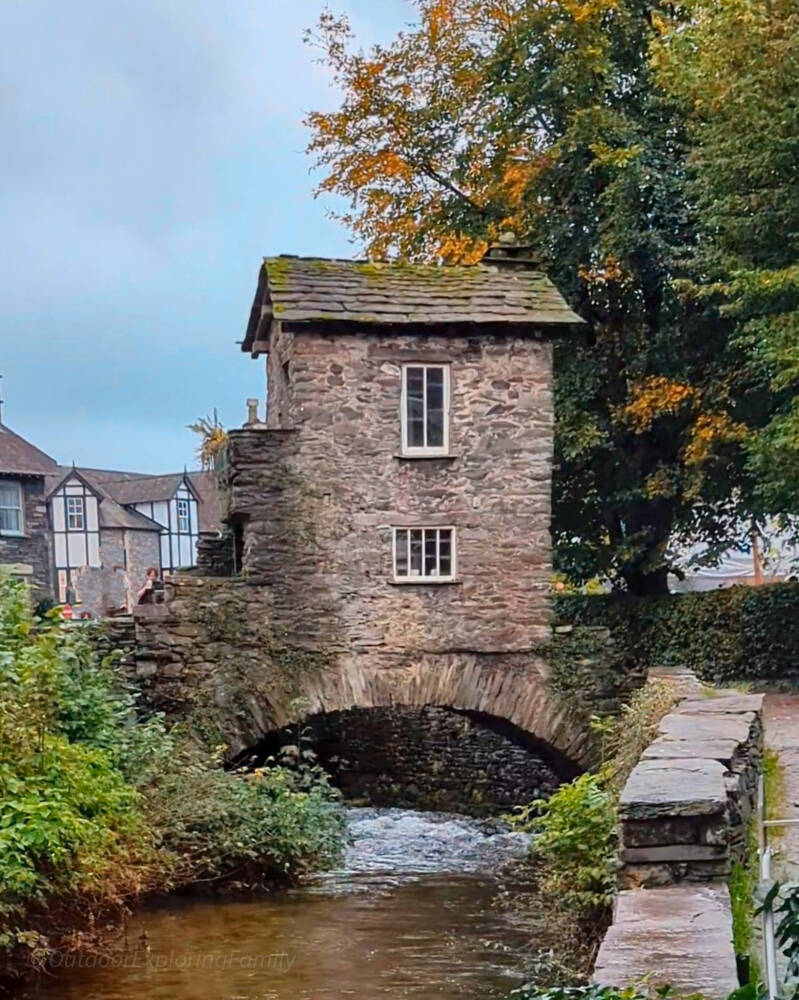
Bridge House, Ambleside sits quietly above Stock Beck on Rydal Road, right in the heart of Ambleside in the Lake District. Water flows beneath its foundations, cars pass by just feet away, and people pause constantly to take photos. It is widely considered one of the most photographed buildings in the Lake District, and once you see it in person, it is easy to understand why.
So small it almost feels unreal, Bridge House has become one of Ambleside’s most recognisable landmarks. It is not grand or imposing. Instead, it draws you in through curiosity, charm, and its unusual position over the beck.
The building stands just minutes from Ambleside’s main shops and cafés, making it an easy stop while exploring the town.
A tiny building with a long, practical history
Bridge House dates back to the late 17th or early 18th century and is now protected as a Grade I listed building. It was built by the Braithwaite family and originally served a practical purpose, providing access across Stock Beck to their land and orchards, as well as storage for apples grown nearby.
Rather than being built beside the stream, the structure was constructed directly on top of a stone bridge arch. Over time, this clever piece of engineering became one of the Lake District’s most distinctive sights.
Inside, the building is just two very small rooms, one on each floor, with low ceilings and thick stone walls. It is often described as “one up, one down,” though even that makes it sound larger than it really is.
Across the centuries, Bridge House has taken on many roles. It has been used as a counting house connected with local mills, as well as a tea room, weaving shop, cobbler’s workshop, and chair maker’s space. At one point, remarkably, it was also home to a family of eight.
Standing there today, it is hard to imagine everyday life unfolding in such a compact space.
Was Bridge House built to avoid land tax?
This is one of the most commonly repeated stories about Bridge House, and something many visitors search for.
Local legend suggests it may have been built in part to avoid land tax, although this has never been firmly proven.
What is documented is that it was built to provide access across the beck and to support the Braithwaite family’s orchards and land on the far side. The tax explanation appears regularly in travel blogs and tourist summaries, but it does not appear as a confirmed reason in official historic records.
We think it is important to share both sides of the story. The legend is part of what makes Bridge House fascinating, but the practical origins tell an equally interesting tale about how people once shaped buildings around everyday needs.
Saved by the people of Ambleside
By the early 20th century, Bridge House had fallen into poor condition.
In 1926, local residents came together to raise funds to save it, recognising how important it was to the character of the town. Their efforts ensured the building could be protected and passed into the care of the National Trust.
Around twenty years later, Bridge House became the Trust’s first information and recruitment centre, a small but meaningful milestone in conservation history.
Today, Bridge House is still cared for by the National Trust. You can always enjoy the building from outside, while access inside varies, so check the latest National Trust information if you are hoping to step inside.


A favourite of artists and creatives
Bridge House has inspired generations of artists, writers, and photographers.
It was sketched and painted by figures such as J. M. W. Turner, and later became linked with Kurt Schwitters, who sold artwork from its steps during the 1940s. Its unusual form and setting over flowing water have made it a lasting creative subject, proving that even the smallest buildings can leave a big cultural footprint.
Visiting Bridge House today
Bridge House sits right in the centre of Ambleside, making it impossible to miss.
Most people stop briefly for a photo, but it is worth slowing down for a moment. Watch the water pass beneath the arch. Notice the tiny windows. Take in how the doors sit at different heights because of the bridge structure below.
If you are hoping to see inside, check the latest National Trust information before visiting, as access varies.
Early mornings tend to be the calmest, before the town becomes busy, and that is often the nicest time to appreciate it.
Our Outdoor Exploring Family moment
We have passed Bridge House in sunshine, rain, and winter. Sometimes it is just a quick glance while walking through town. Other times we stop properly, coffee in hand, listening to Stock Beck flowing underneath.
It is not somewhere you spend hours exploring, but it is a place that stays with you.
And honestly, a trip to Ambleside never feels quite complete without pausing beside this tiny house over the water.