Skears Lime Kilns Walk & History, Middleton-in-Teesdale
Skears Lime Kilns sit in Hudeshope, only around 1.2 miles from the centre of Middleton-in-Teesdale, but finding them is not particularly obvious if you have never been before. That is one of the reasons we wanted to put this page together properly rather than simply tell you that the kilns exist and leave you to work out the rest.
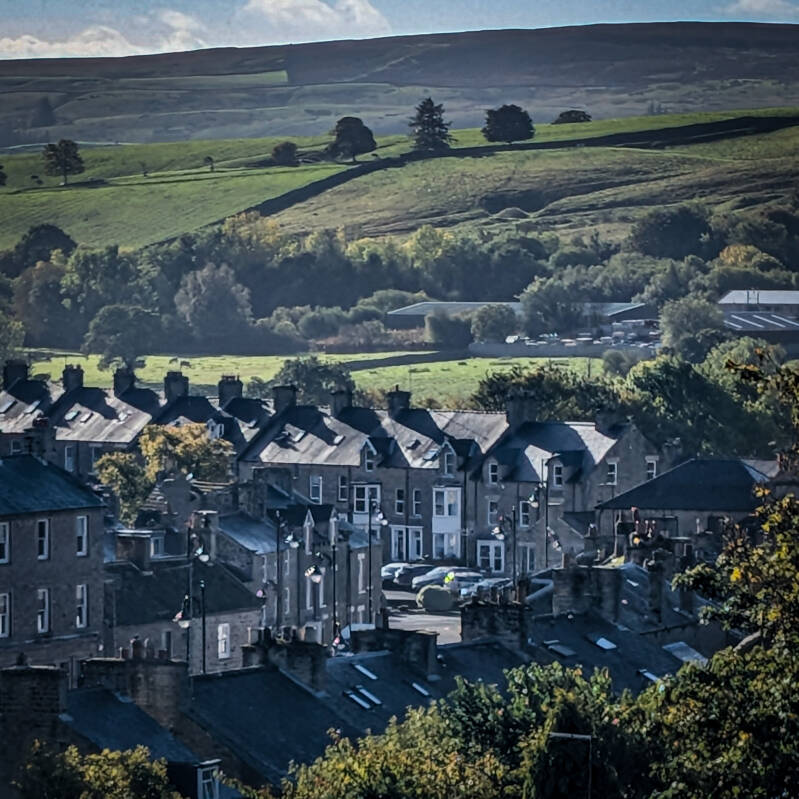
The walk to them is lovely in its own right. It climbs away from Middleton by a set of old stone steps, gives you a great view back across the village rooftops and then slips into woodland where little waterfalls appear after wet weather. From there the route follows Hudeshope until the enormous stone faces of the lime kilns begin to appear through the trees.
This is the way we like to approach them. It is not the only way to reach Skears, but that early view over Middleton makes this route worth taking and the woodland gives the walk a completely different feel from simply following the road.
The kilns themselves are only part of the story. Once we started digging through old newspapers and archive records, we found a quarry recorded here from the early nineteenth century, a kiln burning beside the route in 1920, new kilns being commissioned in 1924, an Eggleston building firm doing the work, lime being sent out through Middleton railway station and a quarry that was still being discussed as a possible working site in the 1960s.
It turns a short walk into something much bigger.
* marks affiliate links. If you buy or sign up, we earn commission at no extra cost to you.
It helps cover website costs and keeps our guides free.
Quick Facts
Distance: Around 2.4 miles return
Time: Around 50–60 minutes
Start and finish: Middleton-in-Teesdale town centre
Postcode: DL12 0SL
Parking: Central car park in Middleton-in-Teesdale
Route type: Out and back, with an alternative woodland return
Terrain: Village pavement, stone steps, woodland path and quiet single-track road
Difficulty: Easy
Dog friendly: Yes, but keep dogs close around the kilns and steep ground
OS Map: OS Explorer OL31 North Pennines*
Digital route: View the route*
GPX files: Free download here

The Route
Start from the centre of Middleton-in-Teesdale and head through the village past the Teesdale Hotel.
Continue towards Hude and cross Hude Bridge over the beck. Once across the bridge, turn right and begin walking uphill along Hude.
After around a minute, start watching the houses on your right-hand side. You will come to a set of stone steps climbing between them, with a wooden footpath sign beside the entrance.
Take the steps and follow the path.
This is one of the reasons we prefer coming this way. As you gain a little height, turn around and look back across Middleton. The rooftops fill the foreground with the dale rising beyond them, and it is a lovely view of the village for such a small amount of climbing.
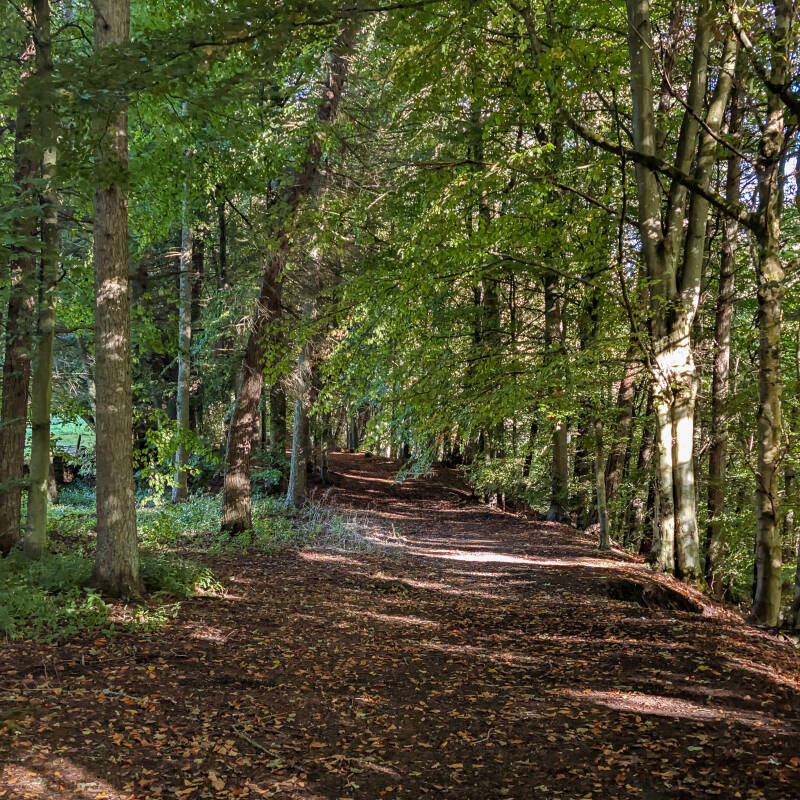
Continue along the path and you soon leave the houses behind and enter the woodland.
The route through the trees is easy to follow and feels remarkably quiet considering Middleton is still so close. The ground can become muddy after rain, but there are no particularly difficult sections.
Keep following the main path. You will eventually pass a small bridge dropping away on your right. Do not cross this bridge, continue straight ahead through the woodland.
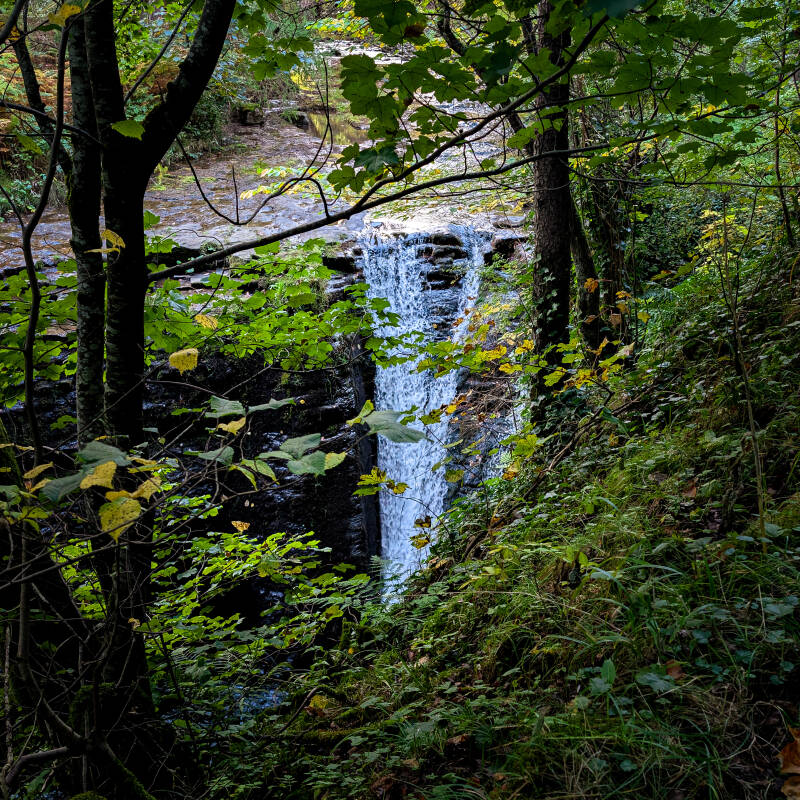
There are several little waterfalls and cascades along this stretch. They are seasonal, so after a dry spell there may not be much to see, but after rain the water works its way down through the trees and adds a lovely bit of sound to the walk.
Continue until you reach the larger bridge directly ahead.
Cross this bridge and carry straight on. The route now joins the quiet single-track road running further up Hudeshope.
From here it becomes very simple to follow. Stay on the road as the woodland begins to open and you move further away from Middleton.
Towards the end, bear right towards the lime kilns.
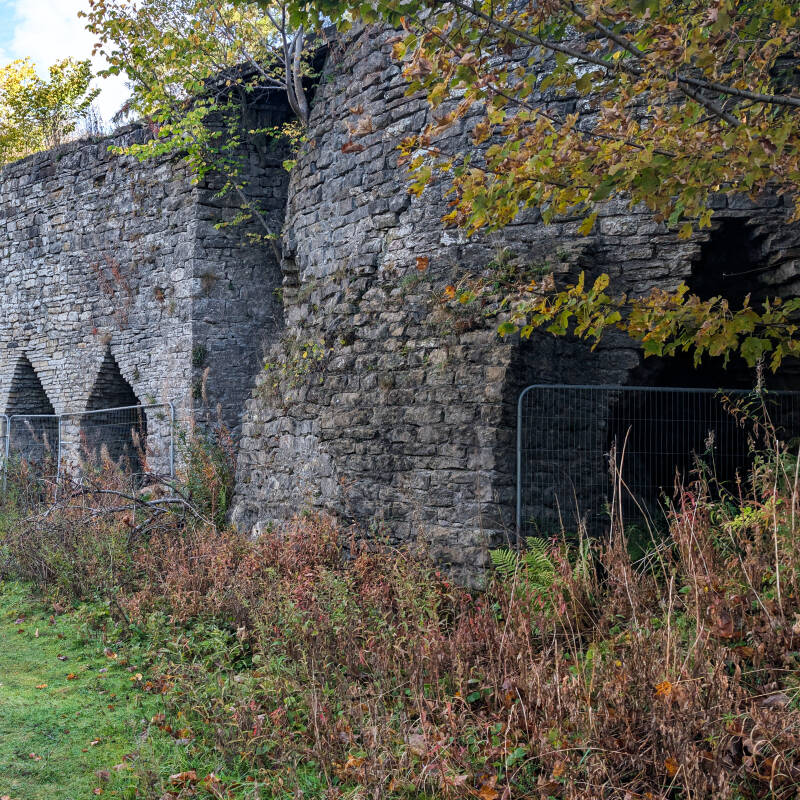
The first proper view is impressive. Huge stone walls rise above the beck, pierced by the large arches that once gave workers access to the bottom of the burning chambers.
Follow the lower path and you can get a good view across the fronts of the kilns. There is also a path towards the upper side which helps you understand how the site worked, because the limestone and fuel went into the kilns from above while the finished lime was taken out below.
The upper workings are fenced. There is no need to cross the fence and we strongly recommend staying outside it. These are old industrial ruins, with uneven ground and steep drops around parts of the site.
Take care around the lower side too. Hudeshope Beck runs below the kilns and there is a steep drop close to parts of the site, so keep children and dogs close.
Once you have finished exploring, the simplest return is to retrace the same route through the woodland and back down the stone steps into Middleton.
There is also an alternative route through the woodland which eventually brings you out towards Town Head and back into the village. Whichever way you return, we still prefer using the route above on the outward walk because of that view back over Middleton near the beginning.
People Were Walking This Way More Than 100 Years Ago
One of our favourite things to come out of researching Skears was discovering just how closely this walk follows a route being described while the lime industry was still alive.
A Middleton walking guide published by M. Heavisides in 1920 describes heading up Hude, climbing stone steps to a “bird's-eye view of the old town”, entering the woods, ignoring a path towards a small bridge, crossing another bridge and passing a waterfall.
Then came something you cannot see today.
He passed a lime kiln “all aglow”, with smoke coming from its top.
The sequence is remarkably close to the walk above. That means this is not simply a modern route somebody has devised to reach an abandoned industrial site. Visitors were coming through these woods in much the same way while lime was actually being burned here.
What Are the Skears Lime Kilns?
The huge structures beside Hudeshope Beck were built to turn limestone from Skears Quarry into lime.
The quarry lies above the kilns in an outcrop of rock known as the Great Limestone, one of the major limestone beds running through the North Pennines. The Durham Historic Environment Record describes Skears Quarry as a nineteenth- and twentieth-century limestone quarry and records working here from 1826 until 1959. Lime from the quarry was supplied to nearby kilns.
The North Pennines geotrail identifies four kilns at Skears. Standing below them today, the scale is much easier to appreciate than it is from a map. These were not little field kilns producing occasional batches for a single farm. They developed into a substantial commercial lime works.
You may occasionally see them referred to elsewhere as Parker's Lime Kilns, particularly in walking material. We have kept to Skears Lime Kilns here because Skears is the name consistently attached to the quarry and kiln complex in the historical and archaeological records we have been able to check.
How Did a Lime Kiln Work?
The basic idea is surprisingly simple.
Limestone was quarried above the site, broken into manageable pieces and taken to the top of the kilns. Limestone and fuel were fed into the burning chamber from above and heated to a very high temperature.
The heat changed the limestone chemically. Carbon dioxide was driven out of the calcium carbonate in the stone, leaving quicklime, or calcium oxide.
Workers could then draw the burnt material from the openings at the bottom of the kiln. That is why the enormous arches you see from the lower path matter. They were working spaces giving access to the bottom of the kiln rather than doorways into an ordinary building.
Quicklime could then be mixed carefully with water in a process known as slaking. The resulting lime had all sorts of uses, including mortar and plaster, whitewashing and treating acidic agricultural land. The North Pennines guide specifically records limestone from Skears being burnt here to make quicklime before being slaked for uses including mortar and improving acidic soil.
Once you know that, the whole structure begins to make sense. Quarry above, charging point at the top, deep burning chamber through the middle and working arches at the bottom.
Why Build the Kilns Here?
Skears is almost a textbook place to build a large lime kiln.
The most important ingredient was already underfoot. The quarry exposed the Great Limestone immediately above the works, so the heavy raw stone did not have to be carried any great distance before it was burned.
The slope was useful too. Commercial kilns were commonly built into rising ground because workers could approach the top to load them while still having access to the draw holes lower down. A regional archaeological survey found that larger commercial kilns tended to sit close to substantial quarries and good tracks or roads, exactly the combination available at Skears.
Then there was Middleton below.
By the 1920s, the Teesdale Lime Works was sending lime well beyond the immediate Middleton area. Local orders could be delivered by motor, while larger or more distant orders could go out by rail. In the 1934 and 1935 adverts, bags of Skears lime were priced “free on rail” at Middleton-in-Teesdale station, meaning the quoted price included getting the lime to the station and onto the train.
So the position worked at both ends of the business: raw limestone was close above the kilns and finished lime could be taken down Hudeshope towards a village with road and railway connections.
Which Came First: the Quarry or the Kilns?
On the records we have, the quarry comes first.
The Durham Historic Environment Record records working at Skears Quarry from 1826, with limestone taken from the Great Limestone above Hudeshope. The surviving lime kilns developed as part of that quarrying landscape during the nineteenth and twentieth centuries, using stone brought down from the workings above.
By 1920 we know lime was definitely being burned here. A walking account from that year describes passing a kiln glowing with heat and smoke rising from the top. Just a few years later, in 1924, F. J. Smith commissioned new lime kilns at the Teesdale Lime Works, showing that the site was still being expanded and modernised.
So the story is not simply that the four large kilns appeared all at once. Quarrying was already established, lime was being burned here before the 1920s, and new kiln capacity was added as the business grew.
There were also other kiln sites higher around Skears, which shows how closely limestone quarrying and lime burning were tied together across this part of Hudeshope.
A Site Built in Stages
When you first get to the kilns they look like one huge wall of stone. It is only when you stand there for a bit and really look that the differences start to show.
The two on the left are slightly different to the two on the right. The stonework changes, the arches are not quite the same and the whole thing starts to look less like one structure and more like something that grew over time. Then right at the far end there is the round kiln, which looks different again.
It is worth taking a few minutes here rather than just getting a photo and moving on. Once you notice those differences, you start looking at the site in a completely different way.
That also fits with what we have found in the records. Lime was already being burned here before the 1920s, and in 1924 F. J. Smith had new lime kilns built at the Teesdale Lime Works. We still cannot put an exact date on every surviving kiln, but it is clear this was a site that changed and developed over time.
When you visit, have a proper look along the whole frontage from left to right. The differences are quite subtle at first, but once you see them, they are hard to unsee.
F. J. Smith and the Teesdale Lime Works
By the early 1920s, the name that begins appearing clearly in the lime business is F. J. Smith.
In 1923, Smith was advertising hand-picked lime for whitewashing and gardens from the Teesdale Lime Works, Middleton-in-Teesdale.
Then came a major change.
In 1924, tenders were invited for labour to build new lime kilns for F. J. Smith at the Teesdale Lime Works. Anyone wanting the particulars was directed to E. C. Surtees at the Raby Estate Office in Middleton.
A later notice records that the contract had been awarded to Moore Bros of Eggleston and that work had begun.
That is one of the most useful pieces of the whole Skears story because it gives us real people rather than an anonymous industrial site. Somebody commissioned the new works, somebody handled the tender locally and an Eggleston building firm actually constructed them. The surviving kilns therefore carry several periods of Skears history within the same complex. The 1924 newspaper evidence is also why we have resisted simply copying a neat construction timeline from another website. Whatever happened here, there was significant new kiln construction in 1924 and that has to form part of the story.
The Teesdale Lime & Roadstone Company
Up to this point the adverts simply name F. J. Smith and the Teesdale Lime Works, but in November 1928 the business changed shape.
On 15 November 1928, the Teesdale Lime and Roadstone Company Limited was registered to take over the quarrying business being run at the Teesdale Lime Works and Skears Limestone Quarries. In other words, the lime works and quarry were no longer just being advertised under Smith’s name. They were now being run through a limited company.
The company had a registered share capital of £1,000, divided into £1 shares. F. J. Smith, of 10 Market Place, Middleton-in-Teesdale, was named as the permanent managing director, with Mrs E. Smith, at the same address, also listed as a director.
That little notice gives us one of the clearest snapshots of who was behind Skears at the time. We know the business was centred on both the lime works and the quarry, and we know the Smiths were directly involved in running it.
The record only gives their initials, so we have kept them that way rather than trying to force a full name onto the wrong person.
What Was Skears Lime Used For?
One of the nicest things about finding the old adverts is that they take Skears away from being just a row of abandoned stone kilns. People were actually buying what was made here.
The lime went out for all sorts of everyday jobs. Farmers used it on the land, gardeners could buy it by the bag, and it was also sold for plastering and whitewashing. In 1927 the Teesdale Lime Works was offering local delivery by motor, while orders further afield could be sent out by rail.
A 1935 advert gives a lovely little snapshot of the business at the time. It announced that the Skears lime kilns would be brought back into operation that year and advertised lime for agricultural use, gardens, plastering and whitewashing.
AGRICULTURAL — GARDEN — PLASTERING — WHITE WASHING LIME
From the Best Blue-Mountain Limestone.
Noted for Purity and Whiteness.
Single cwt. bags, 2/-; 3–5 bags, 1/9 per bag; 6–10 bags, 1/6 per bag.
Orders and payments to the Teesdale Lime & Roadstone Co. Ltd., 135 Newgate Street, Bishop Auckland.
The advert also says the bags were “free on rail at Middleton-in-Teesdale Station.” That did not mean free delivery to wherever the customer lived. It meant the advertised price covered getting the lime to Middleton station and loading it onto the railway, ready for its onward journey.
It is quite a thing to think about when you are standing beneath the kilns today. Those great stone chambers were once turning out bags of lime that were being carried back down Hudeshope, taken through Middleton and sent away by road and rail.
The Beadle Years
By the late 1940s, the Beadle name starts turning up around Skears.
In 1947, P. Beadle Ltd appears in council records for quarrying work at Skears, and a few years later plans connected with Philip Beadle Ltd show limekiln sites and old quarries around Middleton. Other records from the same period show the company leasing land from the Raby Estate.
That puts the Beadle name firmly into the later story of Skears, although the records we have do not show the exact handover from Smith’s company.
The paperwork does not give us a neat moment where one company simply hands Skears over to the next, but it does show the Beadle business involved with the quarry by the late 1940s and still connected with the kilns into the 1960s.
It is another reminder that Skears was never just one business or one period of history. The quarry and kilns kept changing as the industry around them changed too.
So When Did Skears Finally Close?
There is no single neat date that answers this as well as we would like.
The Durham Historic Environment Record records Skears Quarry as working from 1826 until 1959. That makes 1959 an important date, but it does not seem to have been the moment everyone simply locked the gates and accepted that quarrying was finished forever.
In 1962, Skears became part of an argument about a proposed holiday caravan site at nearby Jack Scar. One concern was what would happen if quarry blasting restarted.
A representative of the quarry company made it clear that part-time working was not practical, but that if the recession in the quarrying industry improved, the company could begin working Skears again. Reopening was also expected to create work for people in Middleton.
That tells us something important about the meaning of “closed”. Skears may no longer have been regularly working, but in 1962 it had not yet been written off as a dead quarry.
The safest conclusion is therefore that regular quarry working appears to have ended around 1959, while the business still regarded reopening as possible in 1962. A precise date for the very last firing of a Skears kiln has not yet been found, and we do not think it is worth inventing one simply to give the story a tidier ending.
From Workplace to Industrial Remains
Once the industry disappeared, the kilns began another stage of their life.
Stafford Linsley recorded the Skears Bridge kiln complex during his 1978 lime-kiln survey, with four pages of survey material devoted to the site. The Durham HER now records the structures as ruined lime kilns.
The Beadle papers at Durham also contain a particularly interesting later collection: 34 papers exchanged between Harold Beadle and the North Pennines Heritage Trust between 1988 and 1996 specifically concerning the Skears quarry limekilns.
What Can You See at Skears Today?
The main kiln frontage is the part that grabs your attention first.
From below, the huge arched openings dominate the site. Get closer and the differences in the stonework become much clearer. Some areas use larger, rougher blocks while others have smaller and more regular masonry, and the arches themselves are not all built in quite the same way.
Look upwards and you begin to understand why the kilns were placed against the slope. The working level continued above, where stone and fuel could be brought to the tops of the kiln chambers.
The quarry lies beyond and above them. Once you know that the Great Limestone was being taken out there, the relationship between quarry and kilns becomes much easier to read in the landscape.
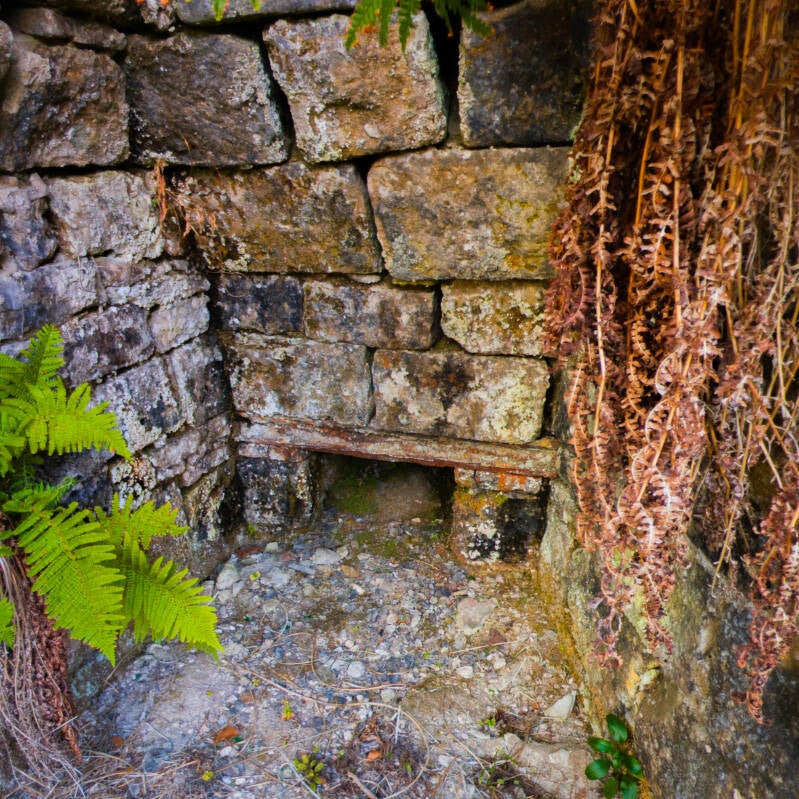
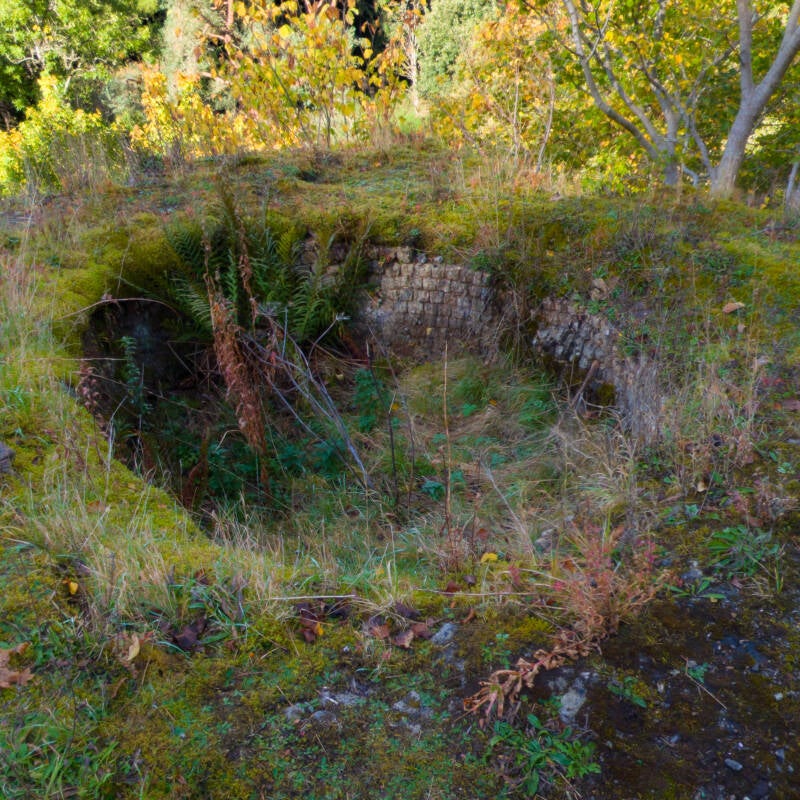
There are smaller remains around the complex too. During our visit we photographed a little concrete-roofed structure and another feature that appears partly swallowed by the hillside behind the kilns. We have not yet found enough evidence to identify either confidently.
Take Your Time Here
Skears is exactly the sort of place we enjoy finding around Teesdale.
You do not need a long mountain walk to have a good few hours outdoors. From the middle of Middleton you can be looking back across the village rooftops within minutes, wandering quietly through woodland a little later and then standing beneath an industrial structure that people were walking past while it was still glowing with heat more than a century ago.
The lime kilns are impressive, but the walk becomes better when you slow down enough to connect everything around them: the quarry above, Hudeshope Beck below, the shape of the hillside, the road back towards Middleton and those enormous arches in front of you.
It is only a short walk.
There is a lot here to notice.
Walked, photographed and researched by Outdoor Exploring Family. Route walked October 2026. Historical research checked against the Teesdale Mercury archive, Durham and Darlington Historic Environment Record, Durham Record Office, North Pennines material and the surviving 1920 Middleton walking account.
Explore more walks and history around Middleton-in-Teesdale
High Skears Lead Mine
Continue further into Hudeshope and discover the remains of the old lead mine beneath the great Skears Hushes.
Marlbeck Lead Mine
Follow Hudeshope further up the valley to the surviving mine shop, old level entrance and surrounding mining remains.
King's Walk, Middleton-in-Teesdale
Explore another historic woodland walk from Middleton, with old paths, bridges and stories connected with the village.
Explore Middleton-in-Teesdale
Discover more local walks, waterfalls, mining history and places to explore around Upper Teesdale.