The Teesdale Hotel, Middleton-in-Teesdale
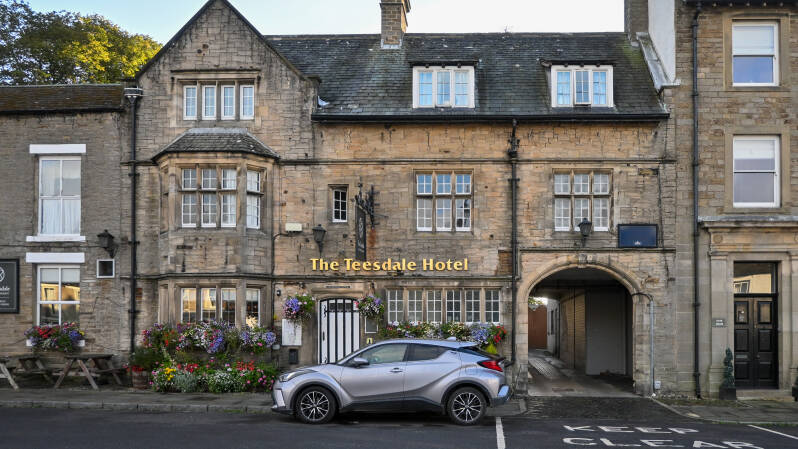
Stand in the centre of Middleton-in-Teesdale and the Teesdale Hotel is difficult to miss. Its tall stone frontage, mullioned windows and great archway onto the Market Place give it the appearance of a building that has been sitting here largely unchanged for centuries. The real story is much more interesting.
Before the Teesdale Hotel there was the Cleveland Arms, and before the Cleveland Arms there was the Cross Keys. The old Cross Keys was a busy village hotel where visitors stayed, property was auctioned, dinners were held and local people gathered. It was also the place where locked-out lead miners met as they fought for better wages. Then, in the late 1880s, everything changed.
The West Auckland Brewery Company replaced the old hotel with a large new building costing around £2,000. Architects were brought in from York, a new landlord took over, the rooms were furnished by a Newcastle firm and permission was obtained to give the hotel a new name and hang the Cleveland coat of arms outside. On 29 February 1888, Middleton celebrated the formal opening of Ye Cleveland Arms with speeches, dinner and champagne.
More than a century later, much of that Victorian hotel is still immediately recognisable. Even better, parts of an older building survived within it. The Teesdale Hotel we see today is therefore not simply one old inn with a single history. It is a building with several lives layered together.
Quick facts
Location: Market Place, Middleton-in-Teesdale, County Durham
Earlier name: Cross Keys Hotel
Later name: Ye Cleveland Arms / Cleveland Arms Hotel
Present name: Teesdale Hotel
Cleveland Arms formally opened: 29 February 1888
Owners responsible for the 1888 hotel: West Auckland Brewery Company
Architects: Demaine and Brierley of York
Main contractor: J. Vickers of Bishop Auckland
Cost: About £2,000
First landlord of the Cleveland Arms: Charles Parsons
Architecture: Elizabethan and Jacobean inspired, incorporating older fabric
Historic status: Grade II listed
One feature to look for: The large archway leading from the Market Place into the former hotel yard

Before the Teesdale Hotel
The easiest mistake to make with the Teesdale Hotel is to look at its deliberately old-fashioned frontage and imagine that the building has always looked this way. It hasn't. The hotel standing here today owes much of its appearance to a major rebuilding in the late nineteenth century, although its story stretches further back.
Parts of an older building survive within the later hotel, and Historic England dates some of that surviving fabric to the late seventeenth century. By the middle of the nineteenth century, the establishment here was known as the Cross Keys, one of several inns serving Middleton-in-Teesdale. A directory from 1856 lists it alongside the Blue Bell, Foresters' Arms, King's Head, Rose and Crown and Talbot.
The Cross Keys was much more than somewhere to stop for a drink. By following it through nineteenth-century Middleton, we find visitors sleeping here, large dinners being prepared, auctions taking place and rooms filling with people discussing everything from local business to the conditions endured by Teesdale's miners. Long before anyone had heard of the Cleveland Arms or Teesdale Hotel, this corner of Middleton was already one of the places where village life happened.
Mr and Mrs Roddam and life at the old Cross Keys
By the 1870s, Mr and Mrs Roddam were closely associated with the Cross Keys. They give us something much better than a simple list of landlords because little glimpses of their lives survive.
In 1877, Mr Roddam found himself before the magistrates after gin sold at the Cross Keys was found to be 50.5 degrees under proof. He was fined 40 shillings plus costs. He wasn't alone that day. Other Middleton publicans were also prosecuted over diluted spirits, including Jane Railton of the Talbot, who defended herself by pointing out that she had been running her house for nearly forty years and had always sold her rum at that strength without complaints from her customers.
Two years later we find the Roddams in rather more respectable circumstances. On 28 October 1879, the Leet of the Manor of Middleton-in-Teesdale met under deputy steward W. J. Watson. Once the formal business was finished, around 42 people adjourned to the Cross Keys, where Mr and Mrs Roddam had prepared what was described as a “most sumptuous dinner.” There were toasts, speeches and songs, and the evening appears to have been quite a night.
By the mid-1880s, references increasingly centre on Mrs Roddam. Visitor lists from August and September 1885 name people staying at Mrs Roddam's Cross Keys Hotel, including visitors from Stockton and Sunderland. This was clearly functioning as visitor accommodation as well as a village drinking house.
Another gathering in September 1886 praised Mrs Roddam and her mother for the splendid supper they had put before their guests, and Mrs Roddam personally responded to the toast. Then, only weeks later, family life at the Cross Keys provides a rather different little story. Her 12-year-old son Frederick Roddam appeared in court charged with stealing a rabbit.
Decades later, when Mrs Roddam died as Mrs Thornton in 1925, Middleton had not forgotten her. She was remembered as having been hostess of the old Cross Keys Hotel “for many years.”
That small sentence tells us more than a list of dates ever could. For part of the nineteenth century, the Cross Keys wasn't simply a building. It was the Roddam family's home and livelihood.
The Cross Keys also played a part in another important day for Middleton. On 23 October 1879, a luncheon was held here before the opening of the new St Mary’s Church. Guests gathered at the hotel before heading up to Town Head, where hundreds of people were waiting to see the new church opened for the first time.
When Teesdale's miners filled the long room
One of the most important gatherings at the Cross Keys had nothing to do with visitors, dinners or auctions. During a serious dispute involving Teesdale's lead miners, locked-out men and boys gathered in Middleton while fighting for better pay and working conditions. Their demands included a wage basis of £1 a week, while the length of the working shift was also being argued over.
By the time of the meeting, the dispute was taking its toll. Men and boys had already left the dale looking for work elsewhere, while others were considering jobs at places including Witton Junction, Cockfield and Evenwood. The problem was that the miners' committee had no funds to help them get there. For families dependent on wages from the mines, deciding whether to stay and continue the fight or leave Teesdale in search of work was becoming a very real choice.
Among the men involved were William Parkin, George Armstrong, Ezra Lowe, Thomas Thompson, James Coatsworth and William Morton. Armstrong brought a lifetime of experience to the discussion. He had worked underground for forty-four years and remembered periods when months of work had earned him very little. James Coatsworth spoke about the poverty and hard living endured by Teesdale miners, while Parkin was one of those trying to hold the men together through the dispute.
An attempt was also made to find a way out of the deadlock. J. C. Monkhouse of Eggleston agreed to act as a mediator and approached the company's superintendent, Mr Bainbridge, but the attempt failed. The men remained determined to hold out for the £1 wage basis.
One of those meetings was held in the long room of the Cross Keys Hotel. It is a wonderful detail to know today because it puts an important piece of Middleton's lead-mining story inside an actual room in this building's predecessor. The Cross Keys wasn't simply somewhere miners went for a drink. On this occasion it became somewhere working men could gather, argue their case and decide what they were going to do next.
For a while the dispute continued, but eventually the £1 basis was granted and work resumed at the mines. There was a personal cost for some of the men who had led the fight. William Parkin and William Morton, the chairman and secretary, lost their employment, while the other delegates escaped with a severe reprimand.
More than a century later, it is easy to reduce Middleton's lead-mining past to old mine workings and names on maps. This story brings some of the people back into it. They had wages to earn, families to support and difficult decisions to make and for at least one afternoon, they sat together in the long room of the old Cross Keys trying to work out what came next.
The end of the Cross Keys
The Cross Keys name survived well into the 1880s. Mrs Roddam was still receiving visitors there in 1885 and was explicitly associated with the Cross Keys in November 1886.
Then the old hotel disappeared.
What followed wasn't simply a landlord changing the name above the door. The West Auckland Brewery Company embarked upon a major project to create a substantially new hotel on the site. The work took around twelve months and cost approximately £2,000, a considerable investment in Middleton at the time.
The architects were Demaine and Brierley of York, while J. Vickers of Bishop Auckland carried out the main building contract. The architects chose a mixture of Elizabethan and Jacobean influences, deliberately giving the new hotel the character of a comfortable old posting house.
That explains something rather wonderful about the building today. The Victorian architects weren't simply constructing a practical hotel. They were deliberately trying to make their brand-new hotel look as though it already had a past.
And yet it genuinely did have a past. Older material was incorporated into the later building, leaving fragments of the earlier structure within the hotel that replaced the Cross Keys.
Leap Day 1888 – the Cleveland Arms opens
The new hotel was formally opened on Wednesday 29 February 1888.
The occasion was marked by a luncheon provided by its owners, the West Auckland Brewery Company. Directors and shareholders attended alongside the architect and contractors, while W. Standish, one of the brewery company's directors, took the chair because its chairman was unwell.
Middleton hadn't merely gained a replacement pub. The Cleveland Arms was being presented as a modern hotel capable of accommodating the visitors increasingly coming into Upper Teesdale.
There was a large public room, several private sitting rooms and a suite of bedrooms. Broad landings and an elaborate staircase formed part of the interior, while the commercial room, sitting rooms and bedrooms were furnished by Bainbridge & Co. of Newcastle-upon-Tyne.
The more public parts of the hotel were fitted by Mr Robson of Bishop Auckland, who was also responsible for the bar. Its counter was made from pitch pine with a polished mahogany top. Behind it were black-and-gold fittings lined with plate-glass mirrors.
Imagine walking through the door in 1888 and seeing all of that new.
Fresh stone outside, newly furnished bedrooms upstairs, polished mahogany at the bar and mirrors gleaming behind it. This wasn't an old country inn slowly adapting to Victorian tourism. Middleton had been given a purpose-built hotel intended to make an impression.
Why it became the Cleveland Arms
Even the new name had been carefully arranged.
Permission to use “Cleveland Arms” was obtained through Mr Scarth, J.P., the Duke of Cleveland's agent. Permission was also given to display the Cleveland coat of arms on a new hanging sign outside the hotel.
Demaine and Brierley designed the swing sign, along with an ornamental lamp over the entrance. The idea was clearly to make the outside every bit as distinctive as the interior.
This is particularly interesting because the Duke of Cleveland was already deeply woven into the life of Middleton and its manor. The Cross Keys had hosted the Manor Court dinner back in 1879. Less than a decade later, its successor was opening with the Cleveland name and arms displayed outside with permission obtained through the Duke's agent.
The Cleveland Arms wasn't therefore a random Victorian pub name. It was chosen deliberately and authorised as part of the identity of the new hotel.
The archway into the hotel yard
One feature described when the Cleveland Arms opened in 1888 is still impossible to miss today. To the right of the main entrance, the great stone archway leads straight through the building from the Market Place into the old hotel yard.
When the hotel was new, this was a working entrance rather than simply an architectural feature. Horses and vehicles could pass through from the street into the yard behind, where the hotel had its stables and coach houses. These were next on the list for improvement after the main building opened, with plans already in place to rebuild them during the spring of 1888.
The archway itself was lined with glazed brick, a practical finish for a busy passage into the yard. Look through it today and the basic arrangement is remarkably easy to understand. The Market Place is behind you, the hotel rises around the passage and the yard lies beyond. It is one of those rare details where a description written more than 130 years ago can still be matched to the building in front of you.
For guests arriving in the early years of the Cleveland Arms, this side of the hotel would have been full of activity. Horses needed somewhere to be stabled, vehicles had to be brought off the street and travellers arriving in Middleton needed rooms, food and somewhere to continue their journey from. The grand frontage faced the Market Place, but through that archway was the practical working side of the hotel that kept everything moving.
Charles Parsons – the new landlord
Waiting to welcome customers into the Cleveland Arms was its new landlord, Charles Parsons.
Parsons was involved before the doors formally opened, arranging the furnishing of the commercial room, private sitting rooms and bedrooms. At the opening luncheon, Mr Hope proposed a toast specifically to the “New Landlord”, which was warmly received.
Middleton stationmaster F. E. Gibson was also there, and his contribution captures exactly what people hoped the new hotel would do. Middleton's future as a visitor destination was being discussed alongside improvements to the town and its railway station. The scenery of the dale was increasingly attracting people from outside the area, and good accommodation was considered part of Middleton's opportunity to benefit from them.
The celebrations weren't restricted to directors and businessmen. A dinner was provided in the large room for the workmen and others who had been involved, while friends and neighbours came into the hotel during the afternoon and drank champagne in honour of the opening.
It must have been quite a day: builders eating together in the large room, directors raising glasses to their investment, Middleton people coming through the doors for a look, and Charles Parsons standing behind a completely new hotel that had cost around £2,000 to create.
Visitors begin arriving at Ye Cleveland Arms
The new hotel quickly settled into the role its owners had hoped for.
By August 1888, visitor lists were already recording guests at “Ye Cleveland Arms Hotel” from Sunderland, Newcastle, Leeds, West Hartlepool, South Shields, Stockton and elsewhere. The deliberately old-fashioned “Ye” appeared repeatedly in the hotel's early years and suited a building consciously designed to resemble an older establishment.
The Cleveland Arms was also becoming home for the Parsons family. In October 1888, just months after the hotel opened, Charles and his wife welcomed a son while they were living there. The birth notice identified Charles as the proprietor of the Cleveland Arms Hotel, giving us a small glimpse of family life beginning inside Middleton's new hotel.
By January 1889, Mr and Mrs Parsons were hosting an annual dinner connected with Middleton's Industrial and Provident Society. The meal was praised and the couple were described as being “of the new hotel.” Parsons told the gathering that providing good accommodation for occasions such as this would be both their duty and their delight.
The phrase “new hotel” once seemed tantalisingly vague. Now we know exactly why it was being used. Less than a year earlier, the Cleveland Arms really had opened as Middleton's new hotel.
Auctions, dinners and a lodge room
The Cleveland Arms soon resumed something the Cross Keys had been doing for years: providing Middleton with somewhere large enough for business as well as pleasure.
Property auctions repeatedly took place here. Agricultural gatherings were catered for. Organisations held dinners and meetings inside, and by 1893 we even find reference to a Lodge Room at the hotel.
Parsons was still closely associated with Middleton life that year. He provided prizes for show classes and supplied an excellent luncheon at a local agricultural event. These little details are important because they show what a Victorian hotel in a place like Middleton actually did. It wasn't separated from the community in the way a modern visitor might imagine a hotel to be. Its rooms, yard, catering and landlord all became useful parts of village life.
That pattern would continue long after Parsons had gone.
New faces at the Cleveland Arms
Charles Parsons remained part of the Cleveland Arms story into the 1890s, but other landlords and families would follow him behind the bar. One of the names we find at the turn of the century is Nils Henrik J. S. Bang, who was living at the Cleveland Arms and working as a hotel keeper when he died on 31 December 1902.
By 1910, the hotel was in the hands of Mr and Mrs Ward, and once again its landlords were closely involved with events taking place around Middleton. When Middleton Agricultural Society held its annual show that year in the park at Middleton House, the Wards provided the luncheon. It would have been a sizeable job, with the show bringing together farmers, livestock, Dales ponies, sheepdog trials and visitors from across the surrounding countryside.
The Wards were still at the Cleveland Arms as the First World War changed everyday life in the dale. In 1916, a sale was organised in Middleton to raise money for the British Farmers' Red Cross Society, and Mr Ward offered the hotel yard for the event. There was even a back-up plan for the Teesdale weather: if conditions turned bad, the sale could simply move inside to the hotel's sale-room.
Mr Ward died not long afterwards, and in 1917 the licence passed to his widow, Hannah Ward. Rather than bringing the family's time at the Cleveland Arms to an immediate end, Hannah was able to carry on the business herself.
By then the hotel had been open for almost thirty years. Landlords had changed and Middleton itself was changing, but the Cleveland Arms was still doing much the same job it had done from the beginning. People slept here and ate here, but its rooms and yard were also borrowed whenever the village needed somewhere for a dinner, meeting, sale or gathering. The people behind the bar changed; the hotel's place in Middleton life carried on.
A market inside the hotel
By the 1920s, the Cleveland Arms was still finding new uses.
In 1925, Middleton opened a produce market that was described as an important moment for the town. Part of it operated from the assembly room at Ye Cleveland Arms Hotel.
Farmers' wives brought produce including butter and eggs, buyers came into Middleton from elsewhere, and stalls appeared in the Market Place on the same day as sales at the auction mart.
Think about how many different versions of this building we've now encountered.
The Cross Keys had its long room filled with miners debating their future. Mr and Mrs Roddam fed the Manor Court. The Cleveland Arms opened with champagne and a dinner for the men who built it. There was a lodge room, a sale-room and later an assembly room where local produce changed hands.
The hotel wasn't merely standing beside Middleton's Market Place. For generations, it was part of what made the Market Place work.
From the Cleveland Arms to the Teesdale Hotel
The Cleveland Arms name remained part of Middleton for decades after that grand opening in 1888. We can still find Ye Cleveland Arms Hotel in 1925, when its assembly room was being used for Middleton's new produce market, with farmers' wives bringing butter and eggs into the village and buyers arriving from further afield.
Later in the twentieth century the old Cleveland Arms took on the name we know today: the Teesdale Hotel. Exactly when the new name first appeared is less clear, but the change marked another chapter rather than the beginning of a new hotel. Behind the new name was still the building created for the West Auckland Brewery Company in the late 1880s, standing on the site where the Cross Keys had welcomed travellers and local people before it.
That is why the different names are worth knowing. Cross Keys, Cleveland Arms and Teesdale Hotel can sound like three separate places when you come across them in old newspapers and records, but they all lead us back to this same spot on the Market Place.
The building itself carries those different periods better than any name could. Much of what we see today belongs to the ambitious 1887–88 rebuilding, including the distinctive stone frontage and great archway into the former hotel yard, while surviving older fabric takes the story further back still. Today the Teesdale Hotel is Grade II listed, protecting a building that has been part of life in the centre of Middleton for generations.
Look again when you pass it
The next time you walk through Middleton, stop opposite the Teesdale Hotel for a minute rather than treating it as simply another building around the Market Place.
Look at the architecture and remember that Demaine and Brierley deliberately wanted their new hotel to feel older than it was. Find the great archway and imagine horses passing through it into a yard surrounded by stabling and coach houses. Inside, picture the pitch-pine and mahogany bar, the black-and-gold fittings and the plate-glass mirrors installed for the opening in 1888.
Then go further back.
Imagine Mrs Roddam preparing supper at the Cross Keys with her mother, visitors arriving from Sunderland and Stockton, 12-year-old Frederick getting himself into trouble over a rabbit, and forty-odd members of the Manor Court sitting down to dinner.
And somewhere in the old Cross Keys, picture its long room filled with Teesdale miners discussing whether to continue their fight for a pound a week.
Then jump forward again to 29 February 1888. The old Cross Keys has gone, fresh stone faces the Market Place, Charles Parsons is the new landlord and glasses of champagne are being raised inside Middleton's newly opened Ye Cleveland Arms Hotel.
The name above the door has changed again since then.
But this corner of Middleton has been welcoming people, feeding them, accommodating them and providing somewhere for the dale to meet for a very long time.
Explore more of Middleton-in-Teesdale
St Mary’s Church, Middleton-in-Teesdale
Discover the history of the parish church and the opening celebrations in 1879, when guests gathered at the Cross Keys Hotel before the service.
Middleton-in-Teesdale in 1870
Step back into village life when the Cross Keys was one of Middleton's busy inns, serving travellers and local people.
Middleton House
Explore the former London Lead Company headquarters that later became a hotel and welcomed royal visitors to Upper Teesdale.
Explore Middleton-in-Teesdale
Find more local history, walks, waterfalls and places worth visiting around the village.