Yew Tree Farm, Hury
Teesdale is scattered with abandoned farms, ruined cottages and places that have simply been left behind, but Yew Tree at Hury Reservoir is one that immediately raises questions.
Roughly 0.3 miles west of the north bank car park, a dense patch of trees has grown around the remains of an old farmstead marked on historic maps as Yew Tree. Inside are the ruins of a substantial farmhouse surrounded by former farm buildings. Then, around 200 feet to the east, there is another smaller house with what appear to be its own outbuildings.
At first glance it would be easy to assume they were all part of the same farm. The old records suggest the story may be a little more complicated.
Quick Facts
Location: Hury, Baldersdale, Teesdale
Historic name: Yew Tree
Site type: Abandoned farmstead
Date: At least 19th century, with the site shown on historic mapping
What survives: Ruined farmhouse, several former farm buildings and a second smaller house around 200 feet to the east
Distance from parking: Roughly 0.3 miles west of the north bank car park at Hury Reservoir
Access: A public footpath runs directly through the old farmstead
Historic maps: Yew Tree is clearly named on older Ordnance Survey mapping
Walker Hall: Walker Hall appears as a named Hury property in early 20th-century records, but its exact relationship to Yew Tree and the surviving buildings has not yet been proved.

Where is Yew Tree Farm?
Yew Tree is on the north side of Hury Reservoir in Baldersdale, around 0.3 miles west of the north bank car park.
From the car park, follow the public right of way west along the north side of the reservoir. It is only a gentle walk and the path leads directly through the old farmstead, passing the surviving buildings before continuing further into Baldersdale.
You do not need to leave the public footpath to see the ruins. The buildings are old and unstable in places, so we would strongly recommend enjoying them from the path rather than entering or climbing on any of the remains.

The main farmhouse
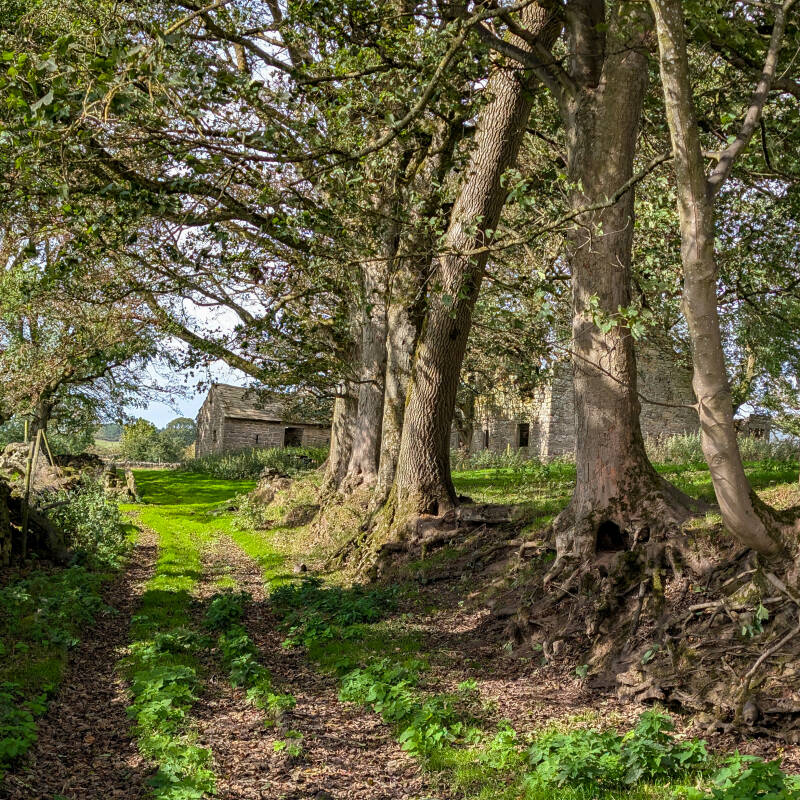
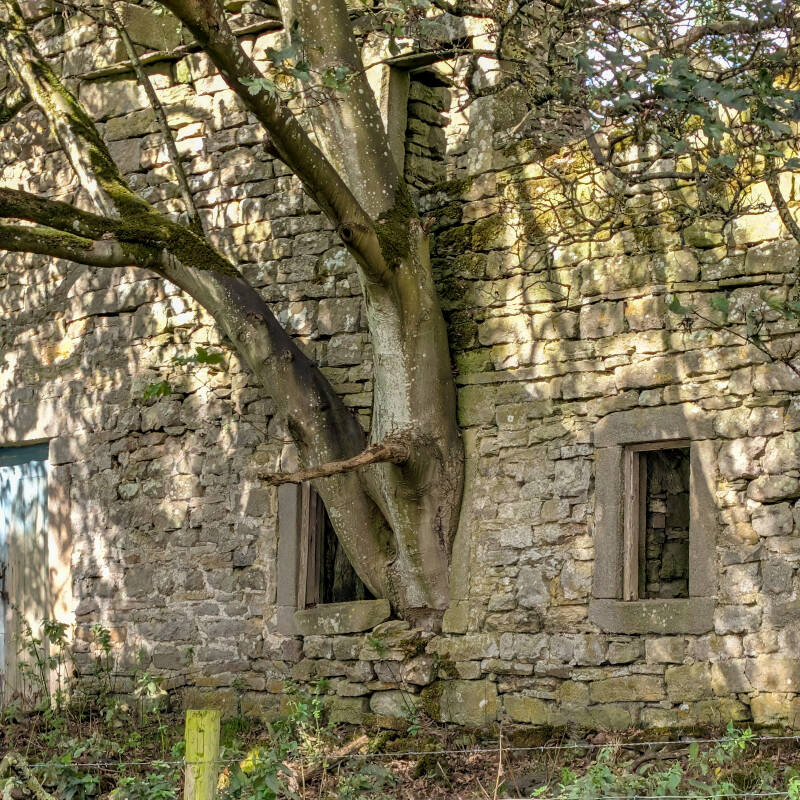
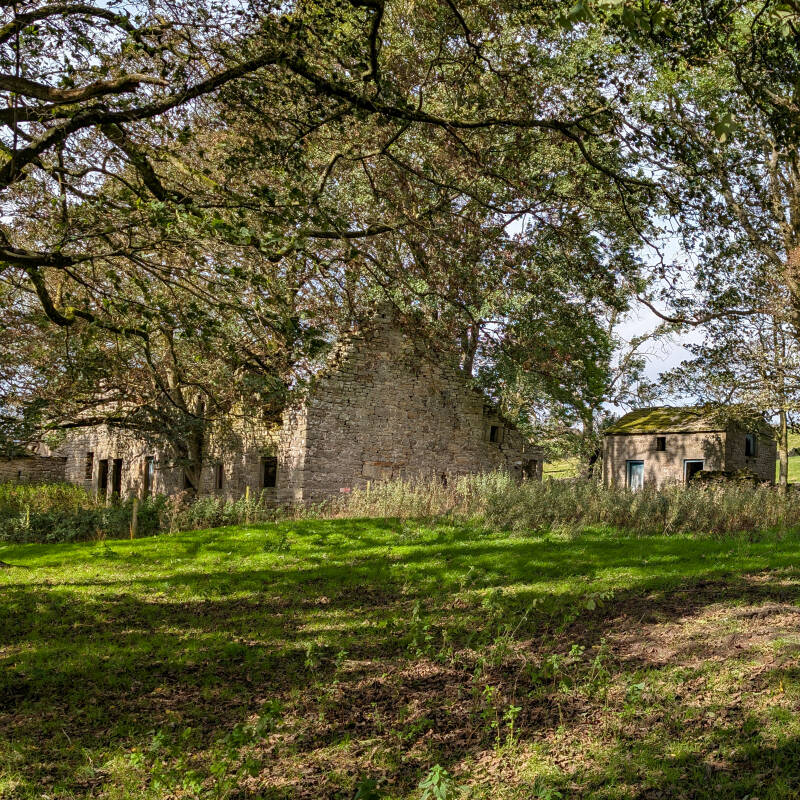
Following the public footpath through the trees brings you right through the middle of the old farmstead. There is much more here than we expected, and with trees growing through the walls and several buildings joined together it takes a little while to work out what you are actually looking at.
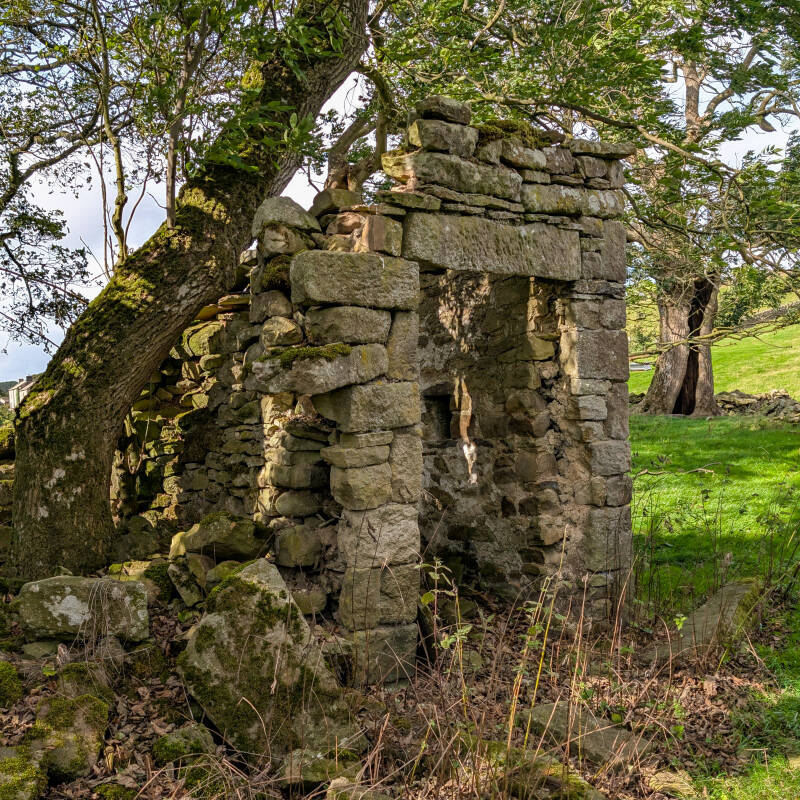
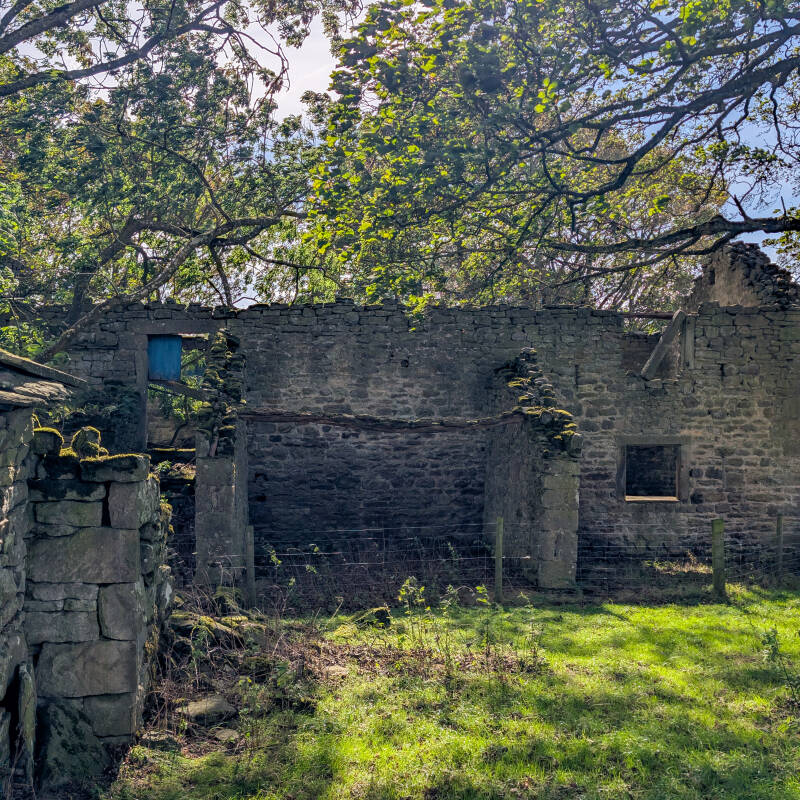
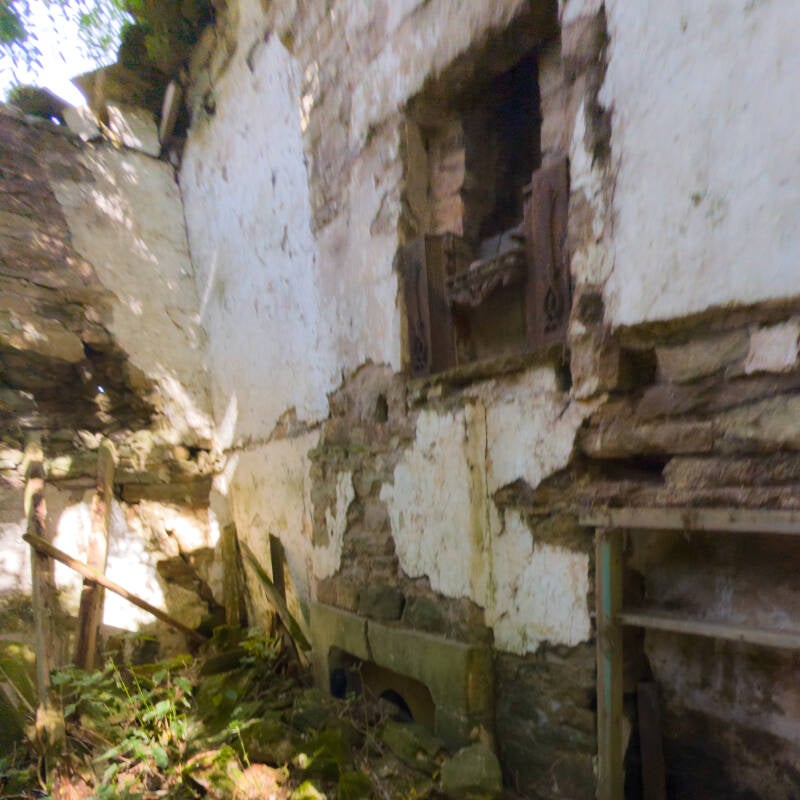
The largest ruin is the old farmhouse. It was mainly a two-storey stone-built house, with smaller single-storey sections attached to the north and south and a farm building joined onto one side. Enough of the walls still survive to make out separate rooms, internal dividing walls, old doorways and window openings.
One of the clearest features is the chimney breast on the eastern side of the house. The upper floors have long since collapsed, but the surviving walls still give a surprisingly good idea of the size of the place. Part of one of the lower offshoots even kept its sandstone-slate roof long after the main roof had gone.
The more we looked at it, the more obvious it became that this was not a tiny isolated cottage. It was a proper farmhouse with living space over two floors and working farm buildings attached around it.
The smaller house
What caught our attention most was another group of ruins around 200 feet to the east.
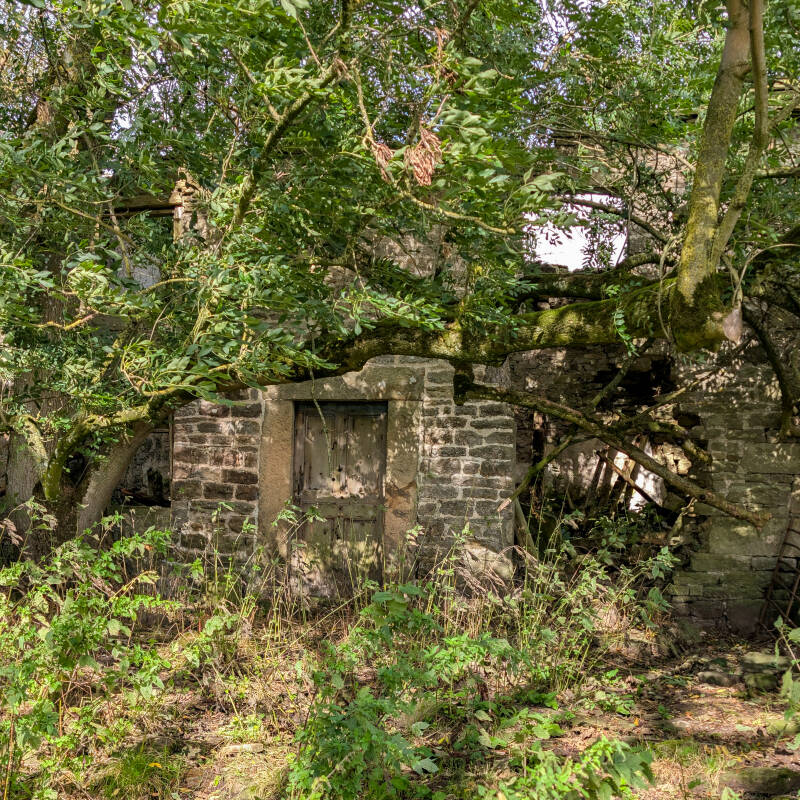
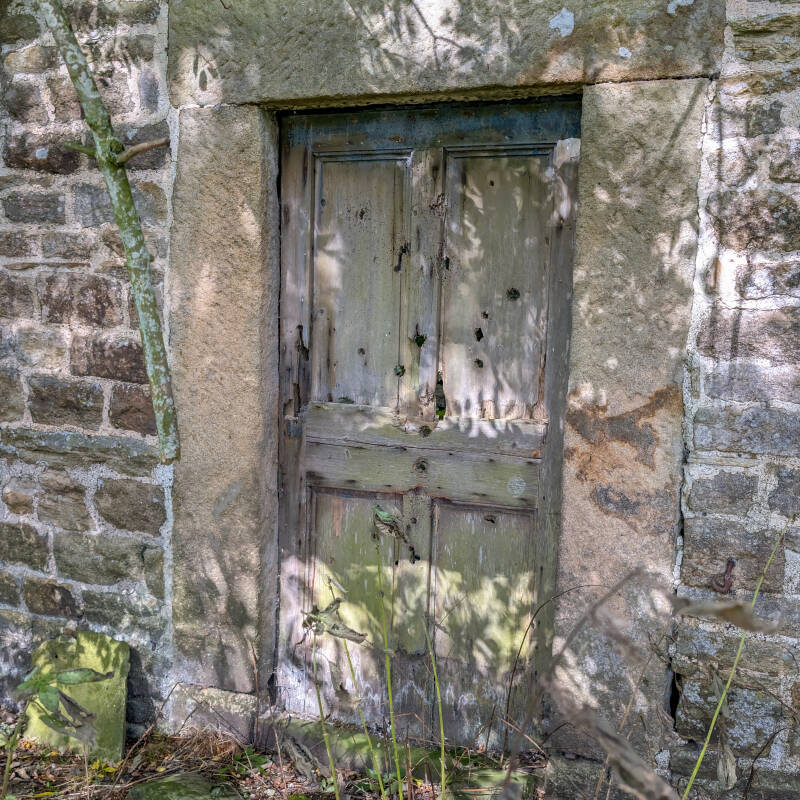
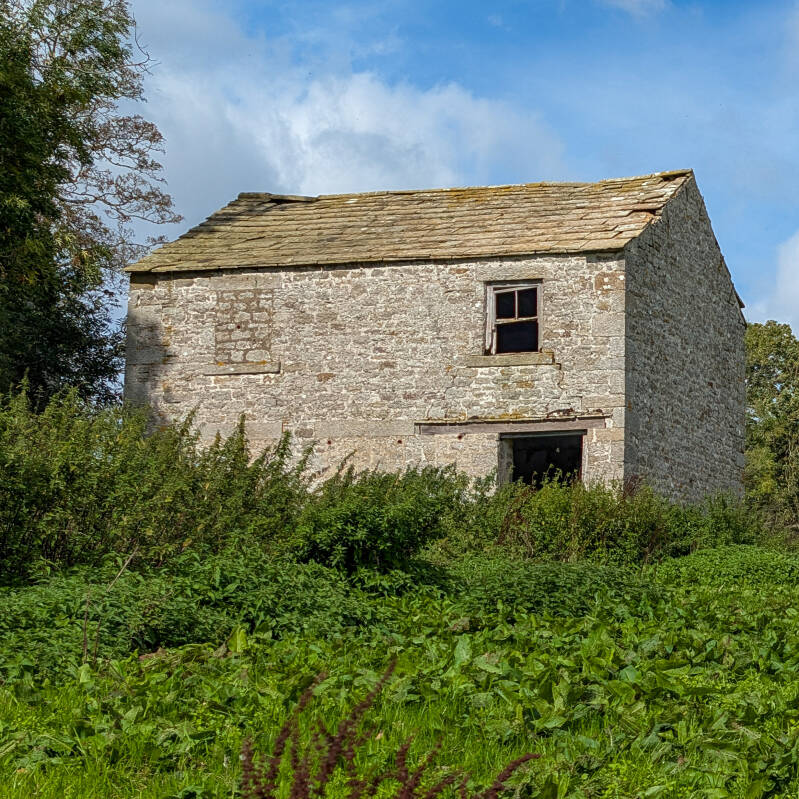
From the front, the smaller house looks much more straightforward than the main farmhouse. There is a doorway in the centre with a square window on either side, and from the openings it appears to have had a central hallway with rooms on both sides.
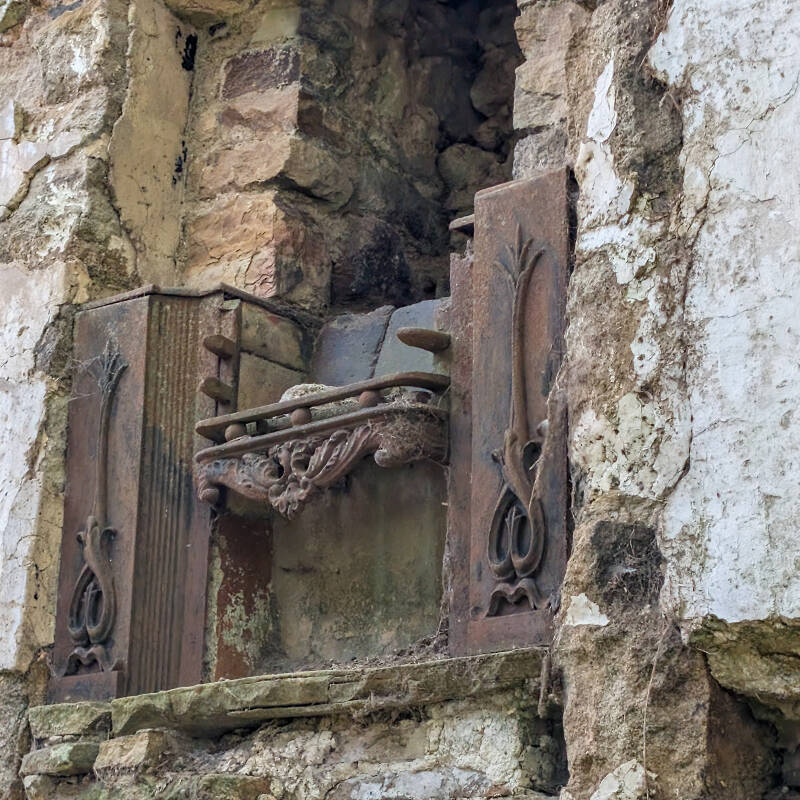
The right-hand room on the ground floor still has a stone fireplace. Directly above it, on the first floor, we could see a small decorative metal fireplace still fixed into the wall. It is one of those little details that suddenly makes a ruin feel like somebody's home rather than simply a pile of old stone.
The left side was harder to make out, but it appeared to have followed a similar arrangement, with a room downstairs and another above.
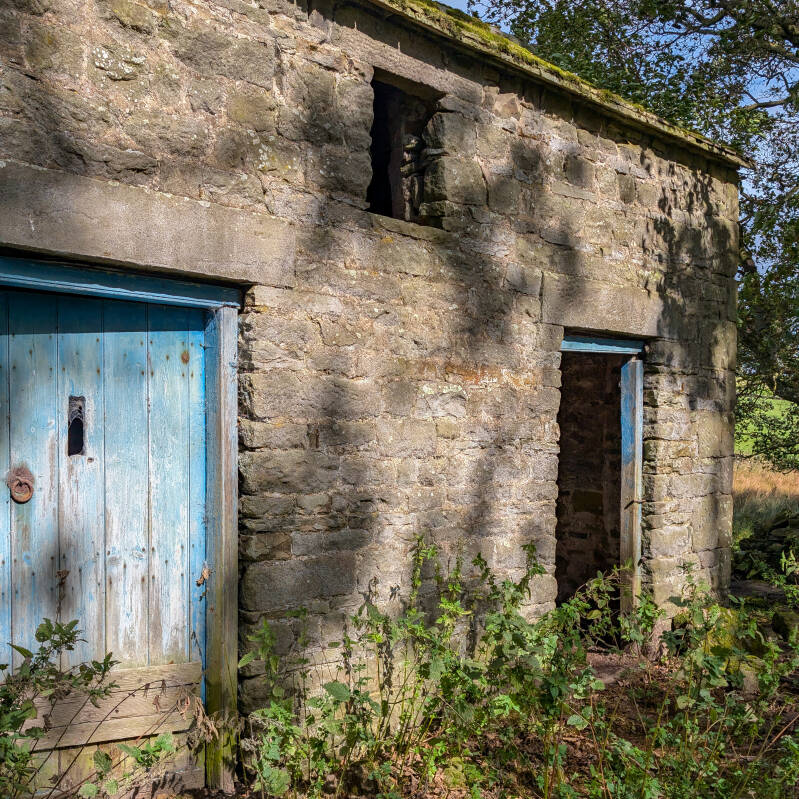
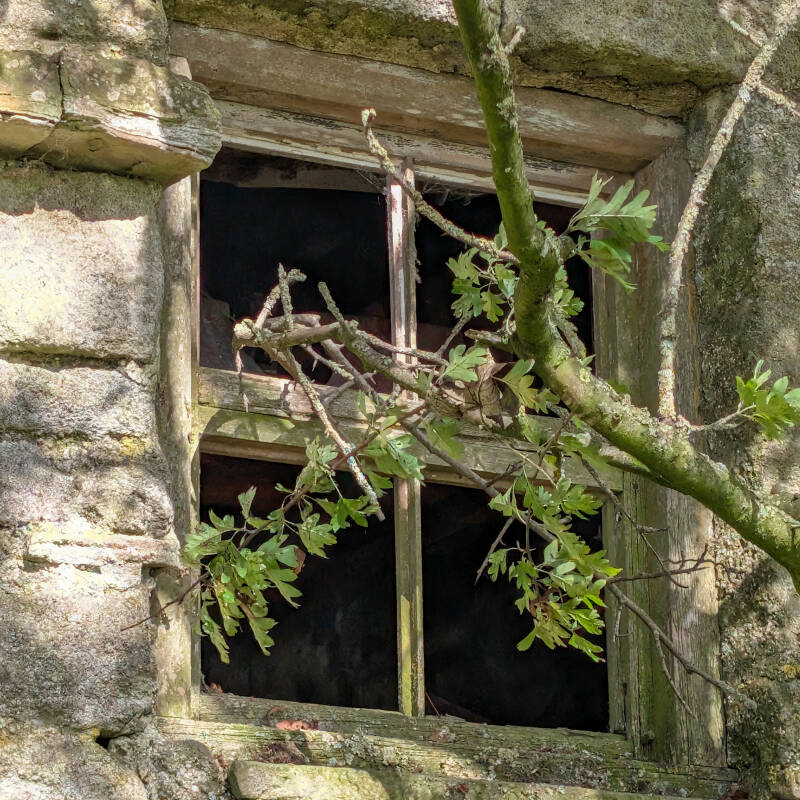
Behind the house is another substantial stone building which seems to have retained part of its slate roof. On the ground floor there is a large opening to the right, while two other openings have been blocked with stone but their lintels are still easy to pick out. What really caught our eye were the two windows upstairs. They look much more like domestic sash windows than something we expected to find in a simple farm barn.
There is another ruined building lower down and slightly in front of this group too.
Standing beside the footpath, it really does feel like a separate little group of buildings from the larger farmhouse. Modern planning drawings also show this eastern group apart from the main Yew Tree Farm buildings, although that alone does not tell us what the smaller house was called.
And that is where the history of Yew Tree starts to become much more interesting.
Yew Tree on the old maps
The old maps help make sense of the site, but they also leave us with one fairly big question.
Buildings are already shown here on the 1854 Ordnance Survey map, although the name Yew Tree is not printed beside them at that point. On later mapping the name Yew Tree appears beside the main group of buildings, with the smaller house to the east also clearly shown.
What we have not found, despite going through the maps we can access, is a separate name beside that smaller house. It is there, but it is simply shown as another building.
That became much more interesting once we started looking through the written records, because another Hury property called Walker Hall begins appearing at around the same time as Yew Tree.
We do not want to force the two names together just because they sit close to each other on the ground. For now, we are treating Yew Tree and Walker Hall separately and sticking to what the records actually say.
What we found about Yew Tree
Yew Tree itself has a fairly good paper trail.
In 1902 it was advertised to let in the Teesdale Mercury as a small farm at Hury, Baldersdale, with a dwelling house, outbuildings and around 16 acres of land.
By the 1911 census, John Bell was living at Yew Tree. He was 35 and recorded as a farmer, which gives us an actual named person living here rather than just a farm name on an old map.
The old mapping from around this period also gives us the name Yew Tree beside the group of buildings we see today.
That gives us something solid to work with. Yew Tree was a real working farm and somebody’s home in the early 1900s.
Then we found Walker Hall
While looking into Yew Tree, we kept coming across another name: Walker Hall.
The clearest record we have found is a 1912 sale notice for a freehold property at Hury, Baldersdale, “known as Walker Hall”.
The occupier was Mr James Hauxwell. The property included a dwelling house, a three-stall stable with a loft, six-stall and four-stall byres, a stirk house, hay house, cart house, gardens, two closes and 7 acres 0 roods 8 perches of land.
That caught our attention because John Bell had been recorded at Yew Tree only a year earlier.
A Kelly’s Directory from the same period also lists the two men separately. John Bell appears as a farmer at Hury, while James Hauxwell is listed as a farmer at Hury and Slateburn.
The directory does not tell us the name of each man’s farm, so we are not using that on its own to identify the properties. What it does show is that Bell and Hauxwell were two separate farmers working at Hury at the same time.
That is why we are cautious about the modern description of Yew Tree as simply “formerly Walker Hall”. The older records seem to tell a more complicated story.
The Hauxwell connection
The Walker Hall name carries on in records connected with the Hauxwell family.
In 1925, a solicitor’s letter to William B. Hauxwell, Hannah Hauxwell’s father, talks about insurance covering Walker Hall and Birk Hatt separately. That matters because Walker Hall is still being used as a property name in its own right more than ten years after the 1912 sale notice.
There is also a later legal account from 1936 which refers to “the Walker Hall land” and mentions Mrs L. S. Hauxwell.
We have deliberately not tried to squeeze more out of that document than the wording allows. What we can safely say is that Walker Hall was a genuine property name connected with the Hauxwell family well into the 20th century.
Modern planning material for Yew Tree also refers to an historical connection with Hannah Hauxwell and points to a separate history document called “Yew Tree Farm – Formerly Walker Hall – Location and History”.
We have read that material, but so far we have not found an old map, sale plan or deed that actually puts the name Walker Hall onto one of the surviving buildings. That is why we are keeping the question open rather than simply repeating the modern wording as fact.
So which house was Walker Hall?
This is the part we still cannot answer.
There are two clearly domestic buildings surviving here: the large farmhouse and the smaller two-storey house around 200 feet to the east. The smaller house has its own doorway, windows and fireplaces, with other old buildings close beside it, so it was clearly more than just another farm outbuilding.
Walker Hall was described in 1912 as having just over seven acres of land. There is an interesting clue on the old mapping, because three numbered parcels around and to the east and south-east of the buildings add up to almost exactly seven acres.
It is tempting to connect that with the smaller house, especially when you stand there and see how separate that little group feels from the larger farmhouse.
But tempting is not proof.
Those old field numbers do not give us a property boundary, and we have not found a plan that says “Walker Hall” and points to one of the two houses.
So for now we are not calling the smaller house Walker Hall, and we are not calling the larger farmhouse Walker Hall either.
What we can say is that Yew Tree was an occupied farm here in the early 1900s, while Walker Hall was also being used as the name of a Hury property connected with James Hauxwell and later the Hauxwell family.
Somewhere in the old plans or deeds there may still be a document that finally tells us which building was which. Until we find it, we would rather leave that part unanswered than turn a good possibility into a fact.
Keeping the history alive
Exploring places like Yew Tree is only part of what we do. When we get home, we usually end up wanting to know more.
A lot of Teesdale's history survives in old maps, newspapers, census records, archive documents, planning papers, letters and sometimes in the memories of people who have known these places for years. We try to bring those pieces together carefully so that the stories behind the places we walk past are not simply forgotten.
We also try to be clear about the difference between something we can prove and something that is still only a possibility. If we cannot find the evidence for something, we would rather say that than turn a good story into a fact.
Yew Tree is one of those places we will keep coming back to. There are still questions we want to answer, especially the location of Walker Hall, and if new records turn up we will continue researching and updating this page.
If you know anything about Yew Tree, Walker Hall or the families who lived and worked around Hury, we would genuinely love to hear from you. Old photographs, documents, family papers and local memories can sometimes provide the missing piece that never made it onto an official map.
If you are happy for information or photographs to be used on this page, please let us know when you contact us. We will always try to check information against surviving records before adding it.
Why places like this matter to us
For us, this is what getting outside is all about. Hury Reservoir is a peaceful place to walk anyway, but following the public right of way past these old buildings adds something completely different to it.
You do not need a huge hike or a full day out. It is just a gentle walk through the countryside, with the reservoir close by and these old buildings sitting quietly beside the path.
Standing there, it is difficult not to think about the people who once lived and worked here. These were homes, farmyards and working buildings long before they became ruins beneath the trees. People cooked beside those fireplaces, worked the surrounding land and walked the same area that we now visit for a bit of peace and space.
That is a big part of why we enjoy researching places like this. A walk might begin simply because we want to get outside for a couple of hours, but sometimes you come home with a question that leads much further into the history of Teesdale.
We may not find every answer about Yew Tree and Walker Hall, but we will keep looking. And every time we learn something new, we will add it here so that a little more of the story stays alive.
Keep exploring Teesdale
Yew Tree is only one small part of the story of this valley. Across Teesdale there are old farms, bridges, settlements, industrial remains and places where the landscape still carries traces of the people who lived and worked here before us.
You can find more of our local research in our Teesdale History & Heritage section, or head back to Discover Teesdale for walks, waterfalls, reservoirs, places to visit and more from across the dale.
We have also built the free Discover Teesdale web app, where you can explore the map, find places nearby, see somewhere to eat or stay and discover what is happening around Teesdale while you are out exploring.
The more we find, the more we realise there is still left to uncover.