London Lead Company School, Middleton-in-Teesdale
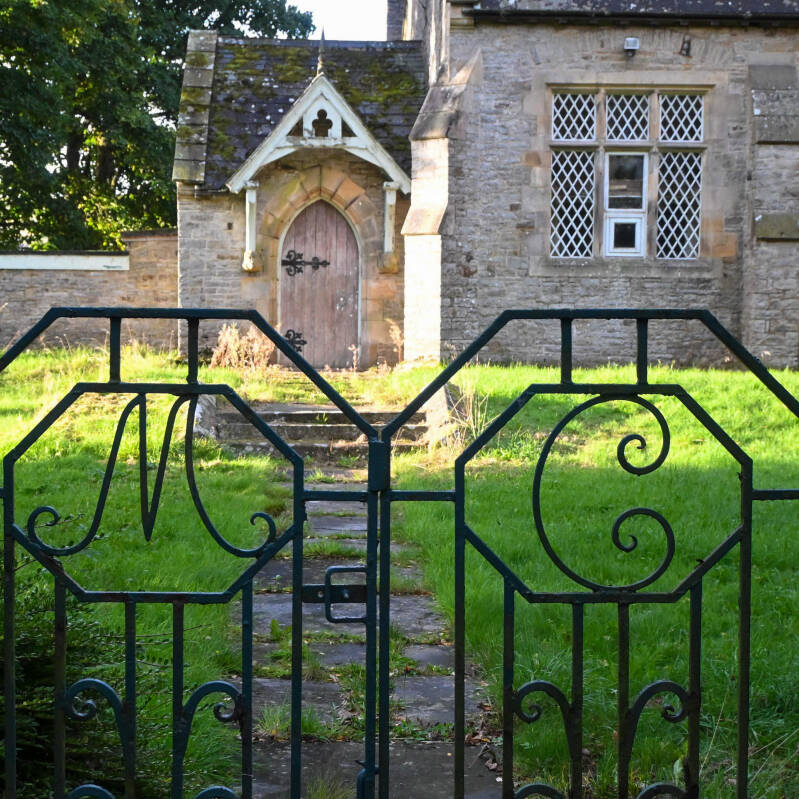
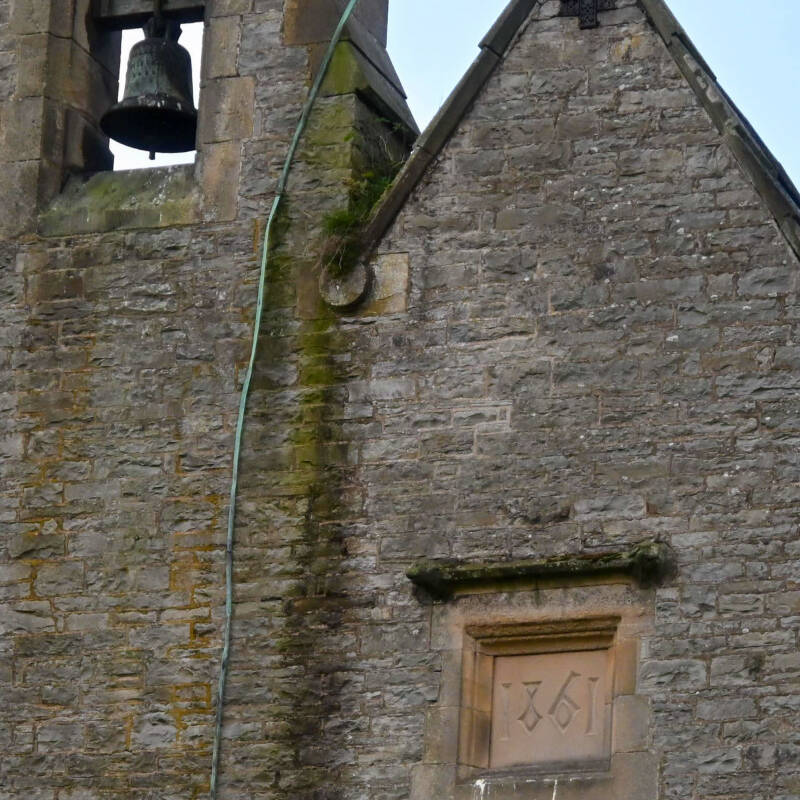
There are buildings in Middleton-in-Teesdale that make a lot more sense once you know what you are looking at, and this is one of them. Standing back from Alston Road behind its stone wall and gates is a beautiful old school, with 1861 carved high in the central gable and a little bellcote still rising above the roof. Today it is easy to pass without realising quite how much of Middleton’s story has happened inside.
This was built as the London Lead Company School, at a time when lead mining shaped almost every part of life in Upper Teesdale. Children from mining families were educated here, the schoolroom filled with flowers and vegetables for village shows, Company workmen and their families came for evening lectures, and in 1877 more than 250 children were lined up for an extraordinary medical examination after a health scare spread through the dale.
The building later became a school camp for children from Sunderland, was requisitioned for military and internment purposes during the Second World War, returned to camp life after the war, and eventually became Kingsway Adventure Centre. It was sold again in September 2025.
We wanted to put its story together because this is exactly the sort of Middleton building worth stopping for. Take a minute to look at the date stone, the old entrances and those huge windows. Generations of people have walked through these doors for completely different reasons.
Quick facts
Location: Alston Road, Middleton-in-Teesdale
Built: 1861
Built for: The London Lead Company
Why it was built: To replace the Company’s earlier school with a larger, more modern building
Building budget: R. W. Bainbridge was authorised to spend £2,000 on the new school
Planned capacity: About 300 children
1877 attendance: 256 children present during one recorded visit, with average attendance given as 240
London Lead Company support ended: 1878
Listed status: Grade II, Historic England List Entry 1281746, listed 26 November 1987
Later uses: Assembly hall, Middleton/Sunderland School Camp, wartime military and internment use, community centre and Kingsway Adventure Centre
School camp: Purchased in 1921 and closed in 1990
Second World War: Requisitioned from 1939 to 1946 for military and internment purposes
Last confirmed sale: September 2025 for £205,000

Why did a lead mining company build a school?
The building dates from 1861, but the London Lead Company had already been educating children in Middleton for more than forty years. Its first schoolroom here was established in 1818 at the instigation of Robert Stagg, and we now know what became of it. By 1878 that old schoolroom had been converted into the Company’s baths and wash-houses, another part of the welfare system it built around its workers and their families.
By the end of the 1850s, that first school was no longer enough. The man who pushed for something better was Octavius Wigram, then governor of the London Lead Company’s Court of Directors. Middleton needed a more spacious and modern school, and after a Company deputation from London visited the area, the decision was made to build one of a much more substantial character.
The job on the ground fell to R. W. Bainbridge, who was authorised to spend £2,000 on the new Middleton school. That was a serious investment, made at a time when the Company’s lead mines were returning large profits. Plans approved in November 1860 were for a school capable of taking about 300 children, and by the following year the building was standing on Alston Road with 1861 carved into the stone. A similar school, of comparable size and cost, was built for the Company’s community at Nenthead.
The Company was not simply paying for a building and leaving the rest to Middleton. For years it helped fund the whole education system around its mining communities. By 1878 its expenditure on schools across its districts had been running at more than £700 a year. The usual charge for the child of a Company workman was one shilling a quarter, while children from outside the workforce paid three shillings, with books provided.
There was a purpose behind all of this. The Company wanted its workers’ children educated, but schooling was also tied closely to the life that came afterwards. Before a boy could be taken into Company employment, satisfactory evidence was expected of his education, his attendance at day and Sunday school and his general character. The schools themselves were run on an undenominational basis, although children were expected to attend a place of worship on Sundays.
It is easy to look at the stonework today and think of the school as an act of Victorian generosity, but the reality was more interesting than that. The London Lead Company was helping to shape an entire community: where families lived, what happened when they became ill, how their children were educated and, eventually, how some of those children entered the same industry as their fathers.

The children who came before the 1861 school
One child who helps put a face to Middleton’s earlier Lead Company school is Richard Watson, later remembered across Teesdale for his poetry. Watson was born in Middleton in 1833 and went to the Company school as a boy, long before the present Alston Road school was built. A later Teesdale Mercury account remembered his school fee as a penny a week.
His schooldays ended early. At ten years old he was allowed to leave because his father had become seriously ill through his work in the damp lead mines. Watson went to work as a washerboy for sixpence a day.
That is worth remembering when looking at the grand 1861 school. It was not created for some distant idea of Victorian education. It was built for families living that sort of life. For many Middleton boys, the step after the classroom really could be out onto a lead washing floor.
What was the Company school actually like?
In the same year that the new Alston Road school was built, a national education inquiry visited the London Lead Company’s school at Middleton. We cannot safely say whether that particular inspection took place in the old premises or after the move into the new building, but the description gives us an unusually clear glimpse of the education the Company was providing at the point the new school arrived.
There were 180 children present, aged between six and fifteen, with boys and girls mixed across seven classes. Twenty-seven children were handed an English history book opened at random and twenty-one read the passage fluently. Their spelling impressed the inspector, as did their handwriting and arithmetic. There was one lovely local touch too. Their reading was noted for its strong Teesdale accent.
The master was John Hyslop, who had already spent around twenty-five years teaching the Company’s children by the time the school was inspected in 1861. He seems to have known generations of Middleton families, and the inspector was struck by the discipline in the school. Hyslop claimed that in all his years there he had never had “a back word” from a pupil.
The discipline could be strict. Adults in Middleton who had themselves been educated under the Company system remembered being made to attend and being expected to get on with their lessons, even if they had not appreciated it much as children. Looking back, some felt differently and recognised the value of the education they had been given. It gives a good sense of the school as a serious place, but also one woven deeply into everyday family life in Middleton.
Hyslop himself became part of Middleton life. Records place him as the London Lead Company schoolmaster before the 1861 building appeared, and he was still described as a schoolmaster in the 1871 census. He had come from Dumfries and spent decades teaching children in the dale.
The schoolroom belonged to Middleton as well
One of our favourite things about this building is how quickly it became more than somewhere for lessons. Within two years of its construction, the Teesdale Mercury was calling it the London Lead Company’s “New School Room”, and Middleton was already filling it with something completely different.
In 1863 the town’s 15th annual Floral and Horticultural Society exhibition was held here. The schoolroom was filled with gooseberries, currants, apples, strawberries, potatoes, onions, leeks, dahlias, roses, marigolds and all sorts of other entries from Middleton and the surrounding dale. Exhibitors came in from Newbiggin and Holwick, and the Band of the 12th Durham Rifles played during the day. When the judging was finished, the judges and committee headed off to the Rose and Crown Inn for dinner.
It is a completely different picture of the building. Imagine the desks moved aside, tables of flowers and vegetables filling the room, people coming and going through the school doors and a military band playing. That was happening here in 1863.
Two years later, in December 1865, the Lead Company was using the schoolroom for a series of free evening lectures for its workmen and their families. One evening was devoted to the life of railway engineer George Stephenson. R. W. Bainbridge chaired the meeting and the conversation wandered from railways to how much travelling had changed within living memory. The same schoolroom was also used for a meeting of Middleton’s branch of the British and Foreign Bible Society.
So when the Company planned a school for hundreds of children, it created something Middleton could use after lessons finished too. For years this was a school by day and one of the village’s important gathering places by night.
In 1878, the schoolroom also hosted a three-day bazaar to raise money for the rebuilding of St Mary’s Church. Local people filled the room with stalls, decorations and music, helping to raise more than £450 towards the new church.
The day 256 children were examined
Perhaps the strangest glimpse inside the school comes from 16 March 1877.
There had been claims of an outbreak of itch among children at the Lead Company school and amongst miners staying in the Company’s mine shops. The allegation clearly touched a nerve. Bainbridge, the London Lead Company’s chief agent, arranged for independent doctors to examine the children and some of the workmen.
That meant going through the entire school.
There were 256 children present that day, and the average attendance for the year was given as 240. Dr T. B. Thwaites described the children as remarkably clean and largely free from skin complaints. Three possible exceptions were recorded, including one doubtful case. Around forty to fifty Lead Company workmen from different mines were examined as well.
What survives from the argument is more interesting than the medical details. Bainbridge was especially keen to defend the children's families, pointing to the effort Middleton mothers put into keeping their children clean and presentable. For us, the figure of 256 is useful for another reason too. When we first saw the building, the original plan for about 300 children sounded enormous. The 1877 inspection proves that numbers close to that really were using this school.
Why did the Lead Company give up the school?
By 1878, around sixty years after the Company had first begun providing education in Middleton, the arrangement was coming to an end.
The change was important enough for Middleton’s ratepayers to gather inside the London Lead Company Schoolroom itself to decide what to do next. There is something quite striking about that: families were sitting in the very building the Company had paid to construct, discussing how the village could keep its school going once that support disappeared.
The decision was not simply the result of the lead mines collapsing or the Company suddenly losing interest in Middleton. Britain’s education system had changed around it. Government was taking much greater responsibility for elementary education, and the Company increasingly felt that a service it had provided voluntarily for decades had become something the state was now expected to provide.
Money mattered as well. Metalliferous mines had become liable for poor rates, placing another substantial charge on the Company. In Middleton it estimated that its share amounted to roughly half of the township’s poor-rate liability. At the same time, wages among its workmen had been good and regular enough for the Company to argue that families were in a better position to contribute towards their children’s education themselves.
The school was also costing more than its income covered. Middleton had been under Government inspection for two years and received grants of £220 in the first year and £250 in the second, but after the various sources of income had been counted there was still an annual shortfall of about £40. R. W. Bainbridge had tried to persuade the Company’s Court to keep the existing system going with slightly higher school fees, but without success.
Middleton was not willing to let the school disappear without a fight. The ratepayers first asked the Company to continue supporting it, with the fee for each child increased to one shilling a quarter so the Company would no longer lose money. If that was refused, they wanted to rent the school at a reasonable rate. And if the Company would do neither, they asked for the lowest price at which it would sell them the building.
That is how the next chapter began.
From Company school to School Board
The London Lead Company stepping away did not mean children suddenly stopped coming through the Alston Road gates. Middleton School Board was established in 1879, and the old Company school continued in use under the new system. The Board rented the building from the London Lead Company for £50 a year, keeping it at the centre of education in Middleton for another decade.
By 1890, though, another argument was brewing. The Education Department wanted additional classroom accommodation, and the School Board was beginning to question whether it made sense to keep spending money on a building it did not own. The Lead Company was apparently prepared to provide extra classroom space, while some ratepayers argued that buying or adapting the existing school would be far cheaper than starting again somewhere else.
Others thought Middleton needed to move on. There were complaints about the condition of the old school and claims that Government inspectors were regularly dissatisfied with it. Rent became part of the row too. The Board had previously asked the Company either to reduce the rent or name a reasonable price for the property, and at one point the possibility of increasing the annual rent to £100 was raised. The Board made clear that if that happened it would build elsewhere instead, and the proposed increase was dropped.
The whole thing spilled into the pages of the Teesdale Mercury, where Middleton’s ratepayers were not particularly gentle with one another. One correspondent accused another of having “cobwebs on his brain”, while others complained about blunders, wasted money and what one writer called a conspiracy of silence.
Even the proposed site for the replacement school caused trouble. It was down near Middleton Bridge, and opponents worried about children being so close to the river, the bridge and horse-drawn traffic. One particularly angry letter in January 1891 claimed that work had begun on the ground before the purchase of the site had even been completed.
The School Board pressed ahead. A new public elementary school was built in 1891, with accommodation for around 500 children. It is the other school that appears near Middleton Bridge on the old maps, and the building survives today as The Old School on Bridge Street, now used by FillPack.
That finally brought the 1861 building’s life as Middleton’s main school to an end. It had been built and paid for by the London Lead Company, passed into the School Board era when the Company withdrew, and continued educating local children for around thirty years before the village moved into its new school by the bridge.
From miners’ children to Sunderland School Camp
Once Middleton’s schoolchildren moved to the new school near the bridge, this old building did not simply fall out of use. It found a completely different purpose. In 1921, it was purchased for use as a school camp connected with Sunderland. The surviving archive describes the purchaser as the Sunderland branch of the EHA, before the camp later passed to the Sunderland branch of the Educational Development Association, a teachers’ organisation.
By then the former Lead Company school was being described as a converted assembly hall, giving us another glimpse of what happened here between the Victorian school years and the arrival of the camp. The building had already moved on from its original purpose, but children were about to become part of its story all over again.
This time they were coming from Sunderland. Groups of schoolchildren travelled out to Middleton-in-Teesdale for educational and recreational breaks in the countryside, swapping streets and classrooms for Upper Teesdale. For some of them, it must have felt like stepping into a completely different world. The same building that had once educated children growing up in a lead-mining community was now giving generations of youngsters from Sunderland the chance to spend time outdoors in the dale.
Photographs survive of Middleton-in-Teesdale School Camp from around 1925, and this was no short-lived chapter. Tyne & Wear Archives still holds camp log books covering 1928 to 1939 and 1947 to 1989, showing just how long children from Sunderland kept coming back to Middleton.
The Second World War brought a sudden break. From 1939 until 1946, the camp was requisitioned for military and internment purposes. The surviving archive does not say who used the building during those years, but for seven years the old school had another very different role before returning to children once the war was over.
After the war, the school camp reopened and carried on for another four decades. It finally closed in 1990, ending almost seventy years of connection between this old Middleton building and generations of children from Sunderland.
Community centre and Kingsway Adventure Centre
Another change had happened by 1987, when the building was formally added to the statutory list at Grade II. Historic England recorded it under the name Community Centre, while still identifying it clearly as the 1861 school built for the London Lead Company.
The old school later became Kingsway Adventure Centre, a family-run Christian outdoor centre offering accommodation for groups visiting Teesdale. The former classrooms and school spaces were adapted for dormitories, showers, catering and activities, while groups used Middleton as a base for climbing, canoeing, gorge walking and other outdoor experiences. Kingsway itself described the building as a converted school formerly known as Sunderland School Camp.
The building has inevitably changed inside. Later extensions include a single-storey dining room to the rear and an office and store addition on the eastern side. The modern floor plan we found bears little resemblance to the sort of open Victorian schoolroom that would once have held hundreds of children, although the old school building can still be read beneath all those later alterations.
What happened to Kingsway?
A new proposal came forward in 2024 to change the former adventure centre into group accommodation with a small wedding and events facility. That application was subsequently withdrawn, so it did not become the next chapter of the building in the form proposed.
The property was later marketed as a vacant Grade II listed former activity centre, with around 505 square metres of internal space, nine bedrooms and accommodation previously arranged for groups. The former Kingsway Adventure Centre was sold in September 2025 for £205,000.
We have not found reliable public information confirming what the building will become next, and we would rather leave that part open than guess. After more than 160 years of changing uses, though, it would be fitting if this remarkable old school has another chapter still to come.
Take a minute to look at it
If you are walking around Middleton, this is one of those buildings worth slowing down for rather than simply photographing and moving on.
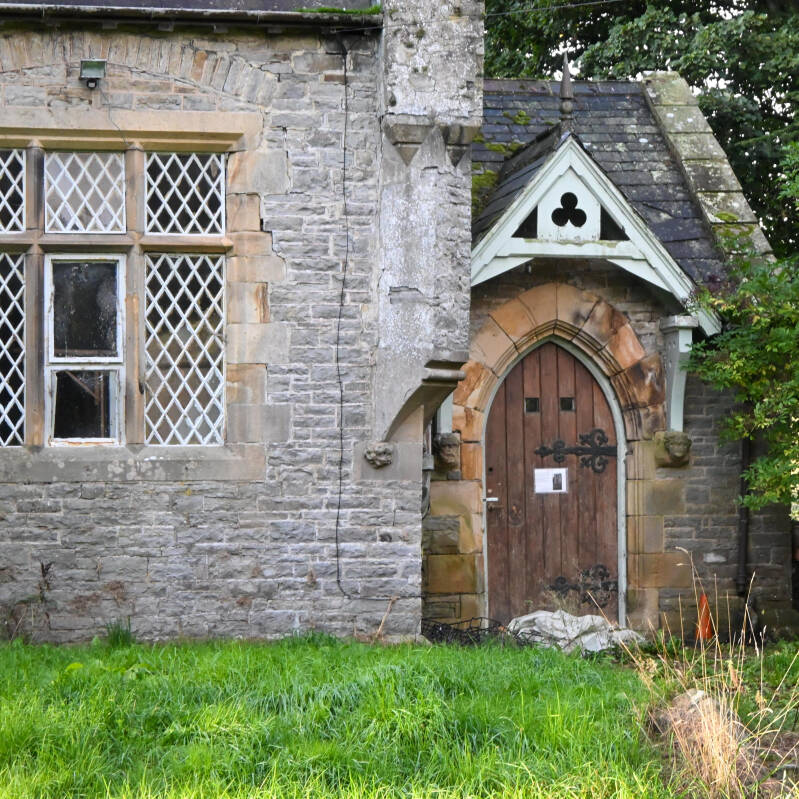
Start by looking high into the central gable, where 1861 is still carved into the stone. Above it rises the little bellcote, complete with its bell, while the great windows below once poured daylight into rooms filled with children. Even the six stone gate piers and the walls along the front have their own Grade II listing and date from the same period.
Then get closer to the entrances, because some of the best details are surprisingly easy to miss.
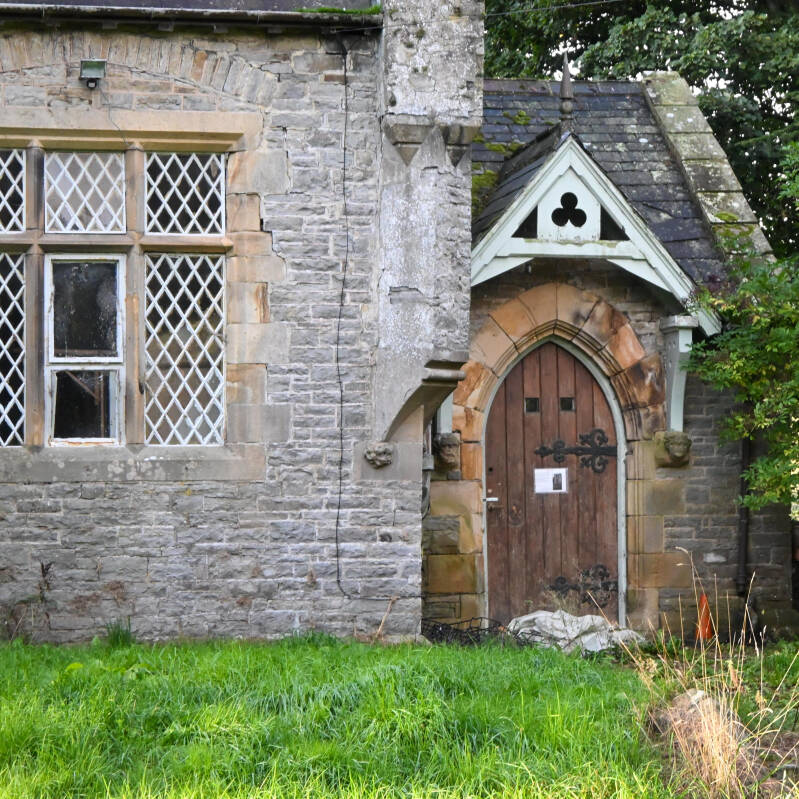
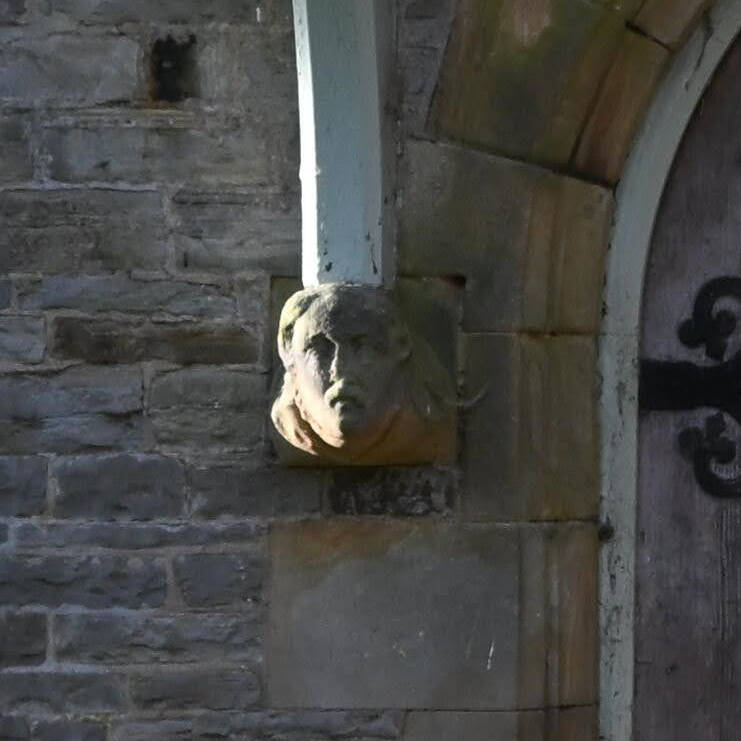
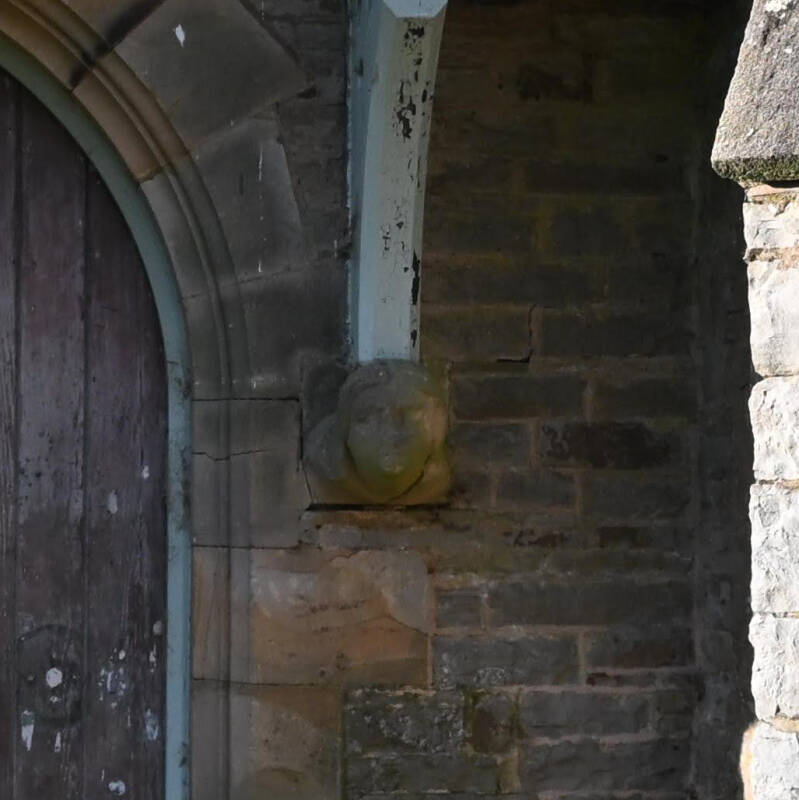
Beneath the small gabled porches are carved stone faces, tucked beneath the supports on either side of the doorways. Historic England describes them as “head-stopped brackets”, but they are much more interesting when you are actually standing in front of them. Each little face looks out from the stonework, giving the entrances a character of their own.
Who they were meant to represent is still a mystery. We have not found any surviving description, plan or record that names them, and there is nothing to show that they were portraits of teachers, Company officials or anybody else connected with the school. They may simply have been decorative faces, added as part of the Gothic style of the building.
The two separate porches are interesting for another reason. When the London Lead Company built its school at Nenthead a few years later, the different porches there were used as separate entrances for boys and girls. Middleton was built for the same Company and has the same obvious division of entrances, so it is possible a similar arrangement was intended here, although we have not yet found anything that proves it.
The doors themselves are worth a look too, with their pointed stone arches and heavy decorative ironwork, along with the leaded windows and the enormous roof rising above what was once a much more open school interior. Standing outside today, it can be difficult to imagine hundreds of children fitting inside, yet in March 1877 there were 256 pupils actually present here on a single day.
And then there are all the other people who have come through these entrances.
In 1863, Middleton families carried prize gooseberries, potatoes, flowers and vegetables into the schoolroom for the town’s horticultural exhibition while the Band of the 12th Durham Rifles played. In 1865, Lead Company workmen and their families came here for a free evening lecture about George Stephenson. In 1877, doctors worked their way through the entire school after fears about an outbreak of illness.
The following year the schoolroom filled again, but this time with Middleton ratepayers trying to work out what would happen when the London Lead Company withdrew the educational support it had provided for sixty years. More than a decade later the arguments started all over again as the village debated whether this building should be bought, enlarged or left behind for a new school near the bridge.
Then came children from Sunderland arriving for school camp, seven wartime years when the building was requisitioned for military and internment purposes, and another long generation of school-camp visitors after the war. Eventually people were coming through these doors again for a very different reason, heading out into Teesdale for outdoor adventures from Kingsway.
The purpose of the building has changed repeatedly, but the old school has kept finding a place in Middleton life. That is why we think it deserves more than a quick glance.
It is not simply a handsome Victorian building on Alston Road. Look at the date carved above the windows, the little bell still sitting on the roof, the old doors and the faces watching from beneath the porches, and then think about everyone who has passed through here. Children from mining families, teachers, Lead Company workmen, Middleton ratepayers, wartime occupants, generations of youngsters from Sunderland and, much later, people setting off to explore Teesdale.
More than 160 years after the London Lead Company built it, the building is still here, and so are many of the little details put into it in 1861. Once you know the story behind them, it becomes much harder to walk past without stopping for a proper look.
Explore more of Middleton-in-Teesdale
Who Were the London Lead Company?
Discover the mining company that helped shape Middleton, providing work, education, housing and welfare for generations of families.
St Mary’s Church, Middleton-in-Teesdale
Explore the history of Middleton's parish church and the fundraising bazaar held inside the London Lead Company School in 1878.
The Lead Company's Baths and Wash Houses
Discover what became of the Company's earlier schoolroom and how bathing and washing facilities were provided for mining families.
Explore Middleton-in-Teesdale
Find more village history, walks, waterfalls and places to explore around Upper Teesdale.