St Mary’s Church, Middleton-in-Teesdale
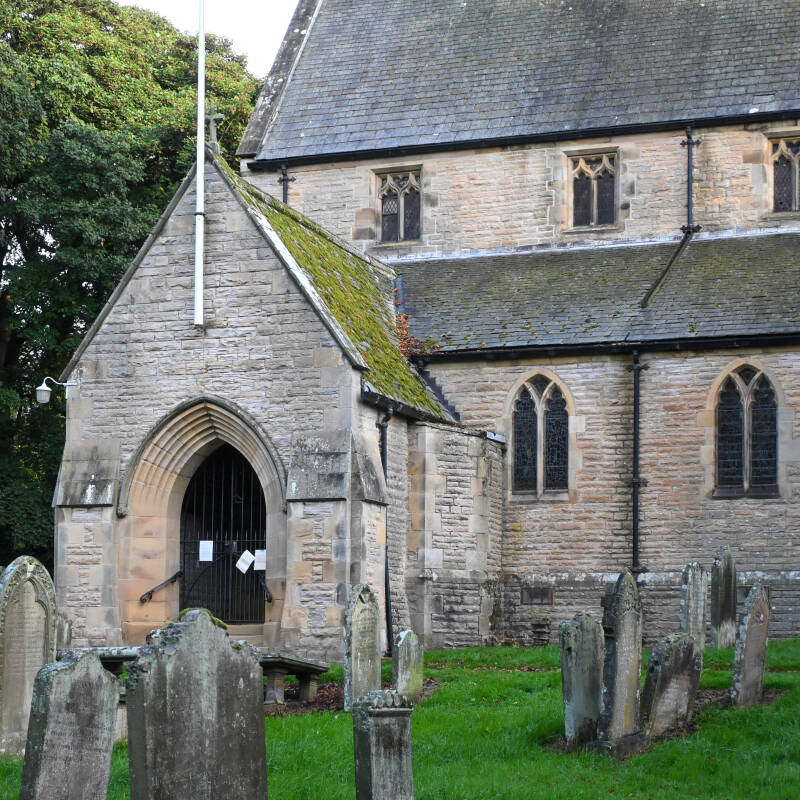
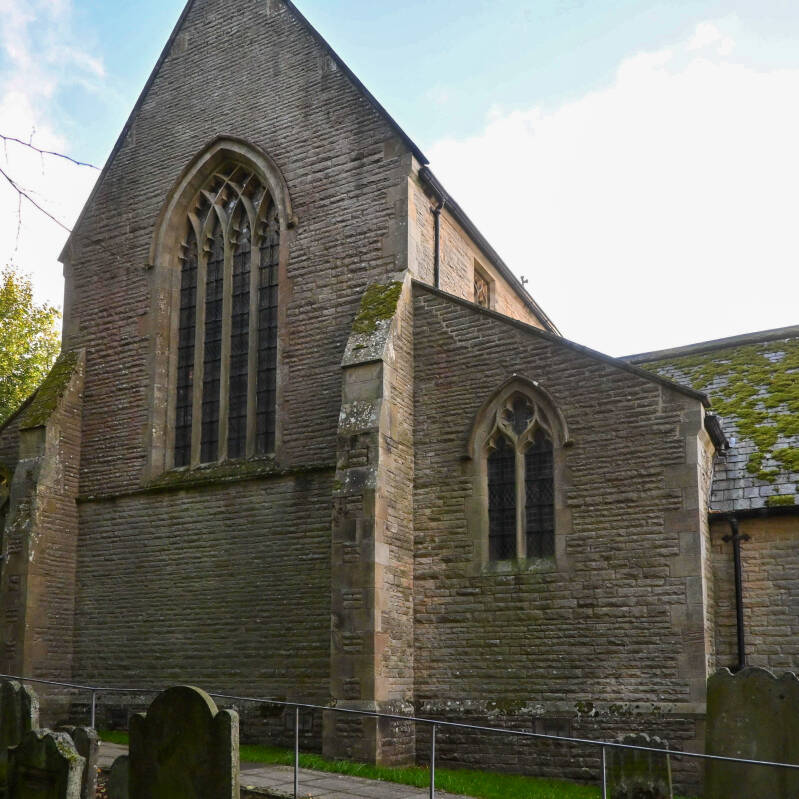
St Mary’s is one of those places in Middleton-in-Teesdale that becomes far more interesting once you slow down and actually look around. From the road you see a handsome Victorian church surrounded by an old churchyard, but walk through the gates and there are clues everywhere that the story began long before the building standing here today.
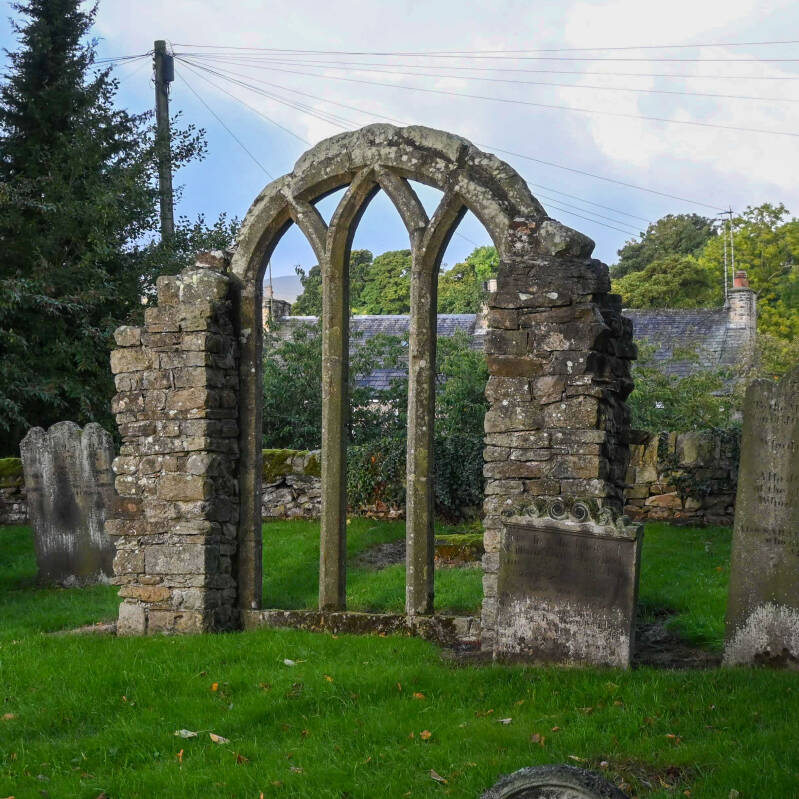
There are medieval stones built into the church, centuries-old graves scattered through the grounds and, perhaps strangest of all, a large stone church window standing completely on its own in the churchyard. It looks almost as though somebody has forgotten to build the rest of the wall around it.
They haven’t.
That window survived an earlier St Mary’s that was pulled down in 1878. The present church rose on the same site, but pieces of its predecessor were saved, reused and moved around the grounds. Dig a little deeper and the story becomes wonderfully human too. There was a local poet who sat beside the old church and wrote it a farewell, villagers who raised hundreds of pounds at a three-day bazaar, an old parish clerk whose singing apparently left something to be desired, and more than 500 people who packed into the new building when it opened in 1879.
This is the story of St Mary’s, but really it is also a little piece of the story of Middleton itself.
Quick facts
Church: St Mary the Virgin, Middleton-in-Teesdale
Location: Town Head, Middleton-in-Teesdale, County Durham
Present church: Built during 1878–1879
Architect: C. Hodgson Fowler
Opened: 23 October 1879
Historic England listing: Grade II, List Entry 1322768
Earlier church: Medieval church on the same site
Old church demolished: Spring 1878
Medieval window in churchyard: Late 13th century and separately Grade II listed
Notable local connection: Richard Watson, the Middleton lead-miner poet
Something unusual nearby: A separate historic bellhouse north of the church

A church stood here long before the one we see today
It is easy to think of St Mary’s as a Victorian church because most of the building in front of you is exactly that. The present church dates from the late 1870s, but Historic England records that it was built on the site of a medieval church, and some of the material from that earlier building survives today.
The documentary trail stretches back hundreds of years too. The surviving parish records held by Durham begin with baptisms on 20 May 1578, while later registers contain marriages, burials and even notes about work on parish buildings. This was an established parish community long before Victorian Middleton expanded around it.
That matters when you walk around the grounds, because the churchyard isn't simply the burial ground of the present church. Generations of people knew an entirely different St Mary’s on this spot. They were baptised there, married there, worshipped there and eventually buried outside it.
Some of them would probably be rather surprised by what happened in 1778.

The parish clerk who apparently couldn't sing
Church records have a habit of making the past sound incredibly formal until you come across something that reminds you these communities were made up of ordinary people with ordinary disagreements.
At an official parish visitation on 3 August 1778, complaints were recorded against the rector for neglecting his duties. But another complaint caught our attention even more.
The newly appointed parish clerk, who was also the village schoolmaster, was apparently lacking in singing ability.
Someone actually thought his singing was bad enough to raise it during an official church visitation.
We have no idea what the poor man's voice sounded like, and perhaps history has been a little unfair to him, but it is difficult not to picture a few frustrated faces in the old St Mary’s whenever the singing started. It is one of those tiny details we love finding because suddenly 1778 doesn't feel quite so distant.
By the 1870s, things had to change
By the middle of the 1870s the churchyard around St Mary’s was effectively full. Plans were being made for additional burial ground beside it, but even that became complicated.
There were arguments over how the new ground should be divided between consecrated Church of England ground and ground available for Nonconformist burials. There were questions over boundaries, sanitary requirements and the legal title to the land. At one point the north wall had to be taken down and repositioned, while part of the proposed ground was removed so that the cemetery met the required size.
An official order had originally been made to discontinue most burials in the old church and churchyard from the end of 1876. That deadline was eventually postponed until 31 March 1878 while the new arrangements were sorted out. Durham's parish archive still holds both orders and the grave register that followed.
At almost exactly the same time another, much bigger change was coming.
The old church itself was going to disappear.
Richard Watson sat beside the old church and said goodbye
This is probably our favourite part of the whole story.
In May 1878, the Middleton poet Richard Watson sat near the old St Mary’s knowing that it would shortly be pulled down. Watson had grown up in Middleton, worked in the lead-mining industry and became known for poems rooted in the people and landscape of Teesdale.
But this church was personal.
In his poem he remembered his parents standing at its altar to be married. He remembered being taken there as a child to be baptised by Rector John Henry Brown. Looking across the churchyard, he could see where his parents now rested.
He understood why Middleton needed a larger church, but that didn't make watching the old one disappear any easier.
Watson called it the town's old familiar place and filled the poem with memories of the generations who had worshipped within its walls. Eventually the evening drew in, the hour sounded and he finished with a simple goodbye:
“House of my ancestors, farewell! ”That line feels completely different when you stand in the churchyard today.
Watson himself would eventually be buried here with his wife Ann, known as Nancy, and their daughter Mary. A stained-glass window inside the present church was later dedicated to the Middleton lead-miner poet.
The old St Mary’s comes down
The medieval church was pulled down in the spring of 1878, but demolition quickly became more than simply dismantling an old building.
As the work progressed, pieces of much earlier history began appearing.
A report described old monumental slabs coming out of the walls, carved stonework, the lid of an ancient stone coffin and fragments decorated with zig-zag moulding. Human remains were uncovered beneath parts of the building too, including burials around one of the old masonry piers.
One burial attracted particular attention because a paten and chalice were reportedly found with the remains, leading to the suggestion that the person may have been an early rector.
The newspaper writers of the time tried to interpret some of these discoveries themselves, occasionally giving them very early dates. We are a little more cautious today. What we can say safely is that substantial medieval material survived and some of it was deliberately preserved when the new church was built.
One particularly important piece wasn't incorporated into the new building at all.
It went into the Rectory garden.
Why is there a church window standing in the graveyard?
If you've walked through St Mary’s grounds, you may already know exactly which bit we mean.
South of the gateway stands a large stone window with absolutely no church attached to it.
Historic England dates the tracery to the late 13th century. It is a three-light window, around three metres high, and it has its own Grade II listing, completely separate from the listing for St Mary’s itself.
More importantly, we found an account from 1878 explaining what happened to it.
While the old church was being taken down, the window was removed intact from the north side of the church and transferred into the Rectory garden. Other old stones were displayed there alongside it.
That little detail matters because some later accounts have described this surviving structure as the old east window. The 1878 report specifically describes the window transferred to the garden as coming from the north side, so we prefer to stick with the evidence closest to the demolition itself.
Historic England records that the window remained associated with the Rectory before being moved into the churchyard during the mid-20th century.
And that is why there is a medieval church window apparently standing on its own in a Middleton graveyard.
It isn't a modern folly. It is a surviving piece of the church Richard Watson sat beside in 1878.
Middleton helps pay for a new church
Replacing St Mary’s wasn't cheap.
During 1878 the expected cost was being put at around £4,500, and fundraising became a community effort.
One of the biggest events was a three-day bazaar held in the large schoolroom of the London Lead Company. The room was decorated with greenery and holly, stalls were piled with things to sell and local people turned out to support the rebuilding fund.
There was music too. A visiting violinist performed during the event, although the newspaper reporter reckoned the noise from the huge crowd made listening to her rather difficult. Even Victorian fundraising events apparently had the same problem as trying to hear somebody speak in a packed village hall today.
The bazaar raised £453 6s 4½d, a substantial contribution. Larger donations had already included £2,000 from the Duke of Cleveland, £500 from Miss Hill and another £500 from the rector, Rev. John Milner.
By the time everything was finished, the cost of the new church was approaching £6,000.
The surviving building records show just how much work was involved. Contracts were issued during the spring of 1878 for masonry, carpentry, plastering, glazing, painting and other trades. Haxby Dougill of Darlington took the major contract covering excavation, masonry, brickwork and slating for £3,461 2s, while other contracts went to craftsmen in Darlington, York and Barnard Castle. Original drawings and specifications for the new church still survive in the Durham archives.
Building the St Mary’s we see today
The architect was Charles Hodgson Fowler, an important Durham church architect who designed the replacement in what was described at the time as a Late Decorated Gothic style.
But this wasn't intended to completely erase what had stood here before.
The new church deliberately echoed the character of the older one. Two windows from the previous church were rebuilt into the new work, while three chancel windows that were too badly damaged to reuse were carefully copied.
The old font was retained too.
Inside, medieval grave covers and carved fragments recovered during demolition were incorporated into the new church. Historic England records a reused medieval two-light window, a medieval octagonal font pedestal, three medieval shafts and 14 incised grave covers, some incomplete, along with pieces of chevron moulding built into the north wall. The church also contains a small brass memorial to Simon Comyer, who died in 1620.
So although the walls around you are largely Victorian, the story inside them isn't.
Pieces of the old St Mary’s were deliberately carried forward.
Middleton's own hands are in the church too
One of the things we particularly like about St Mary’s is that the rebuilding story isn't only about architects and wealthy donors.
Local craftsmanship is part of it.
Much of the oak work was made by Jacob Readshaw of Middleton, with carving carried out by Mr Roddis of Birmingham. Readshaw was much more than simply a joiner. Local history remembers him as a cabinet maker, wood-carver, artist, musical-instrument maker and astronomer.
The altar, altar rails and other furnishings gave people in Middleton something made by one of their own inside their new parish church.
That makes the building feel rather different from something designed elsewhere, delivered to the village and simply dropped into place.
Middleton helped build this church, paid towards it and filled it.
Opening day, 23 October 1879
When the new St Mary’s finally opened on Thursday 23 October 1879, Middleton treated the day almost like a holiday.
The Bishop of Dover, Dr Parry, came to perform the opening on behalf of the Bishop of Durham, Dr Lightfoot. A special train ran from Barnard Castle, and before the church service a luncheon was held at the Cross Keys Hotel, the building now known as the Teesdale Hotel in Middleton's Market Place.
At half past two the church doors opened.
People had already gathered outside, and the building quickly filled. Some couldn't get in at all.
The service was conducted by Rev. John Milner, with clergy travelling from across the surrounding area. The choir sang, the organ was played and Dr Parry preached from Psalm 92.
Around 40 people were presented for confirmation.
The newspaper estimated the congregation at more than 500.
It is worth remembering that number when you stand outside St Mary’s today. More than a century ago this little corner of Middleton was packed with people waiting to see their new church for the first time.
One part of the old church wasn't replaced
When the 1879 church opened there was another curious survivor nearby.
The old detached bellhouse was left standing.
Historic England believes the little stone belfry north of St Mary’s probably dates from around 1567 and associates it with a gift of three bells. The oldest surviving bell is dated 1557, meaning its sound belongs to a completely different Middleton from the Victorian village that built the present church.
The 1879 newspaper wondered whether a tower might eventually be added to the new church and imagined six or eight bells ringing out across the valley.
That never happened.
Instead, the separate bellhouse survived.
The bells eventually fell out of regular full-circle ringing during the 1990s. Restoration began in 1999 and, to help retain the old bell frame, they have since been chimed rather than swung in the traditional way.
It is another bit of old St Mary’s that refused to disappear.
Take time to look at the churchyard
It is easy to walk through an old churchyard looking only for a famous name, but St Mary’s is better approached differently.
Read some of the stones.
Look at the occupations, families and dates. These are generations of the people who made Middleton.
Several monuments around the church are individually listed. One of our favourites commemorates Jane Robinson, wife of Middleton blacksmith Christopher Robinson, and members of their family. The headstone is covered with symbols: an hourglass, a skeleton, a cherub, a serpent and a dove, along with the rather sobering reminder “Eternity How Long”. It was made by a mason who signed his work, T. Snowball.
Nearby are much older Robinson family memorials, including one recording John Robinson, who died in 1683, along with his wife Grace and later generations of the family.
Then somewhere among all of those stones lies Richard Watson, the lead miner who wrote about the church, the dale and the people around him.
You don't need a famous grave for a churchyard to matter.
Sometimes the names nobody outside the dale knows are the ones that tell you most about the place.
Richard Watson came back to St Mary’s in another way
There is something particularly fitting about Richard Watson's connection with this church.
He sat beside the old building in May 1878 and wrote about losing it. His parents had married there. He had been baptised there. Their graves were close by.
The building he knew disappeared shortly afterwards.
Yet Watson's story eventually found its way into the church that replaced it.
A stained-glass memorial window now remembers the Middleton lead-miner poet, depicting him against a lead-mining background. The memorial was installed in 1998, reportedly at the wish of his granddaughter.
So the man who wrote goodbye to the old St Mary’s is remembered inside the new one.
We rather like that.
St Mary’s story is still being written
Old buildings don't reach a point where their history simply stops.
St Mary’s is a good example.
The church is currently on Historic England's Heritage at Risk Register, and its interior is closed because of serious problems with the floor. Dry rot was discovered after a rear pew was moved, and investigations found that it had spread beneath the building towards the organ. Services are currently taking place elsewhere.
There have been discussions about giving the building a wider future as an Upper Teesdale culture and heritage space alongside its church use, while local fundraising has continued.
That somehow feels quite appropriate here.
People were raising money to keep a church on this site in the 1870s. They held bazaars, gave donations and turned out in their hundreds when the replacement opened.
Nearly 150 years later, another generation is trying to work out how St Mary’s moves forward.
Slow down when you pass St Mary’s
This is why we love digging into places like Middleton-in-Teesdale.
You can drive along Town Head and see an old church.
Or you can stop.
Walk through the gate. Look at the window standing by itself in the grass and realise it once belonged to a medieval church. Look towards the separate bellhouse and think about bells sounding here hundreds of years before the Victorian church was built. Read the old gravestones. Look for the strange carvings and names. Think about Richard Watson sitting somewhere close by in 1878, watching the building he had known all his life disappear.
And perhaps spare a thought for the unfortunate parish clerk of 1778, whose singing was apparently bad enough to end up preserved in the official records more than two centuries later.
Teesdale is full of history like this.
Quite often you don't need to go looking for something enormous.
You just need to slow down and notice the details.
Explore more of Middleton-in-Teesdale
The Old School, Middleton-in-Teesdale Discover the history of the London Lead Company's school, where villagers gathered to help raise money for the new St Mary’s Church.
The Teesdale Hotel Explore the history of the former Cross Keys Hotel, where guests gathered to celebrate the opening of the new church in 1879.
Middleton-in-Teesdale in 1870 Step back into village life when the old St Mary’s Church was still standing, and discover the people, shops, inns and everyday stories of Middleton.
Explore Middleton-in-Teesdale Discover more local history, walks, waterfalls and places to visit around Middleton and Upper Teesdale.