Who Were the London Lead Company?
Growing up around Teesdale, the name London Lead Company was never exactly unfamiliar. It is attached to old mine workings, buildings, roads and stories right across the dale, and around Middleton-in-Teesdale especially it seems to be woven into almost everything. Middleton House, Coldberry, Hudeshope, the old school, the smelting mills at Eggleston and the rows of workers’ housing all lead back to the same company.
What is much less obvious is who they actually were. Why was a company called the London Lead Company working mines in Upper Teesdale? Who owned it? How did it get the right to mine beneath land it did not necessarily own? Where did the lead go once it came out of the ground, and why did a business that had shaped the dale for generations eventually sell up and leave?
That is the story this page is trying to explain. Not every mine or every company document, but the bigger picture behind a name that has been part of Teesdale for generations.
Quick facts
Founded: 1692 by royal charter
Known as: The London Lead Company
Business: Lead mining, smelting and refining
Teesdale arrival: 1753, beginning around Newbiggin
Main Teesdale base: Middleton-in-Teesdale
Teesdale headquarters: Established around 1815
Key sites: Newbiggin, Coldberry, Hudeshope and Eggleston/Blackton
End in Teesdale: The company began winding up in 1902 and had left by 1905

The story starts nowhere near Teesdale
The London Lead Company began more than sixty years before it came anywhere near Middleton, and its first business was not actually a lead mine.
In the late seventeenth century, people were experimenting with ways of smelting lead using coal. Smelting was the process that turned lead ore into usable metal, and anything that could make that cheaper or more efficient had the potential to become a very valuable business.
One of the men connected with that work was Talbot Clerke, whose lead works near Bristol used a coal-fired smelting process. A group of investors saw enough potential in the idea to try to turn it into something much larger. Constantine Vernatty was the original petitioner behind the new company, and on 4 October 1692, William III and Mary II granted a royal charter creating the wonderfully long-named Governor and Company for Smelting Down Lead with Pit Coal and Sea Coal.
The King and Queen were not running the business or paying for its mines. The royal charter gave a private group of investors the legal company they needed to raise money and operate together. Talbot Clerke and people associated with him held 500 shares, and the new company planned to use his Bristol works and coal-smelting technology.
It sounded promising. Unfortunately, the first version of the business did not go particularly well.
The first idea failed — but the company didn't disappear
The Bristol venture struggled and the works were returned to Talbot Clerke in 1695. If the story had ended there, the London Lead Company would probably be little more than a footnote in industrial history.
Instead, another group of businessmen was already building a much more successful mining operation.
Two names worth remembering are Edward Wright and John Haddon. They were part of a group with strong Quaker connections which had become involved in mining in Cumberland and North Wales. Unlike the original Bristol scheme, these men were developing the whole business around lead: securing mining ground, getting ore out of it, smelting that ore and finding markets for the finished metal.
In 1704, their business was brought into the old 1692 chartered company. The following year the enlarged concern also absorbed the Ryton Company, which had smelting works on Tyneside and interests around Alston Moor. That was the real second beginning of the business that people in Teesdale would later know as the London Lead Company.
It also explains why describing the company simply as something “founded by Quakers in 1692” does not quite tell the story. The legal company began in 1692, but the Quaker-backed mining business that transformed it came afterwards.
A surprising link with the beginnings of Barclays
Mining needed serious amounts of money. Leases had to be paid for, men needed wages, smelting works had to be built and somebody had to carry the loss when weeks or months of digging produced very little.
Among the businessmen financing Edward Wright were John Freame and Thomas Gould, two Quaker goldsmith-bankers working in London. Their banking partnership, founded in 1690, eventually became part of Barclays. In 1704 Freame was helping to finance the London Lead Company, and the connection between his banking business and the company continued afterwards.
It is one of my favourite little connections in the whole story. Long before Middleton House existed, money behind the company that would eventually reshape Middleton was passing through an early London banking business whose name would survive into the modern world.
This combination of investors, finance, mining knowledge and smelting experience allowed the company to become something much bigger than the failed Bristol experiment of the 1690s.
So why was it called the London Lead Company?
The mines were not in London. The smelting mills were not in London either. The name came from where the company itself was controlled.
The business was governed from London while its mines and local managers could be hundreds of miles away. By the nineteenth century its London office was in Martin's Lane, Cannon Street, while places such as Nenthead and later Middleton handled the practical business on the ground.
That arrangement is worth keeping in mind as the story moves into Teesdale. A miner could be working deep inside a hill above Middleton for a company whose senior decisions ultimately came from London.
Over time the cumbersome legal name was largely replaced in everyday use by the much simpler London Lead Company. Its early Quaker connections also earned it the name Quaker Lead Company, although the business lasted for far longer than that early Quaker generation.
Before Teesdale, they were already a serious mining company
By the middle of the eighteenth century, the London Lead Company had decades of mining experience behind it.
Flintshire in North Wales became an important early area, while Alston Moor and Nenthead developed into another major centre of the business. At different times the company also had interests in places including Derbyshire and Scotland. It was never one fixed empire where every mine operated at once. Leases came and went, productive ground was kept, disappointing ground could be abandoned and new areas were constantly being considered.
That is all we really need to know before bringing the story home to Teesdale. When the London Lead Company arrived here, it was not a group of London businessmen turning up with a few picks and wondering where to start digging. It already knew how to run mines, negotiate leases, employ agents, smelt ore and move lead to market.
How did they know where the lead was?
They were not discovering Teesdale's lead from scratch.
People had already been mining across the North Pennines for generations, and old workings were one of the clearest signs that a vein was worth another look. Exposed mineral veins, existing shafts, workings in streams and hillsides and the knowledge of local miners all helped show where lead-bearing ground might continue.
The London Lead Company could then spend much more money investigating it. Levels could be driven into the hills, shafts sunk and known veins followed underground. Water was also used in some areas to strip away soil and loose material in a process known as hushing, leaving the rock beneath exposed.
Coldberry shows how complicated that story can be. Coldberry Gutter was long regarded as an enormous mining hush, but more recent geological research suggests the deep channel may originally have been formed by glacial meltwater and later used by miners. The London Lead Company went on to develop the surrounding site with levels, dressing floors, water systems, a mine shop, smithy and other buildings.
So when the company became interested in a piece of Teesdale, it was often because people already knew that lead existed there. The company's advantage was having the money and organisation to chase those veins much further.
But they didn't simply buy half of Teesdale
This was the bit I never properly understood until looking into the leases.
The London Lead Company generally did not need to buy an entire farm or estate simply because there was lead underneath it. What mattered was who owned the mineral rights.
A large landowner might own both the ground and the minerals beneath it, while a tenant farmer simply rented the fields and grazing above. The company would make its mining agreement with whoever controlled those mineral rights and obtain permission to search for and remove the ore.
The surviving agreements show exactly how these deals worked. In 1817, for example, the Earl of Darlington granted the London Lead Company a 21-year lease to mine at Flushamie in Newbiggin. Instead of simply charging one large price for the ground, his royalty was one fifth of the output. Other leases used different fractions or later calculated payments according to the quantity of ore and the current price of lead.
It could be a very attractive arrangement for the mineral owner. The London Lead Company supplied the miners, expertise and money and took the risk of spending heavily on ground that might disappoint. If a good vein was found, the owner received an agreed share without having to establish a mining company of his own.
The person farming the land was not necessarily the person receiving that money. Many farms were rented from larger estates, with the estate keeping ownership of the minerals underground. Mining agreements therefore also had to deal with the practical problems above ground because shafts, tracks, buildings and spoil could end up appearing amongst fields that somebody still needed to farm.
Why did they come to Teesdale?
The simplest answer is that Teesdale already had lead worth chasing.
The company could see proven mineral ground, existing workings and the possibility of obtaining leases that would let it develop those deposits on a much larger scale. It did not need to own the whole landscape. It needed promising veins and agreements with the people who controlled them.
That finally happened in 1753, when the London Lead Company took its first Teesdale lease around Newbiggin. Durham Record Office describes this as the company's arrival in the dale and the opening of its first lead mine near Newbiggin.
That one date is worth remembering because almost everything else follows from it.
1753 is when the London Lead Company story in Teesdale begins.
From one Teesdale lease to around nineteen mines
The first move around Newbiggin was only the beginning. Once established, the London Lead Company gradually took on more mining ground and developed workings across Upper Teesdale.
Over its long time here it opened or worked around nineteen mines, although they were not all operating together. Some produced well, others disappointed, some closed and reopened, and the names changed as different veins and sections of ground were developed.
Names such as Coldberry, Hudeshope, Lady Rake, Little Eggleshope, Lodge Syke, Flakebrigg, High Skears and Wiregill begin appearing across the company's Teesdale story. By the later nineteenth century the official mine lists show just how widely its workings were scattered across the dale.
But digging the ore out was only half the job. A lump brought from underground was not something that could simply be loaded onto a cart and sold as lead.
What happened to everything they dug out?
The useful mineral in these mines was mainly galena, a lead ore mixed through rock which contained plenty of material nobody wanted.
Once that rock reached the surface it had to be sorted, broken and washed. The aim was to remove as much waste as possible and leave a much richer concentration of lead ore ready for smelting. At Coldberry, surviving remains include dressing floors, settling tanks and a round buddle used during this part of the process.
The cleaned ore then travelled to the smelting mills, and Eggleston and Blackton became hugely important to the London Lead Company's Teesdale operation.
The company took a lease which included a smelt mill and refining house at Eggleston in 1771. By around 1820 it had built the later Blackton mill, which contained roasting, smelting, refining and reducing furnaces. Long flues carried furnace gases away from the buildings and also allowed lead-rich material deposited inside them to be recovered rather than simply lost.
Some of the ore contained enough silver to make recovering that worthwhile too. The finished lead and silver could then leave Teesdale as valuable products rather than loads of rough stone.
Moving all of this mattered enormously. Ore had to reach the mills, coal and other supplies had to come in and finished metal had to go out. Old packhorse routes were improved for carts, and when the railway eventually reached the area, lead and silver could be taken away through Romaldkirk station. Newcastle was the principal export point for lead from the Durham dales, with London an important market further south.
Suddenly roads, bridges and transport routes that might look unrelated to mining become part of the same story.
Then Middleton became the centre of it all
By the time the London Lead Company made Middleton its northern headquarters, it had already been working in Teesdale for more than sixty years.
The company had started here with mining ground around Newbiggin in 1753, then gradually spread its interests across more of the dale. By the early nineteenth century the Teesdale side of the business had grown far beyond a handful of scattered workings.
In 1815, Middleton became the company's northern headquarters. From here the business could manage mines, workshops, supplies, accounts and the people needed to keep the whole operation moving. This was no longer simply a company sending men underground to find lead. It had become a large working system spread across Upper Teesdale, and Middleton was where much of it was organised.
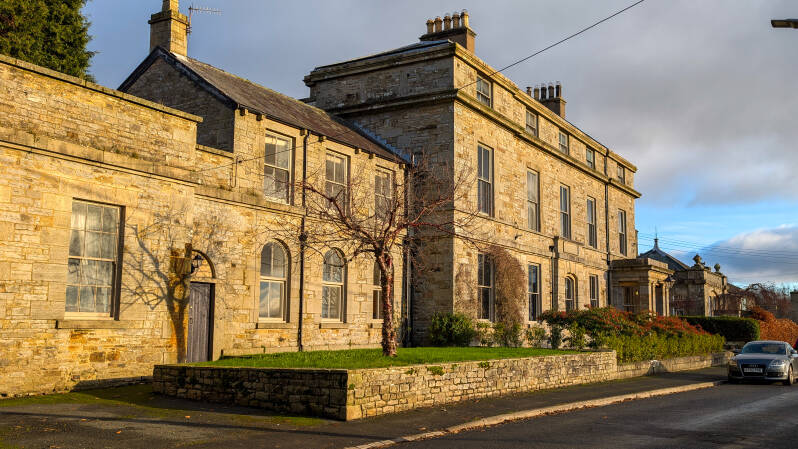
Middleton House belongs to this part of the story rather than the company's first arrival. Robert Stagg was already being described as “of Middleton House” in 1822, while Historic England dates the principal building we see today to 1823 and attributes it to architect Ignatius Bonomi. It was built as the company's agent's house and office and became the grandest surviving reminder of the management sitting above the mines.
From then on, the company and Middleton became increasingly difficult to separate.
It became much more than the company that owned the mines
The London Lead Company needed miners, but a business on this scale needed far more people than those working underground.
There were agents and clerks, joiners and blacksmiths, ore dressers and smelters, road workers and men maintaining buildings and machinery. The surviving Durham archive even includes a photograph of the workmen at the company's Hude Top Workshops around 1900, a reminder that a whole industrial world existed around the mines themselves.
The company also became heavily involved in the lives of its workforce. It provided housing, supported education and medical care and became associated with reading rooms and welfare arrangements. The Lead Company's Teesdale Workmen's Corn Society, established in the 1840s, also became part of the story that eventually fed into Middleton's co-operative movement.
In 1823, Ignatius Bonomi also designed the great arch at Masterman Place, marking the entrance to a new company housing development for valued workers. It is still standing today, quietly carrying the company story right into the middle of modern Middleton.
It would be easy to turn all of that into a cosy story about a generous Victorian employer, but the lives behind it were harder than that. Mining remained dangerous, physically demanding work, and when the price of lead or the fortunes of a particular mine changed, it was the families whose wages depended on the company who felt it first.
That became painfully clear towards the end of the nineteenth century.
The good lead was becoming harder to make pay
The London Lead Company did not suddenly run out of lead.
Its problem was that the economics were changing.
By the 1870s, low lead prices were hurting the North Pennine industry. At the same time, accessible mineral veins were becoming harder and more expensive to work and foreign lead was creating stronger competition. A company could still know there was ore underground and yet reach the point where the cost of finding and extracting it was greater than the money it could expect to make.
The London Lead Company began to shrink.
In 1882, it disposed of its great Nenthead interests. Around the same period its Weardale leases were surrendered and property at Stanhope was sold. When those changes were complete, Teesdale was its sole remaining holding in the Northern Pennines.
That makes the final years in Middleton much more significant. Teesdale was not simply another little branch left hanging around after the rest of the company had moved on. It had become the last major piece of the old North Pennine business.
The miners knew things were going wrong
The trouble was already reaching ordinary families by 1882.
That year London Lead Company workmen petitioned the Duke of Cleveland, asking him to intervene during what they described as a period of severe depression and to help prevent further reductions in the amount of work available. Miners and other local people whose livelihoods depended on the industry also pushed for lower mineral royalties in the hope that cheaper terms might help keep mines working.
That is the point where falling lead prices stop being figures on a company account.
Less profitable lead could mean fewer shifts for a miner in Teesdale. Fewer shifts meant less money arriving at home. A mine being put on standby affected not just the men underground but the shops, trades and families around them.
The decline then becomes visible in the employment figures. Little Eggleshope employed 91 people in 1896. By 1900 that had fallen to 23, and in 1902 there were just 25.
Across the company's Teesdale workings, more and more mine names began appearing with one simple word beside them:
Standing.
They existed, but they were no longer producing.
There wasn't one dramatic final day
The London Lead Company agreed to dissolve in July 1902, but Teesdale did not wake up the next morning to find every mine abandoned and every worker gone.
The end happened piece by piece.
The official 1902 mine list shows Lady Rake and Little Eggleshope ceasing to be worked by the London Lead Company on 30 September 1902, with the mining interests passing back into the hands of the lessor, Lord Barnard. Other company mines including Hudeshope Head, Knotts Level and Lodge Syke were already standing.
The government's mine inspector recognised how serious this was for the district. The company had employed large numbers of local men, and its withdrawal was described as a major loss to Teesdale and Weardale. There was hope that some mines might be restarted by other operators, but even then the outlook was poor.
Some workings did survive under different owners and a little mining carried on afterwards, but the great London Lead Company system was coming apart.
What happened to the men who worked for them?
There was no neat answer for the workforce.
Some mines were taken on by other operators, which meant a number of men could continue mining. Elsewhere the jobs simply became fewer. Around Eggleston, the end of the lead industry saw men leave the area and some move into work in the coalfield.
The company also left behind a complicated welfare problem. For years workers had paid into the Lead Company's Workmen's Fund, which provided support connected with sickness and other needs. Once the company was disappearing, the future of that fund had to be sorted out too.
The issue eventually reached the High Court in 1904. A formal scheme was then drawn up for dividing the remaining funds among members, with a final balance sheet surviving from 1905.
That is a detail I really like because it shows what closing a company like this actually meant. You could not simply stop mining and lock an office door. Generations of work had created workers' funds, welfare arrangements, leases, houses, roads, workshops and property that all had to be dealt with afterwards.
Middleton House shows what the ending looked like
The closing years become particularly easy to picture at Middleton House.
The company had already tried to sell the property for £12,000 in 1884, but it remained in company ownership. In 1903, with the Teesdale business being dismantled, Middleton House was advertised for sale as a freehold estate.
Lord Barnard bought it from the London Lead Company that July. It did not simply “revert” to Raby because a mining lease had come to an end. The Lead Company owned Middleton House and sold it.
Then came the clear-out.
At the end of July 1903 the remaining contents were auctioned over two days. Furniture, china, pictures and books went under the hammer, but so did the remains of the working side of the headquarters: office effects, joiners' shop fittings, timber, harness, carts, wagons and chains.
After generations of people coming to Middleton House to run a mining empire spread across Upper Teesdale, the desks, tools and carts were being sold off.
Even the roads had to be untangled from the company. In 1903, the London Lead Company reached an agreement with Barnard Castle Rural District Council for its roads in Middleton and Eggleston to become public roads maintained by the council.
The company was disappearing, but the village still needed to use what it had left behind.
By 1905, the London Lead Company had gone from Teesdale
The withdrawal that had begun in earnest in 1902 was effectively complete by 1905.
A company which had first arrived around Newbiggin in 1753 had spent roughly a century and a half in the dale. During that time generations of Teesdale families had worked in its mines, workshops and smelt mills. Children had gone to schools tied to its presence, families had lived in houses built around its workforce and Middleton had grown into the centre of a business whose roots stretched back to seventeenth-century London and Bristol.
That is why the end must have felt much bigger locally than the closure of an ordinary employer.
The London Lead Company had become part of how Middleton worked.
Then Middleton had to learn to carry on without it.
You can still find the London Lead Company all around Teesdale
The company itself has gone, but once you know what you are looking for, its story is remarkably easy to find.
Middleton House still stands above Hude. Masterman Place still has Bonomi's great 1823 arch. The old Lead Company school survives in the village. Walk into Hudeshope and the remains at Coldberry take you back into the working landscape of the mines. Down towards Eggleston, the Blackton smelting landscape shows what happened after the ore left the hills.
None of those places tells the whole story on its own.
Put them together and they explain why a company created in 1692 around an experimental way of smelting lead eventually became one of the biggest influences on Middleton-in-Teesdale.
It began with businessmen, investors and a furnace near Bristol. The first attempt failed, but another group took the company in a new direction and built a serious mining business. They followed lead-bearing ground around Britain, arrived at Newbiggin in 1753, leased the minerals beneath land they did not necessarily own and gradually built a network of Teesdale mines and smelting works.
Then Middleton became their headquarters, and the company grew into something that reached far beyond the mine entrance. It touched housing, schools, workshops, roads, welfare and the everyday lives of the families whose wages depended upon it.
When British lead mining stopped making enough money, that world slowly came apart. Mines were put on standby, jobs disappeared, leases were surrendered, buildings were sold and the contents of Middleton House went under the auctioneer's hammer.
So when the name London Lead Company appears on one of our other Teesdale pages, that is the bigger story behind it.
They came here for the lead beneath the hills.
They ended up helping shape the village above them.
Explore more of the London Lead Company's Teesdale
Middleton House
Discover the former headquarters of the London Lead Company, from the days of its superintendents to royal visitors and the building's later history.
The London Lead Company School
Explore the school built in 1861 for Middleton's children and the many different uses the building has had since.
The Lead Company's Baths and Wash Houses
Find out how the company provided bathing and washing facilities for miners and their families in Middleton.
Coldberry Lead Mine
Explore the history of one of Teesdale's major lead mines, from its early workings to the buildings and mining remains still visible today.
Explore Middleton-in-Teesdale
Discover more of the village's history, walks, waterfalls and places worth exploring in Upper Teesdale.