Middleton House, Middleton-in-Teesdale
Stand on Alston Road and look across towards Hude and one building immediately feels different from the rest of Middleton-in-Teesdale. Middleton House rises above the village in a great block of sandstone, its tall central section flanked by lower wings and its grounds stretching away behind. It looks like a country house, but its story is tied much more closely to the working dale below than you might first imagine.
For around two centuries this one building has moved through almost every chapter of Middleton's modern history. It was the home and office of the London Lead Company superintendent, a place where decisions affecting miners and their families were made, later passed into Lord Barnard's hands, became a hotel used for weddings and village dinners, and eventually returned to life as a private shooting house where princes, politicians and international guests came to stay.
There are grand rooms, strange stories, an attempted shooting through a window, an oval bedroom that became known as the Prince's Room, a Labrador that kept wandering into royal photographs and even an unfortunate shooting accident involving Willie Whitelaw. Middleton House could easily be written up as a dry list of owners and dates. The real story is much better than that.
Quick facts
Location: Hude, Middleton-in-Teesdale, County Durham
Built for: the London Lead Company as its agent or superintendent's residence and office
Date: the headquarters is associated with 1815, Robert Stagg is documented at Middleton House in 1822, while Historic England dates the surviving building to 1823
Architect: Ignatius Bonomi, according to Historic England
Listed status: Grade II
Important names: Robert Stagg, Robert Walton Bainbridge, Lord Barnard and Sir Joseph Nickerson
Later uses: shooting residence, hotel and private sporting house before conversion into three homes in the 1990s
Best public view: from Alston Road, looking across towards Hude
Please remember: Middleton House is private property

A house built to run the Lead Company's Teesdale world
To understand Middleton House, you really have to understand how important the London Lead Company once was here. The company had been working in Teesdale since the eighteenth century, with mines spread across the upper dale, but by the nineteenth century Middleton had become the centre of a much bigger operation. This wasn't simply a mining company taking ore out of the hills. It employed miners, quarrymen, joiners, blacksmiths, clerks and managers, provided housing, supported education and medical care, and became woven into everyday village life.
Middleton House sat near the top of that system. It was the superintendent's residence, but it was also the centre of a much wider working complex connected with the company's operations across Upper Teesdale. Historic England describes Middleton House as the principal London Lead Company building in the area, and when you stand back and look at it that makes sense. This was much more than a grand home above the village. Decisions made here could reach mines, workshops and families spread across the dale.
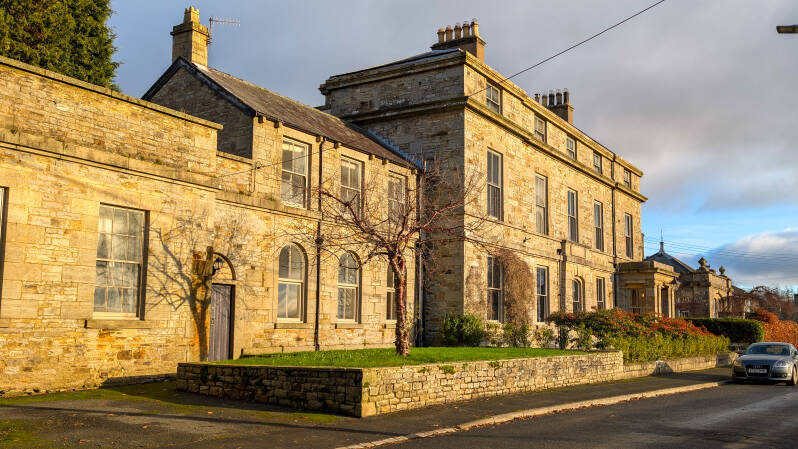
What would Middleton House have been like in the Lead Company years?
This is the part of the story I find easiest to picture. Middleton House may have looked grand from the outside, but during the Lead Company years it cannot have felt like an ordinary country house. The superintendent lived here with his household, while company business carried on around him. Clerks dealt with correspondence and accounts, people arrived to see management, and the buildings behind the house were busy with the practical side of keeping a large industrial concern running.
The contrast must have been enormous. Men were coming in from mines and workshops across Upper Teesdale, while inside the main house there was a much more formal world of offices, meetings, domestic staff and the superintendent's family life. Horses, carts, timber and tools belonged to the working side of the site, while gardens, reception rooms and household servants belonged to another. Both existed together at Middleton House.
For a miner or other Lead Company employee, this was also where authority lived. A problem at work, a complaint, a dispute or even something concerning personal behaviour could eventually reach the people based here. The company was known for providing things that mattered to its workforce, including housing, schools and welfare, but that support came with expectations. Middleton House sat right at the centre of that relationship between the company and the people whose lives depended on it.
We cannot point to a surviving room today and confidently say that Robert Stagg sat behind that particular desk or that Robert Walton Bainbridge held meetings behind that exact door. The house has changed too much over nearly two centuries for that. What survives is the bigger picture: Middleton House was simultaneously a home, an office and the headquarters of a working industrial estate, with the grand rooms at the front and the practical business of the Lead Company continuing around it.
So when was Middleton House actually built?
This is one part of the story where forcing everything into a single neat date would actually make the history less accurate. Durham Record Office places the establishment of the London Lead Company's headquarters at Middleton House in 1815, while Historic England dates the surviving house to 1823 and attributes its design to Durham architect Ignatius Bonomi. Sitting right between those two dates is another important piece of evidence: a bond dated 30 October 1822 already describes superintendent Robert Stagg as being “of Middleton House”.
That means Middleton House existed as a named place before the Historic England date of 1823. The company may have established its headquarters here in 1815 before the present main building was completed, Bonomi may have enlarged or remodelled an earlier house, or construction may simply have happened in stages. At the moment there isn't enough evidence to choose confidently between those possibilities, so we are not going to pretend there is.
The safest way to understand it is that the London Lead Company established its Middleton headquarters during this period, Middleton House is definitely documented by 1822, and Historic England dates the principal surviving building to 1823. Sometimes local history genuinely does leave us with a question rather than a tidy answer, and this is one of those times.
Robert Stagg and the strict world of the Lead Company
Robert Stagg is one of the first people who really brings Middleton House to life. As superintendent, his office was concerned with far more than ore, machinery and company accounts. The London Lead Company had a reputation for looking after parts of its workforce's welfare, but that paternal approach could also reach deeply into people's private lives. Problems between workers, complaints and questions of behaviour could all end up in front of company management, which meant Middleton House became somewhere a miner might encounter the authority of his employer without ever setting foot in a mine.
One extraordinary story from Stagg's time survived in the memories of an old Lead Company worker and was written down in 1898. Someone apparently fired a gun through a window of Middleton House, shattering the glass and sending shot into the opposite wall. Footprints were found outside and George Liddle, the company's head joiner, was reportedly sent to compare them with the boots of workmen in an attempt to work out who had been responsible.
Nobody seems to have known whether the intention had really been to kill Stagg or simply to frighten him, and that uncertainty matters because the story survives through a later recollection rather than a known police report. Even so, it gives us a remarkable glimpse of the tensions that could sit beneath the orderly world the Lead Company tried to create.
Robert Walton Bainbridge and Middleton House at the centre of village life
A later superintendent, Robert Walton Bainbridge, became strongly associated with Middleton House from the middle of the nineteenth century. By then the house was not simply the superintendent's residence hidden behind its walls. Its park and grounds were also becoming part of Middleton life, with an inspection of the 12th Durham Corps taking place in 1862 in what was described as the “park behind Middleton House”.
References to that park continue for decades, which tells us it was an important part of the setting rather than just spare ground behind a large building. Local events were held there, and the house and its grounds sat somewhere between private residence, company headquarters and a place that occasionally opened itself to village life.
Bainbridge's position placed him at the centre of local affairs, but the people who made Middleton House work were not all sitting in grand rooms. George Pinkney, a lifelong Middleton resident who died aged 81 in 1904, had once been head gardener here. He was also a Baptist and local preacher, and his obituary connected his years working amongst the gardens with his love of nature. It is a small detail, but one I really like because it reminds us that gardeners, servants, coachmen, joiners and countless other working people were part of Middleton House too.
The £12,000 sale that didn't happen
A major change came in 1884 when Robert Walton Bainbridge retired and was required to give up Middleton House at Midsummer. On 10 April 1884, the London Lead Company decided to try to sell the property for £12,000, a huge sum at the time. The sale failed, but the attempt still marks an important turning point because Middleton House was beginning to lose its old role as the superintendent's permanent home.
The company continued to own it, but the link between the house and whoever happened to be managing the Teesdale operation became much weaker. By 1891 Middleton House could be let temporarily to Frank Bowes Lyon, while by 1898 the current superintendent, Mr Hunt, was living at The Grove instead. The great house that had once sat at the heart of Lead Company management was already drifting towards a completely different future.
1903 — the Lead Company finally leaves
The summer of 1903 gives us one of the clearest chapters in the entire Middleton House story. With the London Lead Company's Teesdale interests being disposed of, Middleton House was advertised as a valuable freehold residential estate, including the mansion, parkland, gardens, extensive stabling, clock tower and houses associated with estate staff such as the coachman, gardener and gamekeeper.
The auction was arranged for Monday 6 July 1903 at 2.30pm at the King's Head Hotel in Darlington, with Richard O. Pearce handling the sale. Within weeks the ownership had changed. By 22 July, Middleton House had been purchased from the London Lead Company by Lord Barnard.
That clears up something that has become muddled in later retellings. Middleton House is sometimes described as simply having “reverted” to the Raby Estate when the Lead Company left, but the evidence from 1903 shows a proper sale. The company owned the freehold, put Middleton House on the market and Lord Barnard bought it.
Then came the final clear-out. On 30 and 31 July 1903, the remaining contents of Middleton House were auctioned. Furniture, china, glass, pictures, books and bedroom furniture went under the hammer alongside the contents of the office, general office effects, fittings from the joiners' shop, timber, carts, harness, wagons and chains. After generations of Lead Company management, two days of sales helped empty Middleton House of the working world it had been built to serve.
From company headquarters to shooting house
Lord Barnard did not leave Middleton House sitting idle for long. By 1904, T. M. Clutterbuck's shooting party was staying here while shooting over the High Force moors, which shows that the house had already found a new purpose almost immediately after the Raby purchase.
The grounds still remained connected with village life. Events such as the Middleton Floral, Horticultural and Industrial Society show were held in the park attached to Middleton House, while shooting parties came and went from the house itself. The old Lead Company headquarters had become something very different, but it had not entirely turned its back on Middleton.
Exactly when Raby eventually sold Middleton House has proved harder to pin down. What we can see clearly is that by the late 1940s another chapter was already well established.
Middleton House Hotel
By October 1948, Middleton House was definitely trading as the Middleton House Hotel, and from then on it turns up again and again in the everyday life of the dale. Wedding receptions were held here, local organisations booked dinners and meetings, agricultural groups gathered around its tables, and parties and social events brought ordinary Teesdale families into rooms that had once belonged to the superintendent of one of the most powerful mining companies in the North Pennines.
The hotel continued through the 1950s and well into the 1960s. By 1961, Andrew Davy Hope was living at Middleton House. He was described locally as a retired butcher and was involved enough in village life to stand for election to Middleton-in-Teesdale's local council. Andrew and his wife became familiar faces behind Middleton House Hotel, and in 1962 the hotel grounds were opened for a garden fete.
A useful little handover came in April 1966, when Leonard Sawyer, formerly of Market Rasen, became the incoming licensee in succession to Mr and Mrs Andrew Davy Hope. That does not necessarily tell us who owned the freehold, because the hotel licensee and the property owner need not have been the same person, but it gives us a firm change inside the hotel itself and helps us follow the later story.
Joseph Nickerson and the return of the shooting parties
The hotel years eventually gave way to perhaps the most colourful period in Middleton House's history. During the 1960s the property became associated with Joseph Nickerson, the Lincolnshire businessman, farmer and renowned game shot who would later become Sir Joseph Nickerson.
A later account of the purchase gives the story a wonderfully simple beginning. Nickerson had apparently been a regular shooting-season guest at Middleton House and, after discovering one year that the room he normally used had already been let, sent his secretary to buy the property. We have not yet found the original sale paperwork to pin the exact transaction down, but by the early 1970s Middleton House was firmly established as Nickerson's Teesdale shooting base.
That change brought a completely different set of visitors to Hude. Friends, politicians, landowners and members of royal families began passing through Middleton House, while shooting parties headed out onto the surrounding moors.
Prince Charles comes to Middleton House
In September 1973, the future King Charles III was staying at Middleton House as a guest of Joseph Nickerson while shooting in Teesdale. This is not one of those village stories that has grown bigger with every retelling; Charles was photographed and reported here during the visit, heading out onto Wemmergill Moor with Nickerson's shooting party before returning to Middleton House.
Five years later, in September 1978, he was back. Photographs from that visit show Prince Charles outside Middleton House with staff and members of the party, while security around him included his personal detective and local police.
Those photographs also introduced one of the less distinguished but much more likeable characters in the Middleton House story: Harvey the Labrador. Harvey apparently had very little interest in royal protocol and repeatedly worked his way into the photographs, standing amongst the Middleton House group as though the entire visit had been organised for him. For all the grandeur surrounding the place, I think that is one of the nicest little details we found.
The Prince's Room
The royal connection survived inside Middleton House itself. On the first floor is an extraordinary oval room entered through a curved doorway, with a high ceiling and views out towards the private garden. By the time detailed architects' drawings were prepared in the 1990s, that room was actually labelled “The Princes Room”.
A later description of the house connected the name directly with Prince Charles and described the oval bedroom as part of what had become an informal royal suite. The shape is even more striking when you look at the old floor plans because another large curved room sits opposite, while the rest of the main house spreads around them with reception rooms, bedrooms, cellars, kitchens, service areas and passages.
There has long been a story that Charles also visited Middleton House with a young Diana Spencer during their courting days. We have not found enough evidence to move that from local story into the confirmed timeline, so for now it stays exactly where it belongs: as part of the folklore around Middleton House rather than something we are presenting as fact.
The Middleton photographer who photographed royalty
One of my favourite stories from Middleton House belongs not to a prince or millionaire but to John Winter, a Middleton shoe repairer who was also a keen photographer. Joseph Nickerson regularly called on him when important shooting parties were staying at the house.
Winter would arrive in the morning and photograph the group before they went out. He would then return home, develop the film and make the prints during the day, before taking the finished photographs back to Middleton House that same evening. No digital camera, no phone and no sending a file across the internet; a local Middleton photographer took the picture, developed it and had the finished prints back at the big house by nightfall.
Years later he remembered photographing groups that included the Queen Mother, Prince Charles, Prince Edward, Prince Bernhard of the Netherlands, Lord King, Willie Whitelaw and cabinet ministers. He also remembered a young Camilla Parker-Bowles appearing in one of the groups while staying at Middleton House with her husband. For a building that began life as an industrial company's headquarters, it had travelled a very long way.
The day Willie Whitelaw shot the host
Some Middleton House stories sound as though they were invented in a pub, and this is probably the best example. In 1984, Willie Whitelaw was part of one of Joseph Nickerson's shooting parties when he slipped while carrying his gun. It accidentally discharged and Nickerson was struck by shot.
Nickerson survived the mishap, but the story understandably became part of the folklore of the shooting years. It is difficult to imagine a more unlikely scene: one of Britain's most senior politicians standing on a Teesdale grouse moor having just accidentally shot his host. Middleton House somehow collected stories like that.
The end of the Nickerson years
Joseph Nickerson remained strongly connected with Middleton House through the 1970s and 1980s. His own records continued to use Middleton House as his Teesdale address, while each shooting season brought another stream of friends, politicians, landowners and royal visitors into the dale. Sir Joseph died in 1990, bringing one of the most colourful chapters in the house's history to a close.
Middleton House later passed to Brent Stephenson, who had ambitious plans for the property. Those plans did not work out and Stephenson eventually moved out after running into financial difficulties. By 1997, the huge house had been standing empty for just over two years.
For people in Middleton looking up towards Hude, it must have been a strange sight. A building that had housed Lead Company superintendents, hotel guests and royal shooting parties was standing unused, and there were even suggestions that it might become a heritage centre. The money needed for something on that scale was unlikely to appear, though, and the greater worry was what would happen if such an important building remained empty for much longer.
Then a buyer was found.
Saving Middleton House in 1997
A family from elsewhere in the country bought Middleton House in 1997, ending more than two years of uncertainty around the property. The asking price had been close to £220,000, but buying the house was only the beginning because a building of this size and age needed serious work.
The two wings were restored and attention turned to the central house, where one of the largest immediate costs was the main double-pitched roof. Repairs were estimated at £11,895, with English Heritage, Teesdale Council and Durham County Council expected to contribute a combined £4,000 towards the work.
The biggest change was the way the house itself was arranged. On 24 January 1997, applications were submitted for the conversion of the vacant house into three houses, including a matching application for listed-building consent. Approval followed on 19 March 1997, and at first glance that description makes it sound as though the great mansion was simply chopped into three equal pieces.
The architects' drawings show that wasn't what happened.
Middleton House, East Middleton House and West Middleton House
The planning drawings make the arrangement wonderfully clear. The great three-storey central block remained Middleton House, while the lower accommodation on either side became West Middleton House and East Middleton House. Each could function independently, but the central residence kept the principal reception spaces and much of the scale and character of the old house.
That is why the building still reads as one enormous historic property when you look across from Alston Road or along Hude. Architecturally it remains one composition, but internally the old house was given three separate lives.
The plans themselves are fascinating because they show so much of the building's layout: the large reception hall, drawing and dining rooms, kitchen and service areas, cellars, bedrooms and the unusual curved first-floor rooms. Written directly onto one of those plans is the name “The Princes Room”, linking the physical building back to the royal chapter we can trace through the old newspapers.
The old Lead Company buildings behind the house
The courtyard buildings behind Middleton House tell a different story and should not be confused with the East and West Wings. A three-sided stone range survived from the old Lead Company complex, remembered as workshops and stables and forming part of the working world behind the superintendent's residence.
Plans to adapt some of those buildings for housing were already being considered in 1991, with later schemes proposing cottages and flats. Over the following years more of the courtyard buildings were converted for residential use.
That makes the site much more interesting than simply one big mansion. Middleton House was the grand centrepiece, but behind it stood the practical buildings that had helped the Lead Company operate. Parts of both worlds survived into the modern village.
What Middleton House tells us about Middleton-in-Teesdale
I think this is what makes Middleton House worth understanding. The building itself is impressive, but the real importance is everything that happened around it.
Robert Stagg could sit inside dealing with the business and behaviour of Lead Company workers while mines such as Coldberry stretched across the upper dale.. Robert Walton Bainbridge could step outside into a park used for village gatherings. George Pinkney spent years tending the gardens. In 1903 the office furniture and workshop equipment were carried away as the Lead Company finally cleared out. Local couples later held wedding receptions here when it became a hotel, Andrew and Mrs Hope opened the grounds for community events, John Winter arrived with his camera to photograph princes and politicians, and Harvey the Labrador wandered into the royal photographs anyway.
That is two centuries of Middleton life passing through one place. The building has changed, the mines have closed and the people who knew Middleton House in each of those different lives have gone, but the house itself is still standing above the village.
Where to see Middleton House
Middleton House is private property, so this is not somewhere to walk into for a closer look, but fortunately you don't need to enter the grounds to appreciate it.
One of the best views is from Alston Road, looking across the open ground towards Hude. From there you can properly take in the scale of the tall central section and the lower wings rather than seeing only a small part of the frontage. You can also see the house from the public road along Hude itself, and once you know how the 1997 conversion worked the layout becomes much easier to read.
The next time you look across from Alston Road, it is worth remembering what you are actually looking at. This isn't simply the big old house above Middleton. It is the former headquarters of the company that helped shape the village, a building that survived the end of the Lead Company, became a hotel, welcomed royalty, stood empty and uncertain for a time, and then found another life.
Explore more of Middleton-in-Teesdale
Who Were the London Lead Company?
Discover the company that transformed Middleton and shaped the lives of generations of miners and their families.
The Old School, Middleton-in-Teesdale
Explore the school built by the London Lead Company and discover how education became part of life in the village.
The Lead Company's Baths and Wash Houses
Find out how miners and their families could bathe and wash their clothes in facilities provided near Middleton House.
Explore Middleton-in-Teesdale
Discover more of the village's history, local walks, waterfalls and places worth visiting in Upper Teesdale.