County Bridge, Barnard Castle
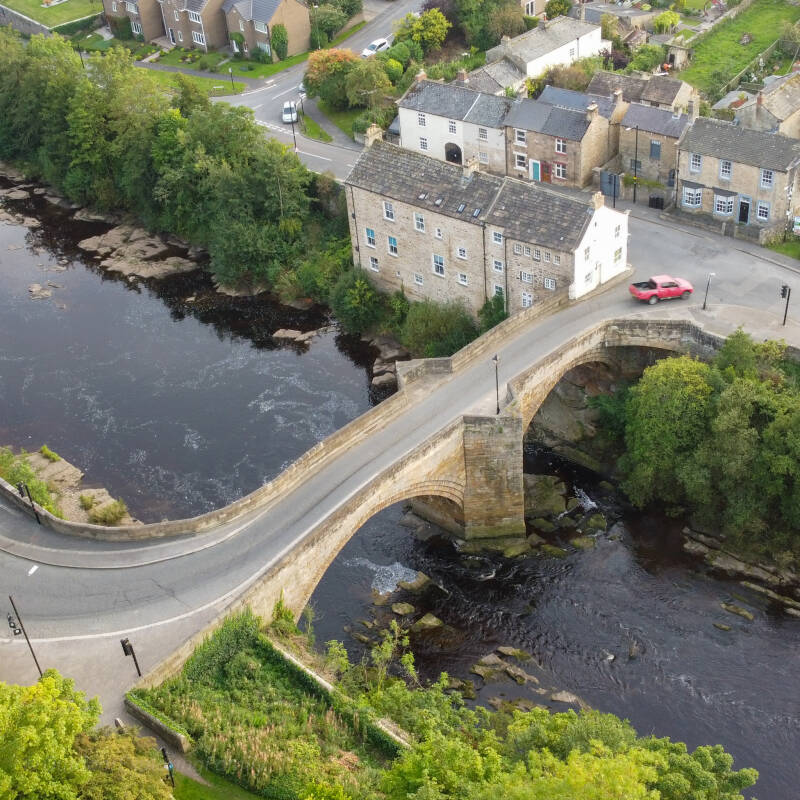
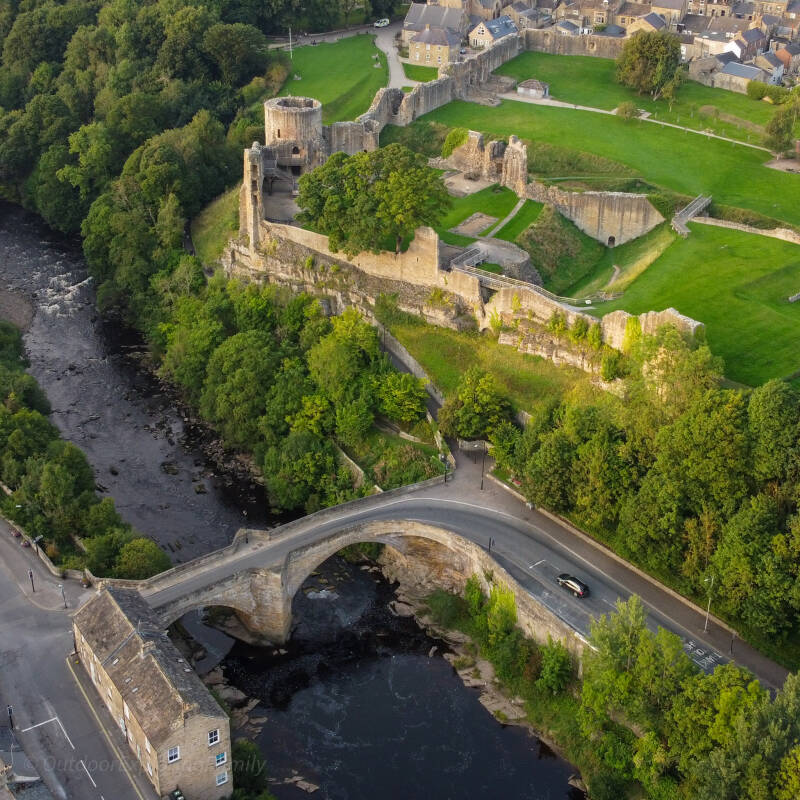
County Bridge is one of the oldest and most recognisable landmarks in Barnard Castle. Spanning the River Tees between Barnard Castle and Startforth, it has linked County Durham and Yorkshire for centuries, carrying travellers, merchants and local people across one of northern England's great rivers.
More than simply a crossing, the bridge marks an ancient county boundary. For generations, those crossing its arches passed not only from one side of the River Tees to the other, but from County Durham into the North Riding of Yorkshire. Its position beneath Barnard Castle made it a strategically important route, shaping trade, industry and daily life on both sides of the river.
Over the centuries, County Bridge has witnessed sieges, floods, changing industries and the rise of motor traffic. Artists including J. M. W. Turner captured its distinctive form, while local traditions tell of a small house that once stood upon the bridge itself.
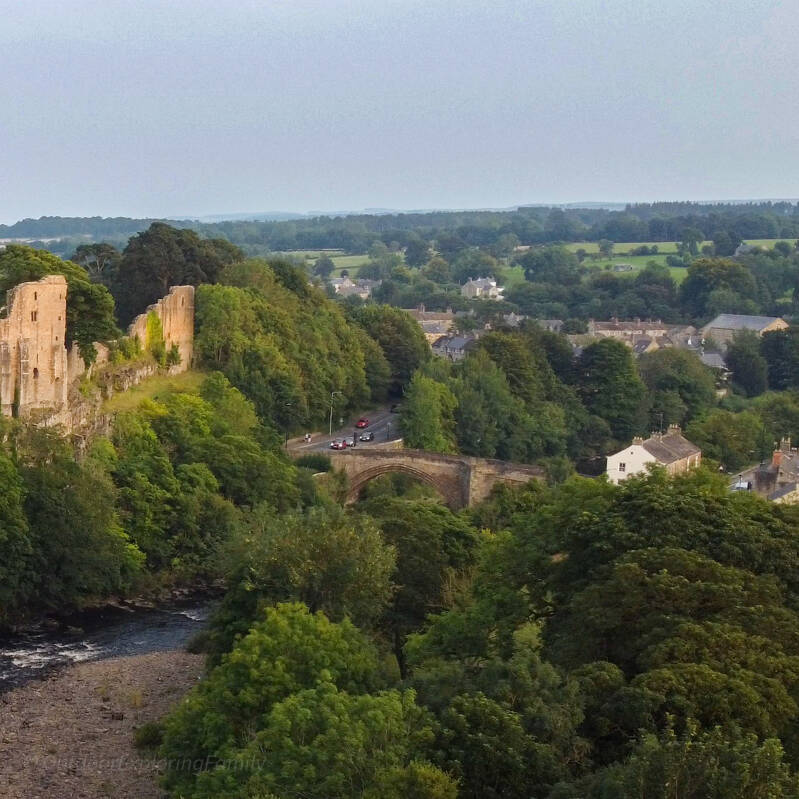
Today, County Bridge remains one of the defining views of Teesdale. With Barnard Castle rising above the river and the Tees flowing beneath its arches, it continues to connect communities just as it has for hundreds of years.
Quick Facts
Location: Barnard Castle and Startforth, across the River Tees
Historic counties: County Durham and the North Riding of Yorkshire
Listed status: Grade I listed
Bridge origins: Medieval, probably dating in part from the 14th century, with repairs recorded in 1596
Notable features: Historic county boundary, two main arches, pedestrian refuges, traffic lights and castle views
River crossed: River Tees
Notable features: Historic county boundary, blind arch, traffic lights and castle views
Artists: J. M. W. Turner sketched the bridge on several occasions
Historic connections: Cuthbert Hilton, the White Swan, Bridge End Mills and the Great Flood of 1771

The History of County Bridge
County Bridge has linked Barnard Castle and Startforth for centuries, providing one of the most important crossings of the River Tees in Teesdale. Until 1974, the river here formed the boundary between County Durham and the North Riding of Yorkshire, a history still recorded in the stonework of the bridge.
The exact age of County Bridge is difficult to pin down because it has been repaired and altered many times. Historic England describes the Barnard Castle part of the bridge as probably dating from the 14th century, making its origins considerably older than the date most often associated with it.
When the antiquary John Leland visited Barnard Castle in the sixteenth century, he recorded a bridge of three arches below the castle, confirming that a substantial crossing already existed here before the end of the Tudor period.
Barnard Castle was besieged during the Rising of the North in 1569, when Sir George Bowes defended the castle for Elizabeth I. Later work was carried out on County Bridge, and a stone marked “1596 ER” records repairs during Elizabeth’s reign. Historic England notes that this stone is now reset in the adjoining wall on the Barnard Castle approach rather than forming part of the bridge itself.
The bridge was repaired again after the Great Flood of 1771, when work was carried out on its parapets. What survives today is therefore not the product of a single building campaign but a bridge that has developed through centuries of repair and alteration.
County Bridge has two main pointed arches, with pedestrian refuges above the central cutwater. Historic England also records the old county boundary marker, including the letters Y N R for Yorkshire North Riding.
On the Barnard Castle side, the retaining wall below Bridgegate contains a large pointed relieving arch. Historic England suggests that this may be associated with the castle above, so it should not be mistaken for a third main span of County Bridge.
For hundreds of years the bridge has carried travellers, merchants and local people across the River Tees. Beneath the walls of Barnard Castle, it remains one of the town’s most historic and recognisable landmarks.

County Bridge in Early Travel Writing
County Bridge was already an established landmark by the beginning of the nineteenth century. One of the earliest published descriptions appears in A Tour in Teesdale (1804), an early guide to the valley printed in York by A. Bartholoman.
The book describes Barnard Castle as one of the most picturesque scenes in Teesdale, noting the castle's ivy-covered walls and windows looking "towards the bridge." This confirms that County Bridge was already an important feature of the landscape more than two centuries ago.
The view admired by visitors in 1804 remains remarkably familiar today. Standing beside the River Tees, with Barnard Castle rising above the water and County Bridge spanning the valley below, it is easy to see why early travellers considered the scene so memorable.
The original 1804 edition of A Tour in Teesdale is now in the public domain and can be read free online through Google Books and other digital archives, allowing modern readers to explore one of the earliest printed guides to Teesdale for themselves.
Read the original 1804 edition of A Tour in Teesdale on Google Books.
J. M. W. Turner and County Bridge
Few views in Teesdale have inspired artists as much as County Bridge and Barnard Castle. Among those captivated by the scene was the renowned landscape painter J. M. W. Turner.
Turner is known to have visited Barnard Castle on several occasions, including in 1797, 1816 and 1831. During these visits he produced sketches of the castle and bridge above the River Tees, capturing one of the most celebrated landscapes in northern England.
Several of these works survive in the Tate collection, including views titled Barnard Castle above the County Bridge on the River Tees and Barnard Castle and Bridge on the River Tees, from the North West.
Turner’s drawings also preserve historic views of County Bridge and its approaches, giving us another record of how this familiar Barnard Castle scene looked more than two centuries ago.
More than two centuries later, visitors still stand in much the same spot to admire the view that inspired Turner.
View Turner's 1831 sketch of Barnard Castle in the Tate collection.
The Swan Inn and Bridge End
Standing beside County Bridge is the former White Swan, a building that has watched over travellers crossing the River Tees for centuries. Today it has been converted into homes, but for much of its history it was known simply as The Swan Inn.
Historic maps show the inn occupying one of the most important locations in Startforth, at the entrance to the bridge connecting Yorkshire with County Durham. Anyone crossing the River Tees would have passed its door.
By 1872, the Swan Inn was already an established part of community life. Following a rifle competition between volunteers from Barnard Castle and Middleton-in-Teesdale, more than forty guests gathered at the inn for dinner, speeches and songs. The evening concluded in what contemporary accounts described as "great harmony".
The inn also played an important civic role. In 1875, a coroner's inquest into the death of Christopher Dent of the Teesdale Union Workhouse was held at the Swan. During the nineteenth century, inns frequently served as meeting places for public business before dedicated civic buildings became common.
Historic records identify several individuals connected with the inn, including John Nevison and landlord Mr Middlemas during the nineteenth century.
By the late twentieth century the building had become known as the White Swan, a name still remembered locally today. It later closed as a public house before being converted into residential properties.
Historic England has also noted evidence of a large round arch suggestive of a former wheel housing. Combined with the nearby Bridge End Mills and industrial buildings shown on historic maps, this raises the possibility that parts of the site may once have had an industrial use connected with the river.
Cuthbert Hilton and the House on the Bridge
One of the most unusual stories connected with County Bridge concerns Cuthbert Hilton and a small house that once stood upon the bridge itself.
Historical accounts from the nineteenth and early twentieth centuries repeatedly describe a building standing in the centre of the bridge. Although no trace survives today, historical accounts associate it with Cuthbert Hilton, the son of the Rev. Alexander Hilton.
According to these accounts, Hilton conducted irregular marriages from the house, taking advantage of the bridge's position on the boundary between County Durham and Yorkshire. Some stories describe couples exchanging vows upon the county line itself, while others mention the custom of leaping over a broomstick.
One rhyme became particularly associated with Hilton:
"My blessings on your pates,
And your groats in my purse;
You are never the better,
And I am never the worse."
Exactly how many marriages took place on the bridge is unknown. Yet for generations, the story of Cuthbert Hilton remained firmly woven into the folklore of Barnard Castle.
Traffic Lights on County Bridge
By the late 1940s, increasing traffic was placing pressure on County Bridge. The narrow stone crossing had been designed for a very different age, and local authorities began discussing ways to improve traffic flow and safety.
In 1948, proposals were made for a temporary Bailey Bridge across the River Tees. However, these plans were ultimately abandoned for economic reasons. Instead, traffic lights were selected as a more affordable solution, with contemporary reports estimating costs between £1,100 and £2,000.
The traffic lights were installed around 1949, though their introduction was not without controversy. Excavations carried out during installation affected the road surface on the Startforth side of the bridge, leading to complaints that repairs had not been completed satisfactorily.
By 1951, reports suggested that some motorists were ignoring the signals. Contemporary accounts also recorded concerns that the lights had not yet received full Ministry of Transport approval, potentially limiting enforcement.
More than two decades later, the original system was described as "rather antiquated". Councillors were told in 1973 that changes to the timing reportedly required a special key and could not easily be adjusted for busy weekends or holiday traffic.
More than seventy years after their installation, traffic lights remain an important feature of County Bridge, continuing to manage traffic across one of Teesdale's most historic crossings.
The Mystery of the 1952 Army Truck Crash
One of the most dramatic events in the modern history of County Bridge took place during the night of Thursday 25 September 1952, when an army truck crashed through the parapet of County Bridge and plunged around 30 feet into the River Tees below.
The incident quickly attracted widespread attention across Teesdale. Reports published in the Teesdale Mercury on Wednesday 1 October 1952 described how police and military authorities launched an extensive search amid fears that people may have been trapped inside the vehicle.
Contemporary newspaper reports stated that the truck had been taken from outside the dance hall at Streatlam Camp earlier that evening. Investigators believed there may have been more than one person travelling in the vehicle, though exactly what happened before the crash remains uncertain.
The lorry came to rest in a deep channel of the River Tees and was not recovered until Sunday afternoon, following a complex seven hour salvage operation. The recovery drew enormous public interest, with newspaper reports estimating that between 500 and 1,000 spectators gathered along the riverbanks and bridge to watch.
The operation relied upon the efforts of four volunteers from No. 1 Command Workshop, REME, Catterick Camp, who entered the cold waters of the Tees to locate the submerged vehicle and attach lifting slings. Newspaper reports recorded Craftsman J. Hughes calling out:
"I am standing on a tyre."
This was the first indication that the truck had been found. Another of the volunteers, Craftsman Salter of Stockton, had recently returned from service in Korea and reportedly remarked that the River Tees was colder than anything he had experienced during a Korean winter.
When the truck was finally brought ashore, investigators found it to be heavily damaged, engaged in bottom gear, and missing its identification plates. Despite extensive searches of both the vehicle and the river downstream, no bodies were ever discovered.
A driver's seat found on the bridge led investigators to believe that the driver may have escaped before the vehicle entered the river. Yet despite inquiries at military camps around Barnard Castle and Catterick, no publicly reported explanation for the crash has been found, leaving many questions unanswered.
Heavy traffic travelling through Barnard Castle towards the Blackpool Illuminations and the Lake District had to be diverted during the recovery operation, underlining the importance of County Bridge as one of the main crossings of the River Tees.
Several photographs of the recovery operation survive through images loaned to the Teesdale Mercury by local resident Mrs Maud Winley, providing a valuable record of one of the most remarkable incidents in the modern history of County Bridge.
More than seventy years later, the crash remains one of Barnard Castle's enduring mysteries, a strange episode in the long history of a bridge that has witnessed centuries of life along the River Tees.
County Bridge Today
Few places capture the history of Barnard Castle quite like County Bridge. Beneath the castle walls and above the waters of the River Tees, the bridge continues to perform the same role it has for centuries: connecting communities, carrying travellers and linking two historic counties.
Whether viewed from the riverside paths, from Flatts Wood or from the bridge itself, County Bridge remains one of the defining landmarks of Teesdale.
Explore More in Teesdale
County Bridge is part of our wider Bridges of Teesdale collection, where we explore the historic bridges, viaducts, aqueducts and river crossings that helped shape the valley.
Looking to explore more of the area? Visit our Discover Teesdale homepage to uncover waterfalls, walks, reservoirs, dark skies and local history from across the valley.
Explore our Barnard Castle Town Guide for historic landmarks, independent shops, riverside walks and quieter corners of the town.
Take a stroll through Flatts Wood, Barnard Castle, where peaceful woodland paths lead to views of County Bridge, the River Tees and centuries of local history.
Venture into Deepdale Woods to discover ancient woodland, a lost railway viaduct, a former rifle range and one of Barnard Castle’s most fascinating landscapes.
Browse our collection of Walks in and Near Barnard Castle for family-friendly routes, circular walks and places to explore throughout Teesdale.