The History of Barnard Castle
The castle in Barnard Castle has been connected with a remarkable number of people during its long life.
There was Bernard de Balliol, whose name eventually became the name of the town that grew around the fortress. There were kings, earls and soldiers who lived within its walls or fought to control them. Richard III repaired and altered the castle, while Sir George Bowes defended it during its final great siege. After the fortress had fallen into decline, Sir Henry Vane removed stone for rebuilding work at Raby Castle. Then came Frank Shield, the local man who made the Round Tower his home and guided Victorian visitors through the ruins.
Each of them left a mark on the place.
Some added new towers, halls and defences. Others damaged it, altered it or carried parts of it away. A few became so closely connected with the castle that their stories are still told today.
This page explores the history of Barnard Castle through the people who shaped it, the buildings they left behind and the events that changed it from a powerful medieval fortress into the ruins we see beside Scar Top and above the River Tees today. It also explains what visitors can still find inside the castle and how to make sense of the walls, towers and open spaces that remain.
Quick Facts
Location: Scar Top, Barnard Castle, County Durham
Postcode: DL12 8PR
What is it? A ruined medieval castle overlooking the River Tees
First established: Soon after 1093
Name comes from: Bernard de Balliol
Managed by: English Heritage
Heritage status: Grade I listed
Known for: The Balliol family, Richard III, the siege of 1569 and Frank Shield
Can you visit? Yes, during English Heritage opening times
Entry: Admission applies to explore inside the ruins

The Castle That Gave the Town Its Name
The story of Barnard Castle begins not long after 1093, when Guy de Balliol established the first stronghold on high ground above the River Tees. Guy was a knight from Picardy who had supported King William II, and the estates he received in north-eastern England placed him in a landscape where control of roads, river crossings and territory mattered greatly.
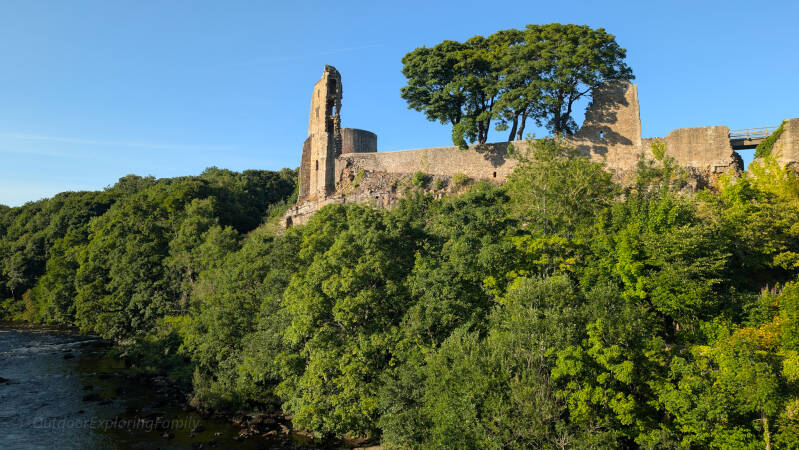
The position above the Tees was carefully chosen. The plateau overlooked an important crossing of the river and stood close to a route running across the Pennines. On the river side, the steep cliffs gave the castle strong natural protection. The approaches from the south and east were easier to reach, so these were defended with banks, ditches and timber barriers.
Guy’s first castle would have looked very different from the sandstone ruins standing today. It was probably a ringwork, with timber buildings protected by an earth bank and a wooden palisade. A stone gatehouse may already have guarded the entrance, but most of the early fortress would have been built from wood. It was practical, defensible and quickly constructed, but it was not yet the great stone castle that later generations created.
When Guy died in 1133, the estate passed to his nephew, Bernard de Balliol. Bernard enlarged the stronghold, began rebuilding it in stone and encouraged the settlement developing beside its walls. The fortress became known as Castrum Bernardi — Bernard’s Castle and over time the same name passed to the town around it.
That simple fact sits at the heart of Barnard Castle’s history. The town did not give its name to the castle. The castle gave its name to the town.
The connection is still visible in the modern streets. Horsemarket runs close to the eastern side of the old fortress, while Bridgegate drops towards the river crossing below. Houses gather beneath the walls, and the town centre begins only a few steps from Scar Top. Barnard Castle was not built beside a town which was already there. The town grew around the stronghold and became closely tied to it.
From Timber Stronghold to Great Stone Castle
Barnard Castle did not appear in its finished form. It grew over several generations as the Balliol family expanded the defended area, replaced timber structures with stone and created increasingly impressive rooms for themselves and their household.
Bernard de Balliol died sometime between 1154 and 1159 and was followed first by his son Guy, then almost immediately by his second son, Bernard II. It was during these years that much of the great stone castle began to take shape. The Town Ward and Middle Ward were enclosed, while important buildings including the North Gate, Constable Tower and Brackenbury Tower were added. The work must have placed considerable pressure on the family’s finances, because by the end of the 12th century the castle had briefly passed into the hands of the Bishop of Durham as security for debt.
The work continued after Hugh de Balliol inherited the castle in 1205. The hall in the Inner Ward was rebuilt in stone, while the Great Chamber and Round Tower created much grander private accommodation above the River Tees. These were not simply military buildings. They included fireplaces, stairs, garderobes and rooms intended for comfortable high-status living, giving the Balliol family somewhere impressive in which to live, entertain visitors and conduct business.
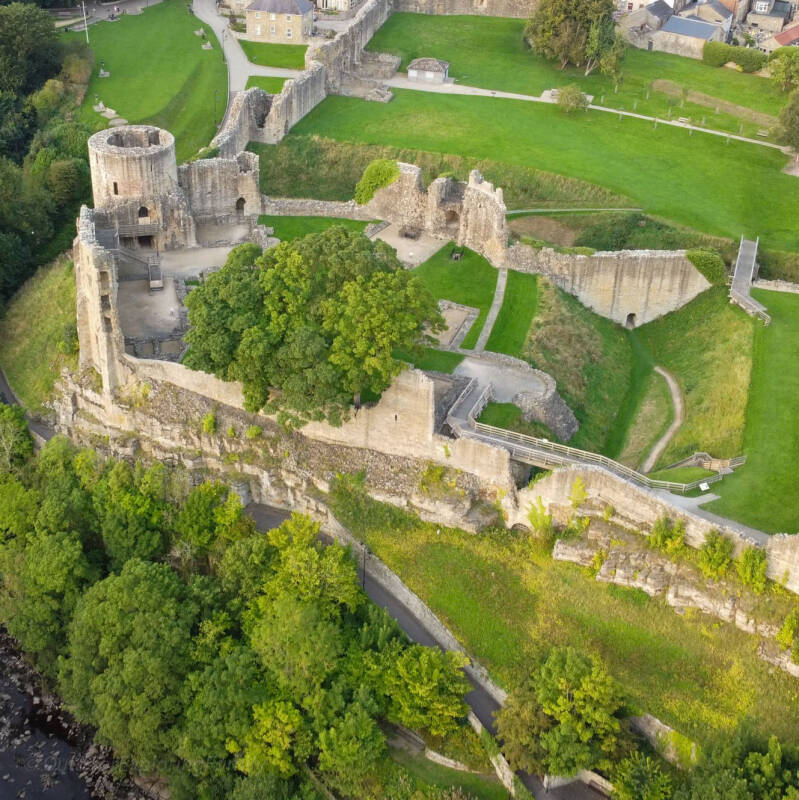
By then, Barnard Castle had become a huge complex divided into four main areas known as wards. The Outer Ward beside Scar Top contained working buildings and the Church of St Margaret. The Town Ward faced the growing settlement and held buildings around a courtyard. Beyond them, ditches, gates and bridges controlled access towards the Middle Ward and the strongly defended Inner Ward.
The Inner Ward was the private heart of the castle. It stood high above the river cliffs and contained the Great Hall, Great Chamber, Round Tower and several other important buildings. Here the lord’s household ate, entertained guests, dealt with business and occupied rooms overlooking the Tees.
What looks today like a collection of open lawns and broken walls was once crowded, roofed and busy. Cooks, servants, soldiers, stable workers and other members of the household kept the castle functioning, while visitors and supplies passed through a series of defended entrances. The surviving stone walls once supported timber floors, roofs, doors and rooms filled with people.
King John, a Deadly Siege and a King of Scotland
When King John stayed at Barnard Castle in January 1216, the buildings of the Inner Ward were new enough and grand enough to provide accommodation equal to that found in some royal castles. His arrival would have transformed the place. Soldiers guarded the entrances, officials filled the hall and servants found food, beds and stabling for the king’s travelling household. Fires burned in rooms which are now open to the weather, and the quiet wards visitors walk through today would have been filled with noise and movement.
The castle soon faced a much more dangerous visitor. Later in 1216, England was in turmoil. Many barons were in rebellion, a French army had entered the country and King Alexander II of Scotland had moved into northern England with the support of local lords. Barnard Castle was attacked during this wider struggle.
Among the men involved was Eustace de Vescy, lord of Warkworth Castle and brother-in-law of the Scottish king. During the siege, he came too close to the castle walls and was struck by a crossbow bolt fired from the garrison. He died from his wounds, depriving the northern rebels of one of their most important leaders.
The castle survived and remained in Balliol hands for much of the 13th century. Later owners included John de Balliol and his wife, Devorguilla of Galloway, whose influence reached far beyond Teesdale. Their support for scholars at Oxford helped establish the institution formally incorporated as Balliol College in 1282, a name which still connects the family with Oxford more than seven centuries later.
Their son, also called John Balliol, was chosen as King of Scots in 1292. His reign was short and difficult. Edward I of England expected his obedience, while Scottish nobles expected him to rule independently. The pressure between the two sides eventually led to conflict, and John was removed from the throne in 1296.
His fall also brought the Balliol family’s long connection with Barnard Castle towards an end. The castle first passed into the hands of Antony Bek, Bishop of Durham, before Edward I took control in 1306. The following year, the dying king granted it to Guy de Beauchamp, Earl of Warwick.
The family whose name had become attached to both castle and town was gone, but the fortress they created remained one of the most important strongholds in the region.
The Earls of Warwick and Richard III
The Beauchamp earls of Warwick held Barnard Castle for generations. By then, parts of the fortress were already old and needed bringing up to date. The Great Hall was improved, the kitchens and service rooms were altered, and a deep ditch helped strengthen the defences between the different wards.
Barnard Castle was still capable of defending itself, but it was also a family residence. Its owners wanted warmer rooms, larger windows and more comfortable spaces in which to live and entertain their guests. Medieval castles were never finished once and left unchanged. Each generation repaired, extended and adapted the buildings to suit its own needs.
One of the darkest events in the castle’s history occurred in 1315, when John le Irreys was placed in command while the Warwick heir was still a child. Le Irreys attacked nearby Bowes Castle, abducted the widowed Lady Matilda Clifford and brought her to Barnard Castle, where she was raped. Edward II sent an armed force to rescue her and removed le Irreys from command.
It is a difficult part of the castle’s story, but it should not be hidden. A castle offered security and status to the people who controlled it, while leaving others dangerously powerless. The same walls which protected one person could imprison another.
In 1446, the Warwick estates passed through Anne Beauchamp to her husband, Richard Neville. He became one of the most powerful noblemen in England and played a leading part in the Wars of the Roses. His support shifted between the Yorkist Edward IV and the Lancastrian Henry VI, earning him the later name Warwick the Kingmaker. He was killed at the Battle of Barnet in 1471.
Barnard Castle then passed through Neville’s daughter Anne to her husband, Richard, Duke of Gloucester. Richard later became King Richard III, but his connection with Barnard Castle began long before he took the throne. He owned the castle from 1471 until his death in 1485 and took an active interest in its upkeep, ordering repairs and alterations to the buildings.
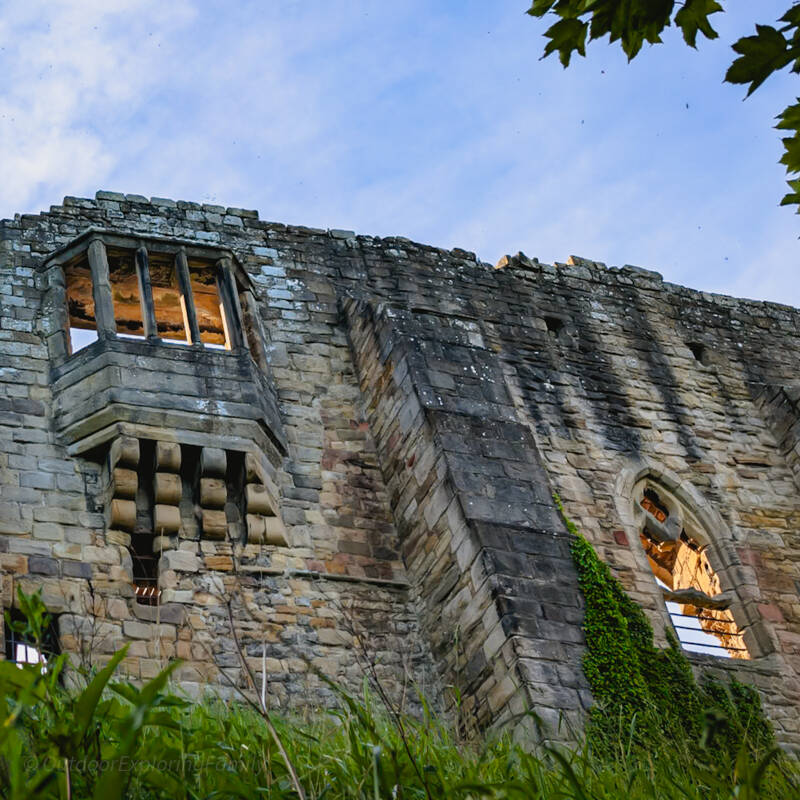
His clearest mark can still be found in the Great Chamber. High in the remains of the projecting window is a carved boar, Richard’s personal emblem. It is easy to miss unless you know where to look, but once found it creates a direct connection between the ruined room and one of England’s best-known kings.
A visitor standing there today can still look through the same opening towards the River Tees. The roof and floors have gone, but the view Richard’s household knew remains.
Brackenbury Tower also preserves the name of Sir Robert Brackenbury, one of Richard’s closest supporters and constable of the Tower of London. Richard and Brackenbury both died at the Battle of Bosworth on 22 August 1485. With Richard’s defeat, Barnard Castle passed to Henry VII and the Tudor Crown.
Sir George Bowes and the Castle’s Final Siege
Under the Tudors, Barnard Castle was no longer the much loved home of a powerful resident family. It was managed by appointed keepers, many of them members of the Bowes family of Streatlam. Without a wealthy household constantly improving the rooms and defences, the castle became harder to maintain.
In 1536, Sir Robert Bowes held the castle during the Pilgrimage of Grace, the great northern uprising against Henry VIII. He surrendered it to the rebels without a fight, became involved with their cause and later returned to royal service. His actions show how dangerous and confusing the period could be. Loyalty, religion, local pressure and personal survival did not always point in the same direction.
Barnard Castle’s final great military moment came in December 1569 during the Rising of the North. The rebellion was led by the earls of Northumberland and Westmorland, who opposed Elizabeth I’s Protestant government and hoped to restore Roman Catholic influence, with Mary, Queen of Scots, at the centre of their plans.
Sir George Bowes gathered around 700 to 800 men inside Barnard Castle and prepared to hold it for Elizabeth. Against him came a rebel army said to number about 5,000.
For eleven days, the old fortress became a place of war again. After six days, the rebels captured the Outer Ward and then pushed into the Town Ward, forcing the defenders back towards the stronger Inner Ward. Men began to desert, supplies ran low and the attackers destroyed the pipes carrying water into the castle from a reservoir.
The loss of water mattered more than any grand speech or display of bravery. Hundreds of people were trapped inside the walls, and without a reliable supply they could not hold indefinitely. Sir George eventually negotiated a surrender.
The rebels occupied the castle only briefly, but the damage marked the end of its useful life as a fortress. Walls and buildings had been battered, and much of the destruction was never repaired. Barnard Castle had survived its final great siege, but it would never again become the powerful stronghold it had once been.
How the Fortress Became a Ruin
After James I came to the throne in 1603, Barnard Castle passed out of Crown control and was granted to Robert Carr, later Earl of Somerset. Sir Henry Vane acquired it in 1625, but by then the enormous medieval complex had little practical use and would have required a fortune to restore.
Vane began removing stone from the castle to provide building materials for work at Raby Castle. The siege of 1569 had already caused serious damage, but abandonment and stone removal helped turn the old fortress into the ruin we recognise today. Without a resident household, roofs failed, timber floors disappeared and weather entered rooms which no longer had anyone to maintain them.
Even the Round Tower found a completely different purpose. During the 18th century, it was used as a shot tower for making small lead pellets. Molten lead was dropped from a height so that it formed into rounded pieces as it cooled, and the tower’s floors and roof were removed during this later use.
By then, people were beginning to look at ruined castles differently. Artists, antiquarians and travellers came to Barnard Castle because they admired the old walls, the wooded gorge and the River Tees below. The castle had lost its military importance, but its history and atmosphere were attracting a new kind of visitor.
Instead of arriving with soldiers, supplies or messages for the lord, people came to draw, explore and imagine the lives which had once filled the ruins.
Frank Shield, the Hermit in the Round Tower
During the 1840s and 1850s, Francis Shield made his home inside the Round Tower. Frank, as he became known, had been born in Barnard Castle in 1815. In the 1851 census, he described himself as a “recluse, antiquary and artist in painting”.
He grew a heavy beard, dressed in clothing which reminded visitors of a monk’s habit and turned his unusual home into part of the experience of visiting the castle. Inside the Round Tower, he created a small living space and welcomed people who had come to explore the ruins.
Frank was not an official custodian and he had no grand title. He was a local working man who became fascinated by the castle, learned its stories and guided Victorian tourists through the old wards and towers. For visitors arriving in Barnard Castle, meeting the bearded hermit inside his stone home must have made the medieval past feel very close indeed.
His life there ended in 1859 after an altercation led to his eviction. Frank later became connected with Egglestone Abbey, where he again lived among old ruins and spoke to visitors. His final years were much harder, and he died in 1881.
Frank’s story gives Barnard Castle something that lists of kings and battles cannot. He was not wealthy, powerful or born into a famous family, yet he became one of the most memorable people ever connected with the place. Long after the castle had stopped being a home for noble families, it became a home for him.
Our full page about Frank Shield, the Hermit of Barnard Castle follows his life from the Round Tower to Egglestone Abbey.
From Victorian Attraction to Protected Ruin
During the second half of the 19th century, the castle grounds became a setting for agricultural and horticultural shows. The wards which had once held soldiers, horses and servants were now filled with farmers, local families and visitors. The fortress was no longer standing apart from the town. It had become one of its shared spaces.
A severe gale damaged the ruins in October 1896, prompting Lord Barnard to arrange repairs. The work was later extended to important surviving parts of the Round Tower and Brackenbury Tower. In 1952, Lord Barnard placed the castle in the guardianship of the Ministry of Works, allowing it to be cared for and presented as a historic monument. English Heritage has looked after Barnard Castle since 1984, and the castle is protected as a Grade I listed building.
Caring for the wider castle walls remains more complicated. In 2025, local concern focused on sections which had suffered landslips, cracks and falls of stone. Discussions about their future involved Raby Estates, English Heritage, Durham County Council and archaeological specialists, while uncertainty over documentary evidence and responsibility had delayed progress. These concerns relate to vulnerable sections of the wider historic walls and should not be taken to mean that the whole English Heritage visitor site is facing immediate collapse.
The castle also remains part of the town after dark. Its older floodlights were switched off in 2005 because they no longer met the required standards. A replacement system was officially switched on on 27 March 2010 after work involving Barnard Castle Town Council, English Heritage, Durham County Council and the Barnard Castle Vision team. Most of the time, the stonework is lit with white light, although other colours can be used for selected occasions.
More than nine centuries after Guy de Balliol first chose the site above the Tees, the castle still changes the way Barnard Castle looks.
What Can You See at Barnard Castle Today?
Barnard Castle becomes much easier to understand when you stop seeing it as a collection of broken walls and begin looking for the rooms and people behind them.
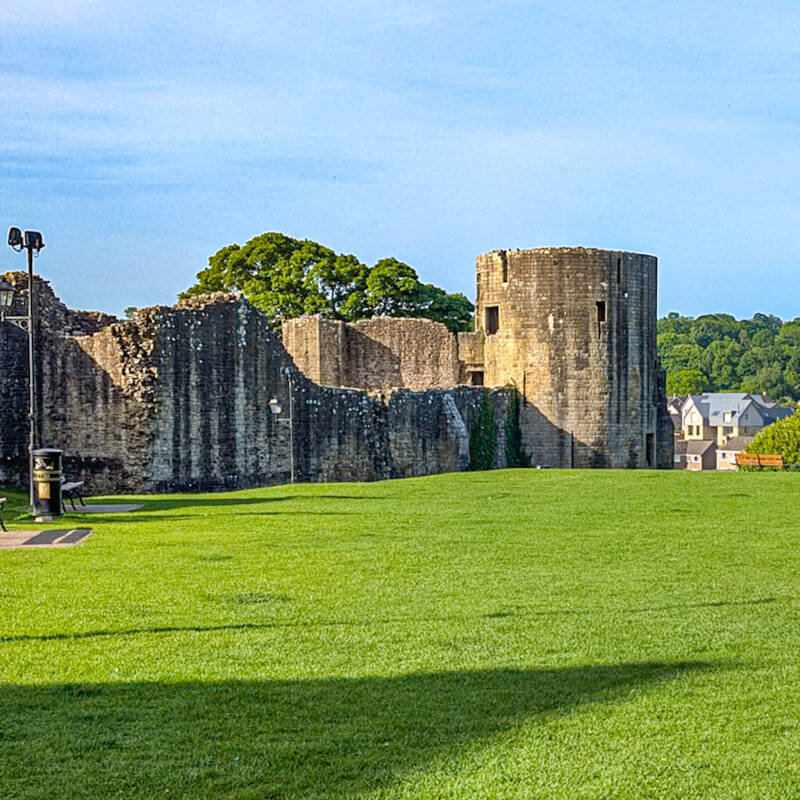
The Round Tower is one of the most recognisable remains. It once contained several floors of high-status accommodation, with fireplaces, stairs, private rooms and garderobes built into its thick walls. It later became a place for making lead shot and eventually provided a home for Frank Shield. Few parts of the castle have lived so many different lives.
Nearby are the remains of the Great Hall, where meals were served, guests welcomed and important business carried out. Large windows once lit the room, while holes in the walls show where timber floors and galleries were supported. Where visitors now see grass and open sky, there was once a roofed hall filled with tables, servants, fires and conversation.
The Great Chamber was a more private and prestigious room beyond the hall. Its projecting window looked out across the River Tees, and Richard III’s carved boar can still be found among the surviving stonework. That small piece of carving has become one of the castle’s most famous details because it links the ruin directly with a man who later became king.
Brackenbury Tower contains fireplaces, cupboards and garderobes, the castle’s medieval toilets. One narrow defensive opening was later enlarged into a proper window with stone seats. It is a small alteration, but it says a great deal about the changing castle. An opening once created for defence became somewhere a person could sit beside the light.
The deep Great Ditch helped protect the Inner Ward, with bridges controlling movement between different parts of the castle. At its western end is a sally-port, a small protected doorway through which defenders could leave without using one of the main gates. It was a practical military exit rather than a secret underground tunnel, but it remains one of the castle’s more easily overlooked features.
The broad Outer Ward appears fairly empty today, yet the Church of St Margaret and other buildings once stood there. This was a working part of the castle filled with carts, animals, supplies and people. The open grass hides the outline of a much busier medieval world.
Archaeology has also revealed what life was like away from the grand rooms. A medieval drain produced animal bones, grain, peas, wild fruit, fish and shellfish. Oysters, cockles and mussels had travelled inland from the coast, while trout, eel and pike may have come from much closer to home.
The Great Hall shows us where powerful people gathered. The drain tells us what arrived on their plates.
Visiting Barnard Castle
Barnard Castle stands beside Scar Top, only a short walk from the centre of town. From the Market Cross, walk along Horsemarket towards the Post Office, then follow the footpath beside Barnard Castle Methodist Church. The open green of Scar Top soon appears ahead, with the English Heritage entrance beside it.
Scar Top itself is a public open space. You can walk onto the green, sit on the benches and enjoy exterior views of the castle without paying. Admission is required to pass through the English Heritage entrance and explore inside the ruins during opening times.
The castle contains large grassy areas, but it remains a genuine medieval ruin. Visitors should expect uneven ground, worn stone, steps, slopes and drops around some sections. Children will find plenty to explore, although they need close supervision around the masonry and higher ground.
Current opening times, admission prices, dog rules and access arrangements can change, so these are best checked directly with English Heritage before travelling. The official visitor address is Scar Top, Barnard Castle, County Durham, DL12 8PR.
Public car parks, cafés, shops and toilets can be found around Barnard Castle town centre. Scar Top’s play area and Teesdale-themed mini golf sit close to the entrance, making it easy to combine the castle with a longer family visit.
The castle can also be enjoyed without entering. Scar Top gives the closest easy exterior view, while Bridgegate, County Bridge and the Startforth side of the River Tees reveal how dramatically the walls rise above the gorge.
Why Barnard Castle Still Matters
Barnard Castle connects this small market town with events reaching far beyond Teesdale. Its story touches the reign of King John, the Scottish crown, the creation of Balliol College, the Wars of the Roses, Richard III and the Rising of the North.
But the smaller stories are what make the castle feel real.
A cook cleared fish bones into a drain. Someone sat in the window seat inside Brackenbury Tower. Worshippers entered the Church of St Margaret. Sir George Bowes watched his garrison shrink as the water supply failed, and centuries later Frank Shield prepared his meals inside the Round Tower while waiting for Victorian visitors.
The castle has been built, enlarged, attacked, abandoned, stripped, admired and protected over more than nine centuries. Every generation left something behind, even when that something was an empty space where a roof, tower or gate had once stood.
The town grew beside the fortress, borrowed its name and never truly moved away from its walls. Barnard Castle is not simply a ruin at the edge of the town. It is the place around which the town’s story began.
Explore more of Barnard Castle’s history
Barnard Castle is only the beginning of the story. To discover the unusual local man who made the Round Tower his home and guided Victorian visitors through the ruins, read the full story of Frank Shield, the Hermit of Barnard Castle.
You can also explore Scar Top, the open green beside the castle with views across the River Tees, a children’s play area and Teesdale-themed mini golf.
To follow the castle’s story down towards the river, discover the history of County Bridge and the crossing which connected Barnard Castle with Startforth for centuries.
To see how the castle fits into the wider story of the streets, buildings and people around it, visit the Barnard Castle History and Heritage Hub.
For help planning a full day in town, including parking, walks, attractions and practical information, use our Barnard Castle Town Guide.