The History of the Three Horseshoes in Barnard Castle
In the late 1820s, the Three Horse Shoes on Galgate was in the hands of Matthew Hedley, a man with two very different jobs. He kept the inn, but he was also a blacksmith. At a time when horses and carts were part of everyday life, the arrangement made perfect sense. Farmers, carriers and tradesmen arriving in Barnard Castle needed horses shod, wheels repaired, tools sharpened and ironwork mended. The Three Horse Shoes gave them somewhere to wait, warm themselves, eat, drink and exchange news while work was carried out nearby.
The building was already more than a century old by then. The front range carries the date 1691, although nobody has yet found a record showing what it was first built for or exactly when it became an inn. From Matthew Hedley’s years onwards, however, the story becomes much clearer. The property grew into a larger hotel, remained tied to the Hedley name for generations and became a regular Wednesday calling place for a veterinary surgeon. Its rooms were later used for meals, meetings, music, darts and football, while its yard produced one of the strangest discoveries in its history when two great pieces of Shap granite were uncovered during sewer work.
By 2010, the old buildings were in poor condition and needed major investment. Steve and Linda Green bought the property and began a two-year restoration that brought the hotel back into full use. The Three Horseshoes remains on Galgate today, still welcoming people through the same old frontage.
Quick facts
Address: 7 Galgate, Barnard Castle
Oldest part of the building: Dated 1691
Listed status: Grade II
Earliest known innkeeper: Matthew Hedley, recorded in 1827–28
Other early trade: Blacksmith
Later development: Large rear range added during the mid-nineteenth century
Unusual use: Weekly veterinary attendance during the 1880s
Modern restoration: Began after Steve and Linda Green bought the hotel in 2010
Today: Hotel, bar and restaurant

Before the Three Horseshoes
The oldest part of the Three Horseshoes is the two-storey range facing Galgate. Its date of 1691 places the building firmly within seventeenth-century Barnard Castle, but the date belongs to the house rather than to the inn. No early licence, deed or directory entry has yet revealed who built it, who first lived there or when the Three Horse Shoes sign appeared. It may have begun as a private house, perhaps with a garden, yard, workshop or barn behind it, though there is not enough evidence to choose one use over another.
Galgate was a practical place to live and work. It stood on one of the main approaches into the town, carrying people and goods towards the market streets. Properties often combined family rooms at the front with workshops, stores and working yards behind. The Three Horseshoes may have grown from that kind of mixed property. The old frontage was never replaced when the business expanded; instead, later buildings rose behind it, leaving several periods of the site’s history standing together.
The first century of the building remains a blank, but by the early nineteenth century it was already an established inn. Its first known landlord also carried one of the trades most closely connected with the traffic passing along Galgate.
Matthew Hedley’s Blacksmith’s Inn
A trade directory for 1827–28 names Matthew Hedley as the victualler of the Three Horse Shoes. Victualler was the term then used for a licensed innkeeper. The same directory lists him as a blacksmith in Galgate, and both occupations appear again in 1833–34. The exact position of the forge is not known. It may have occupied a workshop behind or beside the inn, or it may have stood elsewhere nearby, but the same man was running both businesses in the same part of town.
A blacksmith’s work reached far beyond fitting horseshoes. Cart wheels needed iron tyres and repairs, tools broke, metal fittings wore out and agricultural equipment had to be kept working. Horses also needed regular attention before returning to the road. The inn and the forge would have served many of the same people, bringing trade to one another throughout the day. The name Three Horse Shoes may have been older than Matthew Hedley, but during his time there it fitted the place almost perfectly.
The final record found so far that definitely describes Hedley as a blacksmith comes from the 1830s. He remained at the Three Horse Shoes for many years afterwards and was still connected with the inn in 1851, but later records no longer mention the forge. The blacksmithing may have ended as he grew older, passed to another tradesman or disappeared as the property changed. Matthew made his will on 24 February 1855 and died the following day. His probate record described him as an innkeeper of Barnard Castle.
The Hedley Name Stays at the Hotel
After Matthew Hedley died, we have not yet found a clear record showing who took over the Three Horseshoes. What is clear is that the Hedley name stayed closely connected with the hotel.
In 1879, a nearby business described itself as being next to “Hedley’s, Three Horse Shoes”. That makes it sound as though people in Barnard Castle knew the place by the family name as well as by the sign above the door.
Later records place Miss Margaret Hedley at 7 Galgate, and job adverts for servants were still telling people to apply to Miss Hedley at the hotel. One of those jobs came with board, lodging and washing, which shows that the Three Horseshoes was a busy place with bedrooms, kitchens, staff and guests to look after. There were fires to light, meals to prepare, beds to change and deliveries to organise every day.
Another directory later names Miss Emily Elizabeth Hedley at the same address. We have not yet proved exactly how Margaret and Emily were related to Matthew, or to each other, so it would be wrong to turn the records into a complete family tree. Even so, the connection lasted for many years. From Matthew Hedley in the 1820s to the early twentieth century, the Hedley name remained part of the story of the Three Horseshoes.
The Hotel Grows Behind the Old Frontage
The Three Horseshoes became much larger during the nineteenth century. Behind the low frontage dated 1691 stands a substantial three-storey range added during the middle of the century. The old house remained facing Galgate while the hotel spread upwards and backwards, creating more space for guests, staff, stores and private gatherings.
A date of 1863 is connected with the later part of the property, although no surviving plan or detailed account has yet explained exactly what was completed that year. It may belong to a major enlargement, but the building itself gives the clearest evidence of change. What began as a comparatively modest property had become a sizeable hotel complex by the later nineteenth century.
The rear yard was the working heart of the place. Food, coal, barrels and laundry passed through it, while carts and horses needed space away from the street. An old stable still survived when the property was restored in the twenty-first century. Its age is unknown, and it does not prove that the Three Horseshoes began as a coaching inn in 1691, but it confirms that horses were once kept within the wider site.
When the Veterinary Surgeon Came Every Wednesday
During 1887 and 1888, the Three Horseshoes was used as a regular meeting place for a veterinary surgeon. F. R. Stevens, who was based in Darlington, came to the hotel every Wednesday and was usually there from about 11.30am until 2pm. Veterinary medicines could also be collected from Mr Hedley at the hotel between Stevens's weekly visits.
This gave farmers and horse owners around Barnard Castle a much easier way to get help. Instead of travelling to Darlington, they could come into town on a Wednesday, speak to Stevens at the Three Horseshoes and collect any medicine they needed. The hotel was not a veterinary surgery like the ones we know today. It was simply a familiar place where Stevens could meet people, listen to what was wrong and arrange treatment. Animals may have been seen in the yard or at nearby stables, while more serious cases could be visited later at the farm.
The adverts also mention a late Matthew Hedley, although this was not the original blacksmith and innkeeper, who had died in 1855. There were several men with that name in the wider area, so this part of the story is still unclear. What we do know is that, for more than a year, the Three Horseshoes gave local farmers and horse owners a regular place to find veterinary help and collect medicine.
A Place Where Barnard Castle Met
By the end of the nineteenth century, the Three Horseshoes had become one of those useful town addresses where many parts of everyday life came together. Draws were held there, meetings took place in its rooms and items connected with local sales were sometimes left at the hotel for people to inspect. Before telephones were common in private homes, a well-known inn provided an easy place to leave messages, meet visitors and arrange business.
Local clubs used the hotel for annual meetings and committee work. Football organisations gathered there to choose officials, arrange fixtures and plan the season ahead. By the late 1920s, Mr and Mrs F. H. Finlay were closely connected with the Three Horseshoes, and in 1929 the hotel provided a meal for a local gathering. The public rooms filled for dinners and meetings while the ordinary work of the place continued around them.
Guests still needed breakfast, bedrooms had to be cleaned, fires lit and food prepared. Barrels, coal and provisions arrived through the yard, while staff moved constantly between the kitchens, bedrooms and public rooms. For the people living and working there, the Three Horseshoes was a full-day business rather than somewhere that came to life only in the evening.
The Great Gale of 1936
A violent gale struck Barnard Castle in January 1936, tearing slates and tiles from roofs, bringing down chimney stacks and damaging street lamps and shop signs. Some residents moved downstairs rather than sleep beneath roofs that were shifting and rattling above them.
Galgate took the full force of the weather. A large piece of coping was torn from the top of the Three Horseshoes and fell away as debris scattered through the town. The building had already stood for more than two centuries, but its old stonework was no safer than the roofs and chimneys around it.
No injury at the hotel was recorded, and the damage was repaired, but the incident placed the Three Horseshoes within one of the most frightening nights experienced by Barnard Castle during the period. A year later, the hotel appeared in the newspapers again for a very different reason.
A Winning Bet That Never Reached the Bookmaker
In June 1937, hotel manager Alexander Drimmond appeared before Barnard Castle magistrates after accepting money from a regular customer to place horse-racing bets. John Atkinson Grange had handed over £1 on three occasions. The first two horses lost, but the third, Pantry Man, won at odds of seven to one.
When Grange returned to collect his winnings, he discovered that the bet had never been placed. The original pound was returned and the matter reached the police. The case also names Frank L. Robson as the proprietor or owner of the Three Horseshoes, while Drimmond lived at the hotel and managed the business. A barmaid was working there, and Grange was a regular customer who called in for beer.
The magistrates imposed a fine of £2 10s. The story has an unusual coincidence: three horse-racing bets passed through the manager of the Three Horseshoes, with the third ending in court. It also opens a brief window onto the ordinary life of the bar, where customers knew the manager well enough to trust him with arrangements outside the usual business of the hotel.
The Shap Granite Beneath the Hotel
In early 1939, sewer workers digging through the Three Horseshoes yard uncovered two boulders of Shap granite. The smaller stone was used to fill a hole, while the larger one was left near the hotel entrance because it was too awkward and of no use to the work.
For about a week, the boulder became a small Galgate curiosity. An unexplained lump of granite beside a building dated 1691 could easily have gathered stories about ancient boundaries, old coaching days or forgotten travellers. Its real origin was recorded before that could happen. The stone had simply been dug from beneath the yard and was available to anyone willing to move it.
Its true journey was far older than the hotel. Shap granite had been carried eastwards from Cumbria by glacial ice and left across the Barnard Castle district thousands of years before the town existed. The boulder had not stood outside the Three Horseshoes for centuries. It had lain beneath the yard until the sewer trench brought it back to the surface.
Band Music, Darts and Football
The middle of the twentieth century brought a different kind of life to the Three Horseshoes. In 1954, a local organisation recorded its thanks for the use of the hotel’s band room, confirming that the building contained a room large enough for music, rehearsals or organised gatherings.
Darts became one of the strongest later connections. By the 1950s, a Three Horse Shoes team was competing in Barnard Castle leagues, and the hotel’s name appeared regularly in match reports and league tables. Football clubs also used the premises, and later teams played under the Three Horseshoes name. The forge and weekly veterinary visits belonged to the past, but the hotel was still giving local people somewhere to organise, compete and gather afterwards.
In 1957, Christopher Kielly was recorded as living and carrying on business at the Three Horse Shoes when bankruptcy proceedings began. The surviving record does not explain the cause of the financial trouble, but running a large old hotel brought constant costs and uncertainty. By the 1970s, the Three Horseshoes was advertising bar meals and private functions, with Mrs D. O’Brien named as the contact. During the 1980s, Santos Levin was the landlord, and the hotel continued to take part in fundraising and town life. In the 1990s, Stephen and Mandy Bird were running the business and received recognition in a tenant competition organised by Century Inns.
The Green Family Restores the Three Horseshoes
By the beginning of the twenty-first century, the Three Horseshoes was still trading but the old buildings needed extensive work. Steve and Linda Green bought the property from Enterprise Inns in December 2010 and began a restoration that lasted around two years and cost approximately £750,000.
The project reached far beyond the bar and public rooms. Parts of the hotel were renewed or rebuilt, unused buildings behind the Galgate frontage were brought back into use and eleven en-suite bedrooms were created. The older frontage, the larger nineteenth-century ranges and the buildings within the rear complex were retained as part of the restored hotel.
An old stable remained among the buildings when work began, preserving a physical link with the horse-powered life of the property. Steve and Linda reopened the Three Horseshoes with their sons Robbie and Ryan, and by 2013 the hotel had been fully modernised. The redevelopment also created 15 jobs in Barnard Castle.
The Three Horseshoes Today
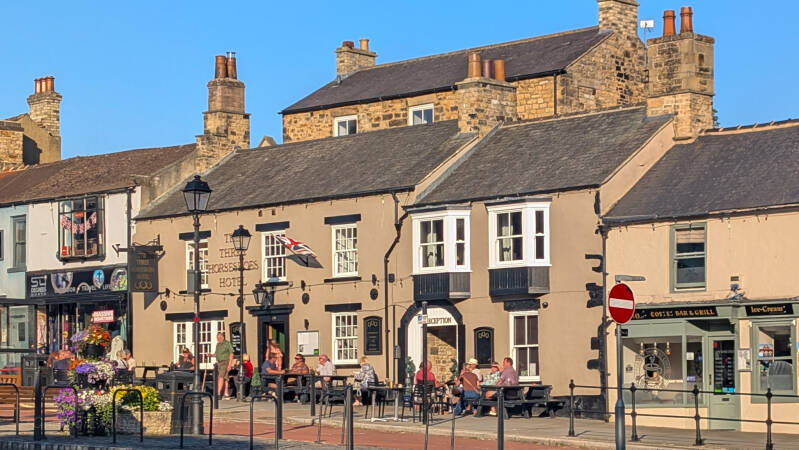
The Three Horseshoes continues as a hotel, bar and restaurant on Galgate. The frontage still carries the date 1691, while the larger nineteenth-century buildings rise behind it. Parts of the accommodation are known as The Stables and The Carriage House, names that reflect the earlier working character of the site without claiming an unproved coaching history.
The earliest chapter remains missing. We do not yet know who built the house, what it was first used for or exactly when it became the Three Horse Shoes. The end of Matthew Hedley’s blacksmithing years has not been found, and several later landlords remain absent from the surviving sequence.
What can be followed stretches across nearly two hundred years. Matthew Hedley ran the inn and worked as a blacksmith. The Hedley name remained attached to the hotel for generations. Veterinary advice and medicines were available there each Wednesday in the 1880s. Meals, meetings, music and sport later filled its rooms, while the Green family’s restoration carried the old buildings into their modern life.
People still enter from Galgate to eat, drink, meet and stay beneath the same frontage that has looked onto the street since 1691.
Explore More of Barnard Castle
The Three Horseshoes is only one part of Galgate’s long story. Discover how the street was once known as Gallowgate and explore the evidence for Barnard Castle’s former execution ground in Barnard Castle Gallows.
Follow the development of the streets around the hotel, from the medieval borough and market place to the later growth of Galgate, Newgate and the surrounding town, in How Barnard Castle Grew.
You can also read The History of Barnard Castle Castle, from the Balliol family and Richard III to the siege of 1569 and the castle’s later decline.
Find more local buildings, people and unusual stories through our Barnard Castle History and Heritage Hub.
For walks, attractions and practical visitor information, return to our Barnard Castle Town Guide.