John Bowes of Streatlam Castle and The Bowes Museum
John Bowes is one of the most important figures in the history of Barnard Castle and Teesdale.
He is best remembered as the founder of The Bowes Museum, the grand French style museum that still stands in Barnard Castle today. But his story is much deeper than one building. It is a story of family, inheritance, Streatlam Castle, coal wealth, horse racing, Paris theatre life, art collecting, public generosity and one of the most ambitious cultural gifts ever created in the North of England.
John Bowes was born into a complicated world. His father was John Lyon Bowes, 10th Earl of Strathmore and Kinghorne. His mother was Mary Milner, a woman connected with the Streatlam estate who became far more important to his life than many short histories suggest.
Although John inherited great wealth and major English estates, his place in aristocratic society was never simple. He was born before his parents married, and although his father married Mary Milner shortly before his death, John did not inherit the Scottish earldom. Instead, he inherited the English estates connected with the Bowes family, including Streatlam and Gibside.
That mix of privilege and uncertainty shaped his life.
John Bowes became a landowner, businessman, racehorse owner, theatre owner, collector and benefactor. But above all, he became part of a remarkable partnership with Joséphine Bowes, the French actress, artist and collector whose vision helped shape The Bowes Museum.
Together, John and Joséphine created something extraordinary for Barnard Castle.
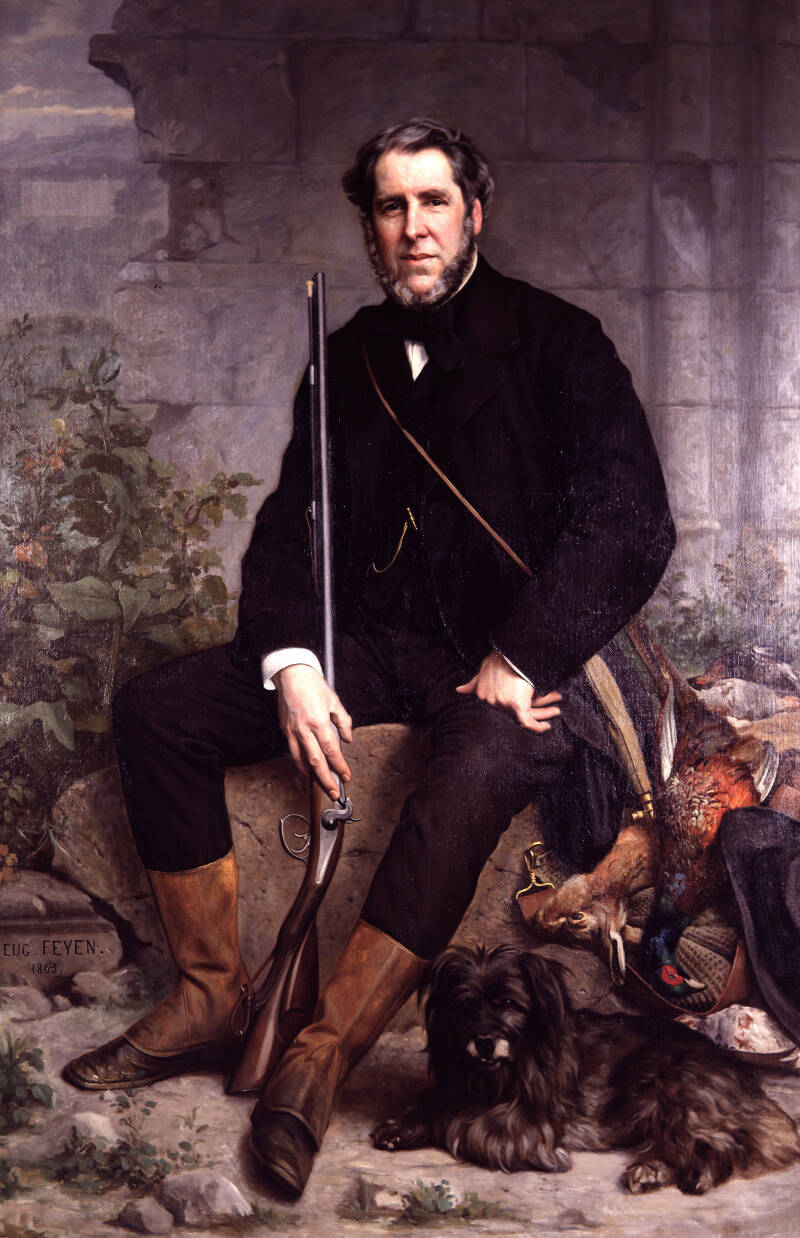
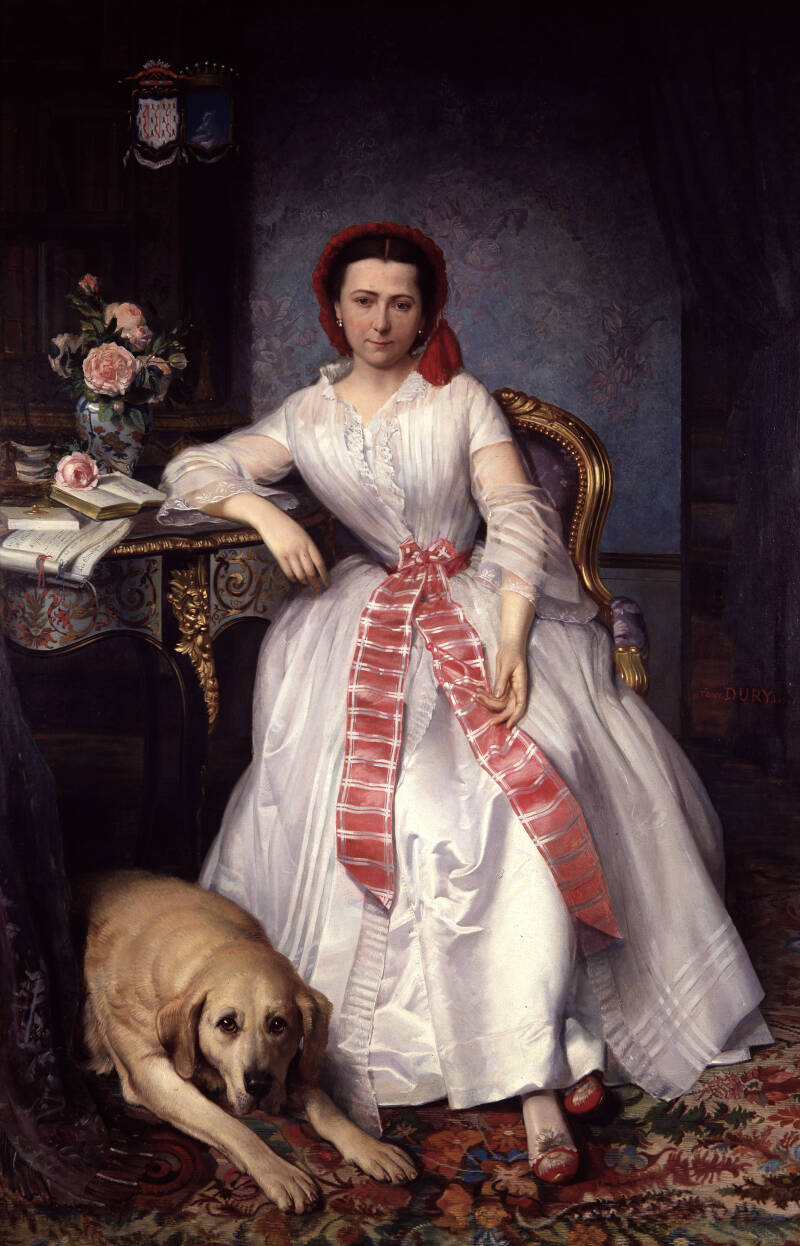
John Bowes and Joséphine Bowes, whose shared vision helped create The Bowes Museum in Barnard Castle.
With sincere thanks to The Bowes Museum for kindly allowing us to use these portraits.
Quick Facts About John Bowes
Full name: John Bowes
Born: 19 June 1811
Died: 9 October 1885
Father: John Lyon Bowes, 10th Earl of Strathmore and Kinghorne
Mother: Mary Milner
Wife: Joséphine Benoîte Coffin Chevallier, Countess of Montalbo
Main Teesdale connection: Streatlam Castle and Barnard Castle
Other major estate: Gibside
Known for: Founding The Bowes Museum with Joséphine Bowes
Also connected with: horse racing, coal wealth, Paris theatre, art collecting and local philanthropy
Museum foundation stone laid: 1869
Museum opened: 1892, after both John and Joséphine had died
Probate: proved in 1885, with a personal estate valued at £147,874, 19 shillings and 3 pence
The Family History Behind John Bowes
To understand John Bowes, you have to understand the family world he was born into.
The Bowes family had been connected with Streatlam for centuries. Streatlam Castle, near Barnard Castle, was not just a home. It was the centre of a powerful estate world tied to land, coal, politics, farming, servants, tenants and social influence.
Through Mary Eleanor Bowes, the great Durham heiress, the Bowes estates became linked with the Lyon family, creating the wider Bowes Lyon family story. This same family line later connected with Queen Elizabeth The Queen Mother.
By the time John Bowes was born in 1811, the family story already carried generations of wealth, inheritance, marriage settlements, legal disputes and public influence.
He inherited more than money.
He inherited a complicated history.
His Father: John Lyon Bowes, 10th Earl of Strathmore
John Bowes's father was John Lyon Bowes, 10th Earl of Strathmore and Kinghorne.
He was connected with both Streatlam Castle and Gibside, two of the most important Bowes family estates. These places were tied to enormous wealth, much of it connected with land, coal and estate income.
The 10th Earl’s private life did not follow the expected pattern of aristocratic marriage. He formed a long relationship with Mary Milner, who was connected with the Streatlam estate. Their son John was born in 1811, before they were married.
This mattered greatly.
In 1820, when the Earl was seriously ill, he married Mary Milner. He died shortly afterwards. Although this marriage helped secure John’s position in some ways, it did not make him heir to the Scottish earldom. The title passed elsewhere in the family.
John Bowes inherited the English estates, including Streatlam and Gibside, but not the Scottish title.
That left him in an unusual position. He was extremely wealthy, well educated and powerful, but his place in aristocratic society was not straightforward. He belonged to that world, but also stood slightly apart from it.
That may help explain why his later life took such an unusual path.
His Mother: Mary Milner
Mary Milner deserves more attention in the story of John Bowes.
She was not simply a hidden or forgotten figure. The surviving picture suggests she was closely involved in estate life, business matters and her son’s education.
Because of the social rules of the time, Mary could not easily take the public role of an aristocratic wife before her marriage to the Earl. But she appears to have lived much as his partner and was important within the private world around him.
After the Earl’s death, Mary remained a central figure in John Bowes's life.
She later married Sir William Hutt, who had been John’s tutor at Cambridge. Hutt became much more than a stepfather. He became a trusted adviser, political figure and important influence in John’s adult life.
This changes the way John Bowes should be understood.
He was not simply a lonely child left behind by history. He grew up in a complex family structure shaped by Mary Milner, estate trustees, education, legal questions and later Sir William Hutt’s guidance.
Mary Milner helped connect John Bowes to both his family past and his future as an educated, internationally minded man.
Education and Early Life
John Bowes received the education of a wealthy gentleman.
He studied at Eton and later at Trinity College, Cambridge. This placed him among the educated elite, but his background still carried the shadow of legal and social complication.
His early life was shaped by two different forces.
One was the old estate world of Streatlam and Gibside, with land, servants, farming, coal, tenants, horses and family expectation.
The other was a more modern world of education, politics, travel, business and culture.
John Bowes would eventually step beyond the traditional role of a country landowner. His life became wider, more international and more artistic than many people might expect from a man rooted in Teesdale estate history.
Streatlam Castle and the Teesdale Connection
Streatlam Castle was central to John Bowes’s identity.
The castle stood between Barnard Castle and Staindrop and had been connected with the Bowes family for generations. By John’s lifetime, it was more of a grand country house than a defensive castle, but its name, history and estate still carried enormous importance.
Streatlam was the place that tied John Bowes to Teesdale.
Even though he spent much of his adult life between London and France, the family landscape around Barnard Castle remained part of who he was. The decision to build The Bowes Museum in Barnard Castle only makes full sense when seen against that background.
He could have built his museum in London. He could have built it in France.
Instead, the museum rose in Teesdale, close to the family world of Streatlam.
That choice changed Barnard Castle forever.
John Bowes the Businessman
John Bowes was not only a collector or country gentleman. He was also a businessman.
His wealth was tied to land, coal, property and industrial interests. The Bowes estates were part of a wider economic world that included farming, rents, mineral wealth, transport, railways and coal trade networks.
This matters because The Bowes Museum did not appear from nowhere.
The money behind the museum came from a much larger estate and industrial background. John Bowes inherited wealth, but he also moved in business circles and understood finance, investment and large projects.
That practical side of his character is important.
Without it, the museum might have remained only a dream.
John Bowes and Horse Racing
John Bowes was also one of the great horse racing figures of the nineteenth century.
His most famous horse was West Australian, who became the first winner of the English Triple Crown after winning the 2000 Guineas, the Derby and the St Leger in 1853.
This was a remarkable achievement and placed John Bowes among the leading racing owners of his time.
Horse racing was not a small side interest. It was part of the world of wealth, status, land and breeding connected with Streatlam Castle. Racing also shows another side of John Bowes: competitive, ambitious and deeply involved in elite Victorian society.
Paris and a Different World
John Bowes's life changed when he became deeply involved with Paris.
In 1847, he bought the Théâtre des Variétés on Boulevard Montmartre. This was not a quiet side investment. It placed him directly inside the lively cultural world of Paris theatre, performance, artists, dealers and fashionable society.
Paris was very different from Teesdale.
Streatlam represented land, inheritance and family duty. Paris offered theatres, salons, collecting, art, music, conversation and creative freedom.
John Bowes did not simply visit France. He became part of that world.
It was at the Théâtre des Variétés that he met Joséphine Benoîte Coffin Chevallier, an actress known on stage as Mademoiselle Delorme. She was talented, artistic and socially confident. Their relationship became the defining partnership of his life.
They married in 1852, five years after they first met in Paris.
Joséphine Bowes
Joséphine Bowes was not just John Bowes’s wife.
She was central to the creation of The Bowes Museum.
Born in France, she brought with her a deep understanding of French art, design, theatre and society. She had worked as an actress, became a social hostess, painted as an artist and developed strong relationships with artists and dealers.
John had wealth, business experience and Teesdale roots.
Joséphine had artistic vision, taste and confidence.
Together they created the collection and the idea that became The Bowes Museum.
For many years, the story of the museum was often told as if John was the founder and Joséphine was simply beside him. That is too simple. The museum’s French style, artistic ambition and emotional identity owe a great deal to Joséphine.
She helped shape not only what the museum would hold, but how it would look and feel.
Why The Bowes Museum Was Built in Barnard Castle
The Bowes Museum was one of the boldest cultural projects in Victorian northern England.
John and Joséphine collected thousands of objects, including paintings, furniture, textiles, ceramics, clocks and decorative arts. Their collection had strong European influence and could easily have belonged in a major capital city.
But they chose Barnard Castle.
That choice is the heart of the story.
The museum was not built as a private mansion. It was planned as a public museum and park, intended to bring art, beauty and education to people far from the usual centres of culture.
In 1869, Joséphine laid the foundation stone and spoke words that still capture the partnership behind the project:
“I lay the bottom stone, and you, Mr Bowes, will lay the top stone.”
Neither of them lived to see it completed.
Joséphine died in 1874. John Bowes died in 1885. The museum opened to the public in 1892.
Their dream outlived them both.
The Museum, The Witham and Public Life in Barnard Castle
John Bowes was part of a wider nineteenth century story of public improvement in Barnard Castle.
The Bowes Museum was the largest and most famous example, but it was not the only one. Barnard Castle was also shaped by The Witham, the Mechanics Institute and other public buildings linked with education, culture and civic life.
John Bowes supported The Witham and was among the important subscribers connected with its development. This matters because it shows that his interest in culture and public improvement was not limited only to his own museum project.
The world around John Bowes also overlapped with other important Teesdale figures, including Thomas Witham of Lartington Hall. Thomas Witham and John Bowes were near contemporaries. Thomas was born in 1806 and John in 1811, so only five years separated them.
Their lives followed different paths, but they moved within some of the same Teesdale worlds of landed estates, public life, legal affairs, cultural institutions and local improvement.
Thomas Witham later became connected with the legal and financial story of The Bowes Museum and Park. Legal notices and later records connect Thomas Witham with the trustees of the Joséphine and John Bowes Museum and Park during a period when mortgage and borrowing arrangements were part of the museum’s financial story.
This matters because The Bowes Museum was not simply built, opened and secured overnight. It was an enormous project involving land, collections, trustees, legal arrangements, estate money and long term financial responsibility.
John and Joséphine Bowes gave Barnard Castle the vision, collection and founding purpose. But after their deaths, the museum still needed trustees, careful management and practical support to carry that vision forward.
That is why figures such as John Bowes, Henry Witham, Thomas Witham and Thomas Breaks all belong within the wider story of the people who helped shape Barnard Castle and Teesdale.
The Will of John Bowes
John Bowes died at Streatlam Castle on 9 October 1885.
His probate record valued his personal estate at £147,874, 19 shillings and 3 pence, a huge sum in Victorian Britain. But his will also shows that wealth was not always simple.
A contemporary newspaper summary described the will as very long and noted that it included six codicils. It recorded many legacies to relatives, friends, dependants, people in France, estate connections and trusted figures.
The most important public legacy was the provision connected with The Bowes Museum and Park.
John Bowes left major support for the museum project, helping secure the future of what he and Joséphine had planned. But the estate was complicated. Much of his wealth was tied up in land, property, collections, trusts, heirlooms and estate arrangements, rather than simple ready cash.
The will also helps explain why the museum still faced serious financial challenges after his death.
John Bowes was wealthy, but The Bowes Museum was an enormous project. It required trustees, legal management, estate administration and continued support after both founders had died.
This does not weaken John Bowes's legacy. It makes the story more human and more practical. The museum was born from vision and generosity, but it survived through years of careful work by trustees and supporters who carried the project forward.
His Final Years and Legacy
John Bowes spent his final years carrying forward the museum project after Joséphine’s death.
He did not live to see the building open.
That fact gives the story a quiet sadness. The museum that now carries his name was never seen by him as a finished public institution. Like Joséphine, he had to trust that others would complete what they had begun.
After his death, the work continued through trustees and supporters until The Bowes Museum opened in 1892.
Today, the building stands as one of the clearest examples of how one life can shape a town long after death.
John Bowes’s legacy is not only in the collection. It is in the decision to place that collection in Barnard Castle. It is in the idea that people in Teesdale deserved access to art, culture and beauty. It is in the park, the building, the skyline and the continued identity of the town.
Why John Bowes Still Matters
John Bowes matters because his life connects so many parts of Teesdale history.
He connects Streatlam Castle with Barnard Castle.
He connects aristocratic inheritance with public generosity.
He connects County Durham coal wealth with European art.
He connects Teesdale with Paris.
He connects The Bowes Museum with The Witham, local benefactors and the wider story of public improvement in Barnard Castle.
He was not a simple figure. He was wealthy, complicated, ambitious and shaped by unusual family circumstances. But his lasting legacy is clear.
Together with Joséphine, John Bowes gave Barnard Castle one of the most remarkable museums in Britain.
Explore More in Teesdale
The story of John Bowes stretches far beyond a single building. Across Teesdale, other places and people still connect to his life, his family and the remarkable legacy he helped leave behind.
Discover the story behind The Bowes Museum and how John and Joséphine Bowes created one of the most remarkable cultural landmarks in the North of England.
Explore Streatlam Castle, the lost Bowes family home near Barnard Castle and the estate landscape that shaped much of John Bowes’ life.
Read about Thomas Witham and his later connection with the legal and financial story of The Bowes Museum and Park after the deaths of John and Joséphine.
Learn about Henry Witham and the story behind The Witham, another important Barnard Castle legacy shaped by education, culture and public improvement.
Explore the life of Thomas Breaks, the wool merchant whose gift helped create the town’s historic Market Cross, now widely known as the Butter Market.
Or return to the People of Teesdale hub to discover more of the figures, families and stories that helped shape Barnard Castle, Teesdale and the surrounding villages.
Sources and Acknowledgements
This page has been carefully researched using a mixture of museum information, archive catalogue records, probate material, historic newspaper reports and listed building records.
Key sources used include The Bowes Museum’s own history pages and blog articles about John and Joséphine Bowes, Mary Milner, Mary Eleanor Bowes and the creation of The Bowes Museum; Historic England records for The Bowes Museum park and gardens and surviving Streatlam Castle estate structures; The National Archives catalogue entries relating to the Bowes family, Streatlam, Gibside and The Bowes Museum and Park; probate records and contemporary newspaper summaries of John Bowes’s will; and local archive material connected with Thomas Witham, The Witham and the later legal and financial history of The Bowes Museum.
With sincere thanks to The Bowes Museum for kindly allowing us to use the portraits of John Bowes and Joséphine Bowes on this page.
Every effort has been made to keep this page accurate and fair. Where the historical record is complicated, especially around inheritance, estate law and family relationships, we have tried to use careful wording rather than overstate what can be proved.