How Barnard Castle Was Lit: Gas Lamps and the Town Lamplighter
Jackie Evans lived at the bottom of The Bank and was remembered locally as Barnard Castle’s lamplighter, town crier and pawnbroker. During the darker months of the year, he was one of the men responsible for walking the streets and lighting the town’s gas lamps by hand.
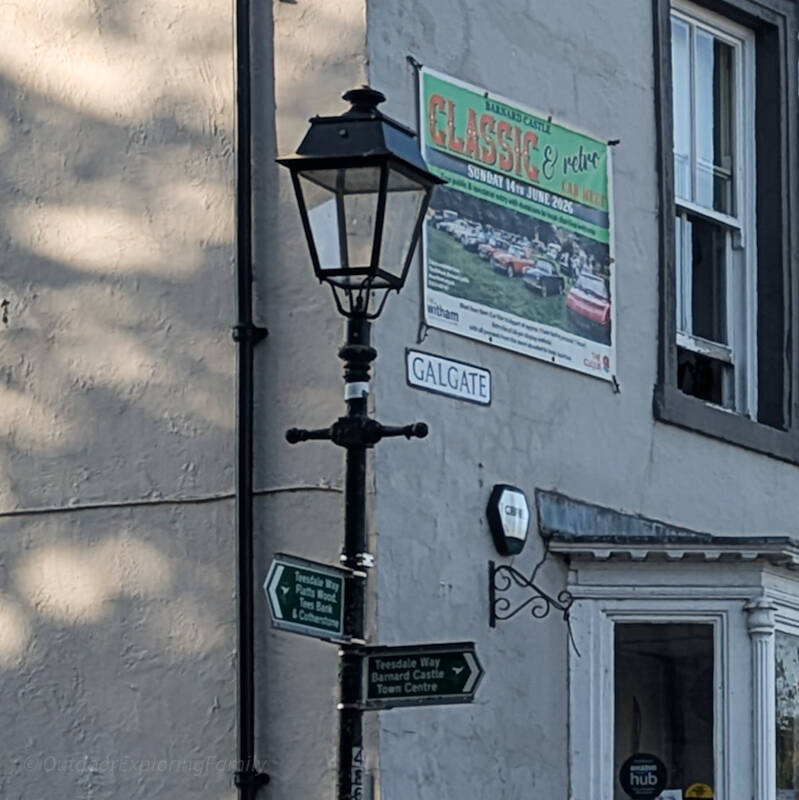
Before electric street lighting, each lamp had to be lit individually and many had to be extinguished again later in the evening. Most did not burn through the night, and the light they gave was limited. Streets such as Galgate, Newgate and The Bank were not brightly illuminated as they are today. Instead, people walked between small pools of light, with darker stretches in between.
Barnard Castle’s organised gas lighting began after the Barnard Castle Joint Stock Gas Company was established in 1834 and the gasworks opened in 1835. What followed was more than a century of new lamps, complaints about dark streets, arguments over cost and repeated attempts to keep the lighting system working as the town expanded.
Quick facts
Gas company established: 1834
Gasworks opened: 1835
Early street lamps: 82
All-night lamps: 18
Usual switch-off time: 11pm
Saturday switch-off: Midnight
Remembered lamplighter: Jackie Evans
Other roles: Town crier and pawnbroker
Lighting season in 1937: 1 September to 26 April
Still employing a lamplighter: 1938
Final gas lamp: Exact date not yet confirmed

The First Gas Lamps
Before gas lighting, Barnard Castle became a very different place once daylight faded. Light came from houses, shops, inns and private lanterns, but the streets themselves were largely dark. That made steep and uneven routes such as The Bank harder to use, while narrow yards and poorly drained footpaths could be difficult to follow safely.
The opening of the gasworks in 1835 changed that. Coal was heated in sealed retorts to produce gas, which was then cleaned, stored and carried through pipes beneath the town. Some of it supplied homes and businesses, while some was used for the public street lamps.
Early records refer to 82 lamps around Barnard Castle. Eighteen were allowed to burn throughout the night, while the remaining 64 were usually extinguished at around 11pm. On Saturday nights they stayed lit until midnight.
That meant Barnard Castle was gas lit, but only partly. Most of the town still became dark late at night, and even when the lamps were burning they only illuminated a small area around them. The exact position of each lamp therefore mattered. A light close to a footpath could be useful, while one standing too far into a wide road might do little for the people walking beside it.
The town paid around £90 a year for the lighting, but the gas itself was only one part of the cost. Someone still had to go out and attend every lamp.

The Men Who Lit the Town
The lamplighter worked during the darker part of the year, following a set route through Barnard Castle and lighting each lamp in turn. Later, the ordinary lamps had to be put out again.
The work continued through rain, wind, frost and snow. If a lamp was missed, that part of the street stayed dark. If the gas pressure was weak or the burner was faulty, the flame might be too low to provide much useful light.
Jackie Evans is the best remembered of Barnard Castle’s lamplighters. Ted Hinchcliffe, who left the Teesdale area in 1949, later recalled the house at the bottom of The Bank where Evans had lived. He remembered him as the lamplighter and town crier, as well as a pawnbroker.
That combination of jobs would have made him well known around the town. As town crier, he carried public announcements. As pawnbroker, he dealt directly with local people. As lamplighter, he walked the streets during the evening and helped keep Barnard Castle moving after dark.
The Bank was then a much busier and more densely occupied place than it is today. Shops, inns, businesses, homes and narrow yards ran down towards the river. It was a community with trades and occupations that have since disappeared, and Jackie Evans belonged firmly to that older working town.
We do not yet know the exact years in which he lit the lamps, and he was not the only person to do the job during the long life of the gas-lighting system. His name matters because it gives the story a recognisable person rather than leaving the lamplighter as an anonymous council employee.
Newgate, Galgate and the Railway
Not every street in Barnard Castle received the same level of light. By 1880, Newgate was being described as the best-lit street in the town because its lamps stood nearer the houses and footpaths, placing the light where people were actually walking.
Galgate was less successful. It was described as the longest and widest street in Barnard Castle and had become the main route between the town centre and the railway station. The railway brought increasing numbers of passengers, horses and vehicles onto the street, especially when trains arrived after dark.
Even several years after the railway had opened, there had been a time when one horse-drawn omnibus was enough to meet the trains. By 1880, the station was much busier. Six vehicles might be waiting for two ordinary afternoon trains, while as many as twelve could gather for the evening arrivals.
The lamps on Galgate stood in two parallel lines along the roadway, but the width of the street meant that they did not light the footpaths particularly well. The Lighting Committee proposed moving them nearer the houses, following the arrangement already considered successful in Newgate, and adding nine new lamps.
The idea soon became tangled in local politics. Mr Hall supported the scheme and reminded the Local Board of Health that Galgate’s existing lighting arrangement had been introduced about forty years earlier. Mr Hilton objected to further permanent spending and questioned whether the Board could afford it.
The discussion then moved into a separate quarrel over money. There were accusations about £100 owed to Messrs Backhouse and an alleged promise involving £80 towards the Bluestone scheme. Mr Hilton denied making the promise and declared that, if he had done so, he must have been drunk or a fool.
Mr Barker eventually proposed a smaller scheme. The lamps on the upper part of Galgate would be rearranged and three new ones added. That amendment was carried.
There was also an awkward question about members of the Board who owned shares in the gas company. A shareholder could take part in the discussion, but the clerk made it clear that he could not vote on a decision affecting his own financial interest.
Another report from 1880 called for two or three lamps along the route between the railway station and the Tees bridge. Passengers leaving the final train were thought to face inconvenience and danger on dark winter nights. The suggestion was that the North Eastern Railway Company might help provide the lamps, which would only need to remain lit until the last train had arrived.
Complaints, Dark Lamps and Electricity
By 1892, dissatisfaction with the town’s lighting had reached the Local Board once again. The Lighting Committee recommended another lamp for Wood Street but decided that Park Terrace was already sufficiently illuminated. At the same meeting, complaints were raised about lamps not being lit and about the conduct of the lamplighter.
The committee had already spoken to him and made it clear that his work was being watched. He was described as being “on his trial”, although members agreed to give him a fair chance to improve. The report does not name the man, so there is no evidence connecting these complaints with Jackie Evans.
There were wider problems with the arrangement of the lamps and meters. Some metered lamps remained alight longer than the others, while several ordinary lamps were left dark. Members also complained that certain lamps were turned fully on while others burned at only half strength. One described the condition of Barnard Castle’s lighting as “a burning shame”.
Not every weak or unlit lamp was necessarily the lamplighter’s fault. The gas had to travel through an expanding network of pipes and reach each burner at a steady pressure. A poor flame could result from low pressure or faulty equipment as well as a lamp being missed during the evening round.
The Board was also disputing the price charged by the gas company. When the company declined to continue supplying gas at the previous rate, the Board carried on using it under protest.
The same meeting considered whether electricity might provide a better way of lighting Barnard Castle. Mr Burn had written to the Brush Electric Company, which offered to send an engineer to survey the town and prepare an approximate estimate. Mr Smith believed electricity would provide a more reliable service and would allow the Board to dispense with the lamplighter.
The proposal was approved for further investigation, but it did not bring an immediate end to gas lighting. More than forty years later, Barnard Castle was still paying a lamplighter and adding new lamps to his round.
Startforth and the Missing Light
Across the river, Startforth had its own difficulties. When responsibility for the village’s local affairs separated from Barnard Castle in 1889, the change became obvious as soon as darkness arrived: the street lamps were not lit.
A newspaper columnist joked that Startforth had been reduced to the position of an unlit country village. On the following Monday, an unnamed person decided that the lamps had been erected to provide light rather than stand as ornaments and lit several of them without any clear authority.
Startforth had not normally had lamps burning throughout the night, but on this occasion they were left alight until morning. Nobody appeared certain who would pay the gas company for the gas consumed, and there were rumours that the lamps might be removed.
The story was reported with humour, but the problem was real. Administrative responsibility had changed while the lamps and gas pipes remained where they had always been.
The argument continued when people living beyond the main illuminated part of Startforth complained that they were paying gas rates without receiving the full benefit. A group of ratepayers submitted a written petition explaining that there were no lights beyond the footbridge and asking for two lamps to be placed on the higher road, roughly fifty yards to either side of Mr Wilkinson’s property.
During the meeting, another suggestion was made that one lamp should stand near Mr Wilkinson’s and another near Mr Howson’s. Until the lighting was extended, residents outside the properly lit area believed they should be treated like those in the outlying district and pay a lower assessment.
Mr Hall considered it unfair for people to pay towards lighting they could not use. Mr W. A. Hall explained that the gas company would need to extend its mains before lamps could be provided farther along the road. Mr Slater questioned why the village required so many lights and remembered when there had been fewer. Mr Boardman replied that people had then lived in “dark days”.
There was even a suggestion that the lamps should be extinguished when the public houses closed at 11pm. By this time, however, street lighting had become a service people expected. Once residents were charged for it, they wanted the light to reach their own part of the village.
The Lamplighter in the 1930s
Gas lighting survived in Barnard Castle far longer than the discussion of electricity in 1892 might suggest. In 1937, the town still employed a lamplighter during an official lighting season running from 1 September until 26 April. His wages averaged £2 13s 5d per week.
The Surveyor reported that the lamplighter then had 32 more lamps to attend than he had in 1930. Further lights were shortly to be added on a housing estate, increasing the workload again. The Works Committee recommended raising his wage to £2 18s 6d per week to cover the additional lamps.
The following year, the lamplighter applied for another increase because the number of lights under his care had continued to grow. The council postponed its decision until further information had been gathered.
These reports show that Barnard Castle’s gas-lighting system was not simply being allowed to fade away during the 1930s. It was still being extended as new housing was built, and the person responsible for the lamps had considerably more work than he had only a few years earlier.
No complete map of the lamplighter’s round has yet been found. The surviving reports identify lamps and lighting discussions in places including Newgate, Galgate, Wood Street and Park Terrace, but they do not provide a full street-by-street route.
When Did the Gas Lamps Finally Go?
The exact date when Barnard Castle’s final working gas street lamp became redundant has not yet been found.
Electric lighting was being investigated in 1892, but a lamplighter was still employed in 1938. The replacement of the gas lamps was therefore not the quick change that members of the Local Board may once have imagined.
Gas production at Barnard Castle Gasworks ended in 1952, although this does not by itself prove that every gas street lamp went out that year. Gas could be supplied from outside the town, and individual lamps may have been converted or removed at different times.
Some old columns may have been removed completely, while others could have been adapted to carry electric lanterns. Until a council minute or newspaper report records the final conversion, the last night of Barnard Castle’s gas lighting remains unknown.
What can be proved is that gas lighting shaped the town for more than a century. It followed the growth of railway traffic, reached new housing, caused arguments over rates and brought figures such as Jackie Evans into local memory.
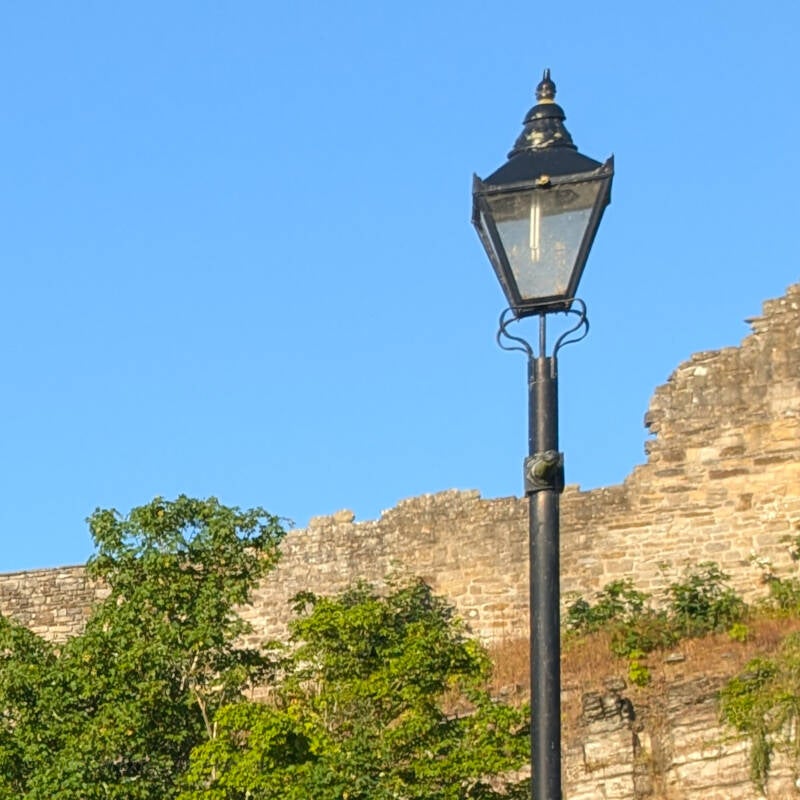
Today, street lighting works almost unnoticed. Earlier generations depended on the gasworks, the underground pipes and the people who walked the town attending each lamp by hand.
Barnard Castle was once lit one lamp at a time.
Explore more of Barnard Castle’s history
Barnard Castle’s gas lamps are only one part of the story written into the town’s streets. To see how those streets first developed, discover how Barnard Castle grew from an early river crossing and medieval stronghold into the market town we know today.
You can also explore the full history of Barnard Castle, from the Balliol family and Richard III to the siege of 1569 and Frank Shield’s unusual life among the ruins.
For one of the town’s darker stories, read about Barnard Castle Gallows and the evidence for the medieval execution ground near the upper end of Galgate.
To discover more of the buildings that shaped daily life in the town, follow the story of Blagraves House, from the Blagrave family and old local traditions to Victor Walton’s House of Mystery and its later life.
You can also read how The Witham grew from the Mechanics’ Institute, Reading Room and Dispensary into one of Barnard Castle’s most important public buildings.
To find more historic buildings, streets and stories in one place, return to the Barnard Castle History and Heritage Hub. For help planning a wider visit, including walks, attractions and practical information, use our Barnard Castle Town Guide.