Thorngate Bridge, Barnard Castle
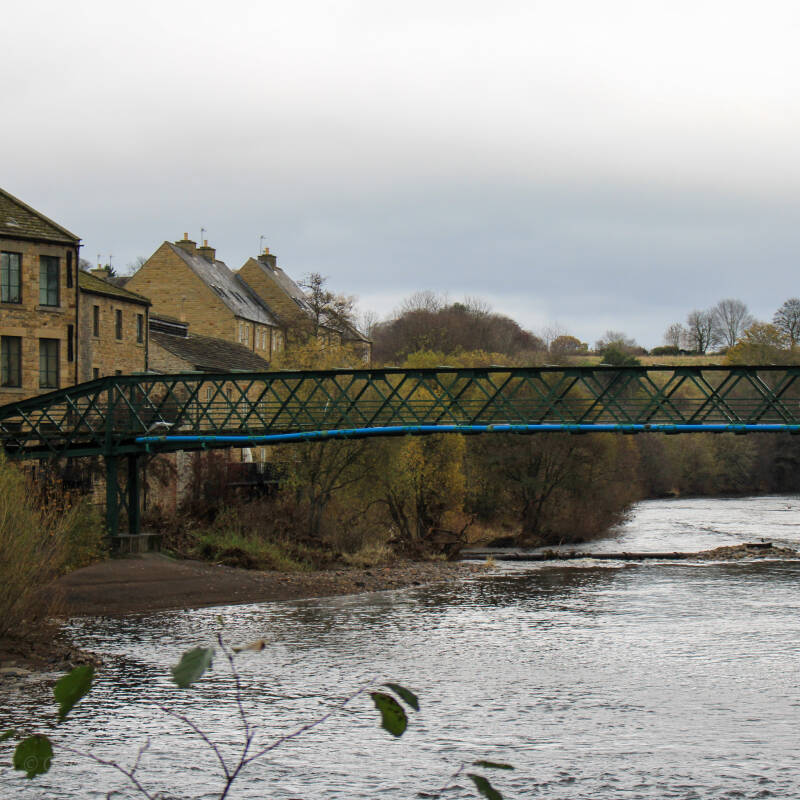
Thorngate Bridge, known locally to many as the Green Bridge, is a footbridge over the River Tees at Barnard Castle. It crosses from the bottom of Thorngate to Startforth.
Today it is part of the riverside walk, but it is also much more than that. The bridge is still used as an everyday crossing between Startforth and Barnard Castle, whether for work, school, shopping, walking into town or simply moving between the two sides of the river.
The present iron bridge dates from 1882, but the story of this crossing goes back further. Before the Green Bridge we see today, there was an earlier Thorngate footbridge, built to replace the old ford and stepping stones. That first bridge became an important route for local people before it was swept away during the great flood of March 1881.
This page tells the story of Thorngate Bridge from the old crossing at the foot of Thorngate, through public fundraising and Victorian engineering, to the flood that destroyed the first bridge and led to the Green Bridge we know today.
Quick Facts
Location: Thorngate, Barnard Castle
Local name: The Green Bridge
Crosses: River Tees
Route: From the bottom of Thorngate to Startforth
Bridge type: Footbridge
Present bridge built: 1882
Listed status: Grade II listed
Engineers: Wilson Bros. & Co., Darlington
Earlier bridge: Opened in 1871 and swept away in the great flood of 9 March 1881
Original purpose: A foot crossing for local people, including workers travelling to the nearby mills

Before Thorngate Bridge
Before there was a footbridge at the bottom of Thorngate, the old way across the River Tees was by ford and stepping stones.
This was one of the older crossing points between Barnard Castle and Startforth. It sat below the town, away from the main County Bridge, and gave people a more direct way across the river from Thorngate to the Yorkshire side.
But the Tees was never an easy river to trust.
In calm weather the ford and stepping stones may have been useful enough, but in wet weather, winter weather, or after heavy rain higher up the dale, the crossing could quickly become dangerous or impossible. The river here is fast, rocky and powerful, and the old route across the water did not give people a reliable way between the two sides.
By the late 1860s, there was a growing feeling in Barnard Castle and Startforth that the old crossing needed to be replaced by a proper footbridge.
The idea was not simply about making a pleasant riverside walk. It was about daily life. People needed to move between Thorngate, Startforth, the mills, the market, nearby paths and the wider roads beyond the town. A bridge here would save time, improve access and give ordinary foot passengers a safer crossing than the old ford and stepping stones.

The Public Campaign for a Bridge
The movement to build the first Thorngate Bridge began in earnest in 1869.
On 25 March that year, a public meeting was held at the Witham Testimonial in Barnard Castle to promote the building of a bridge at the foot of Thorngate. The meeting was chaired by the Rev. J. Brockbank, Vicar of Startforth, who became one of the important names connected with the early bridge campaign.
Support soon followed.
Mr Fieldhouse, of the firm Holroyd and Fieldhouse, stated that the firm would give £100 towards the proposed structure. That was a major contribution and shows how seriously the idea was being taken. A committee was appointed, public subscriptions began to come in, and the scheme started to move from an idea into something more realistic.
There was still a problem though.
A bridge could not simply be placed across the Tees without somewhere to land on the Startforth side. Early designs were considered, but the cost of some of them was high, and the landing place on the Yorkshire bank caused difficulty. The project slowed, and for a time it seemed to sit in the background.
By August 1870, the situation had changed.
The land on the Yorkshire side of the river had passed into new ownership. The new owners gave permission for the bridge landing and also promised £20 towards the cost. That was the moment the project seems to have gained fresh energy.
Several designs had been considered, but expense remained a problem. Eventually the design of Messrs Robinson and Ianson was adopted at a meeting on 16 August 1870. At the same meeting, it was agreed that if guarantors could be found for the remaining £70 shortfall, the bridge could be ordered at once.
The Local Board also played a part. It approved the proposed footbridge at the bottom of Thorngate, but only on the condition that the old route to the ford was not blocked. A proper cartway had to be left open beside the new bridge, so carts and horses could still reach the river crossing when conditions allowed. The Board also gave £25 towards the bridge.
This means the first Thorngate Bridge was not just a private whim or a decorative addition to the river. It was a public subscription project, supported by local people, helped by landowners, approved by the Local Board and driven by the need for a better crossing between Barnard Castle and Startforth.
The First Thorngate Bridge
The first Thorngate Bridge opened on 20 April 1871.
It was not the green bridge we see today. The present footbridge dates from 1882. The 1871 bridge was an earlier structure, built after the public campaign that began in 1869 and moved forward in 1870.
The first bridge was made of wrought iron, apart from its wooden floor. It had three spans and was about 180 feet long. Its iron piers rose around 20 feet above the level of the river, supporting a lattice work structure across the Tees. The girders rose above the deck and also formed the bridge sides.
The engineers were Messrs Ianson and Robinson of Darlington, and the contractors were Messrs Pease, Hutchinson and Co. The total cost was about £418.
For a small footbridge, that was a serious undertaking.
The opening itself seems to have had mixed fortunes. A public procession had been planned, but the demonstration was abandoned after what the newspaper described as some kind of hitch. Even so, the occasion did not pass unnoticed. A dinner was held at the King’s Head Hotel, where the engineers, subscribers and supporters of the scheme were toasted.
Rev. Brockbank spoke about the importance of the bridge and looked ahead to a time when Startforth would become more closely linked with Barnard Castle. His words proved strangely powerful. The bridge did become useful. It did help join the two sides of the river. But it would not last as long as those early supporters hoped.
For ten years, the first Thorngate Bridge gave people a direct foot crossing from the bottom of Thorngate to Startforth. Then, in March 1881, the River Tees rose in one of the great floods of the century.
A Bridge People Used Every Day
Once Thorngate Bridge was built, it quickly became part of everyday life between Barnard Castle and Startforth.
By January 1874, the bridge was already being used as a familiar local landmark. A letter in the Teesdale Mercury complained about the poor state of footpaths on the Yorkshire side, describing the route from Thorngate Bridge towards the Sills, the steps and Startforth Churchyard as being in a filthy condition. The complaint may have been about mud and broken paths, but it tells us something useful. People were using the bridge and the paths beyond it often enough for their condition to matter.
The crossing was not just a quiet riverside feature. It was part of a working route.
In July 1876, Mr Brockbank raised the idea of placing a public gas lamp at each end of Thorngate Bridge. The suggestion was supported because the bridge was “much frequented,” and because more houses were being built on the Startforth side of the river. The writer believed the bridge would become even more useful as Startforth grew.
That small detail says a lot.
A bridge that needs lighting is a bridge people are using after dark. It means workers, residents, market goers and people moving between Barnard Castle and Startforth were crossing in autumn and winter evenings, when the riverside would have been dark and difficult.
By 1877, the lighting was being arranged. The Barnard Castle end and the Yorkshire end were both discussed, with the Local Board and Greta Bridge Highway Board involved. Later records also show the Local Board replacing decayed timber in 1879, making an approach path in 1880, and arranging for the bridge to be painted.
So although the first Thorngate Bridge had been built by public subscription, it had become something more than a private project. It was now part of the daily movement of the town.
The Great Flood of March 1881
In March 1881, the River Tees rose with frightening speed.
The days before had brought deep snow across Upper Teesdale. In some places the drifts were said to be eighteen to twenty feet deep. Then came rain, a west wind and a rapid thaw. The snow did not melt gently. It poured into the becks, burns and tributaries feeding the Tees.
By late morning, the river through Barnard Castle was already running high.
Higher up the dale, High Force was in full flow, with the Tees thundering over the rocks and spray driven through the air. By the time the flood reached Barnard Castle, the Tees was forcing its way through the arches of County Bridge, while Percy Beck and Deepdale Beck were pouring fiercely into the river.
People gathered on both banks near Thorngate Bridge.
The bridge had already attracted attention because it was moving in the flood. Spectators watched as the water rose around it and the structure began to oscillate. Some people crossed and recrossed it even as others feared it would not survive. A woman on her way to market was said to have been the last person to cross safely.
The river was still rising. The wind was strengthening. Wreckage and floodwater pressed against the bridge. What had begun as a useful crossing between Barnard Castle and Startforth was now standing in the path of one of the most destructive floods Teesdale had seen for many years.
The Collapse of the First Thorngate Bridge
The first Thorngate Bridge collapsed at around twelve minutes to twelve.
By late morning, people on both banks could see the bridge moving badly in the flood. Robert Borrowdale of the Manor House, Startforth, later gave a detailed account from the Yorkshire side of the river. He said he had watched the bridge for more than three hours and had warned people about its condition.
One of the iron piers on the Durham side did not properly rest on the rock bed of the river. As floodwater and wreckage struck it, the pier became loose. The bridge began to move more severely, helped by the force of the water and wind.
Borrowdale noticed the centre of the bridge bending out of line. He said the movement increased from around an inch and a half to around six inches shortly before the collapse. Then a gust of wind came through, and the bridge snapped in the middle.
The destruction was sudden and complete. The bridge parted in the centre, rolled over, and was swept away in two halves.
Two men were lost.
William Thwaites, a watchmaker from Barnard Castle, and Richard Gargett, gamekeeper to the trustees of Bowes Moor, were on the Durham side of the bridge when it gave way. Both were carried into the floodwater and drowned. Those watching could do nothing. The river was too powerful, too fast and too dangerous for any rescue attempt.
The bridge that had taken years to plan and fund had stood for just under ten years.
Its loss was not only the loss of a useful crossing. It was a local tragedy, witnessed by people from both sides of the river, and remembered because two men lost their lives with it.
After the Disaster: Who Was Responsible?
After the first Thorngate Bridge was swept away, Barnard Castle was left with an awkward question.
Who was responsible for putting it back?
The bridge had begun as a public subscription project. It had been promoted by local people, supported by donations and approved by the Barnard Castle Local Board. The Board had also given £25 towards the original bridge, arranged lighting, dealt with repairs, replaced decayed timber, improved the approach and paid towards painting.
But that did not automatically mean the Board owned the bridge or had the legal power to rebuild it using ratepayers’ money.
In March 1881, the loss of Thorngate Bridge became a legal problem as well as a practical one.
The Local Board needed to know whether it could be forced to rebuild the bridge, whether it had the power to rebuild it voluntarily using public money, and who had the right to take possession of the remains of the old iron bridge.
To answer those questions, a legal opinion was sought from Mr Glen. This shows how complicated the position had become. The bridge had been built by public subscription, helped by donations and used by local people, but that did not make ownership or responsibility straightforward after the flood.
This was not just paperwork. The cost of a replacement was expected to be around £400 to £500. If the Board spent public money and later found it had no legal authority to do so, members feared they could be personally liable to repay it.
That explains why the rebuilding of Thorngate Bridge was not immediate. The town wanted the crossing back, but the legal position was unclear. The first bridge had been useful to Barnard Castle, Startforth and the people who crossed between them, yet its ownership and maintenance sat in a grey area between private subscription, public use and local authority involvement.
The Wreckage of the Old Bridge
The remains of the first Thorngate Bridge became part of the story too.
After the flood, pieces of the broken iron bridge were left along the river. There was concern that parts of the wreckage were being taken away, so Mr Kirtley moved the remains to the yard at Thorngate Mill. This appears to have been done in the interests of the mill owners, who had contributed £100 towards the original bridge.
The wreckage was not worthless. During the later discussions, it was said that there were around forty tons of malleable scrap iron. Even sold simply as scrap, that represented a useful sum of money towards any future replacement.
That detail gives a very real picture of the aftermath.
The first Thorngate Bridge had not disappeared cleanly into history. Its broken ironwork was recovered, moved, valued and discussed. People wanted the crossing back, but they also had to decide who had rights over the remains, who could use them, and whether they could help fund a new bridge.
In the end, the loss of Thorngate Bridge became more than a flood story. It became a local argument about public need, private rights, money, responsibility and the value of a crossing that many people had come to rely on.
The Present Thorngate Bridge
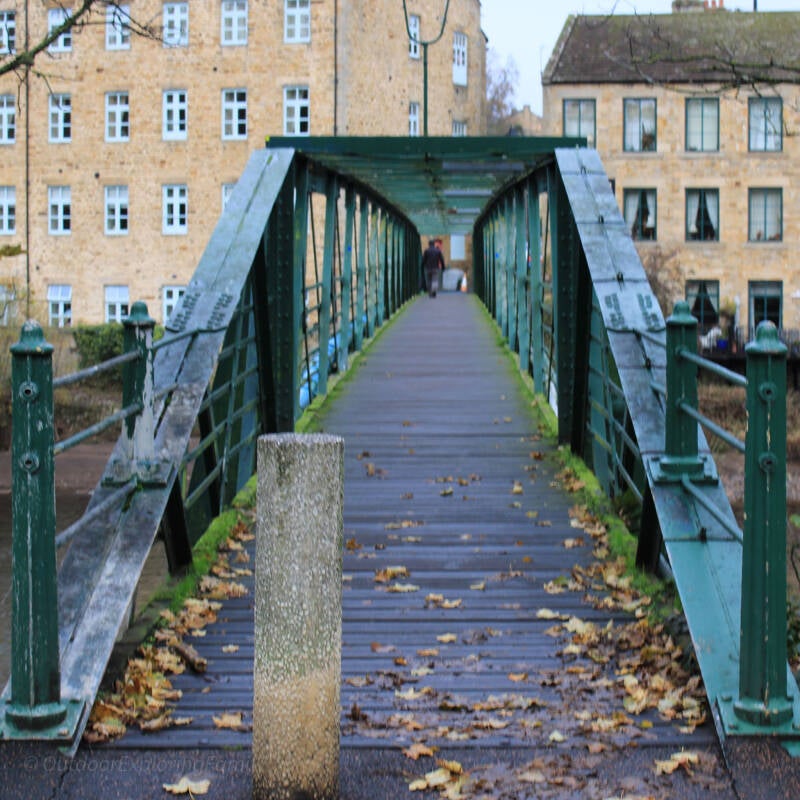
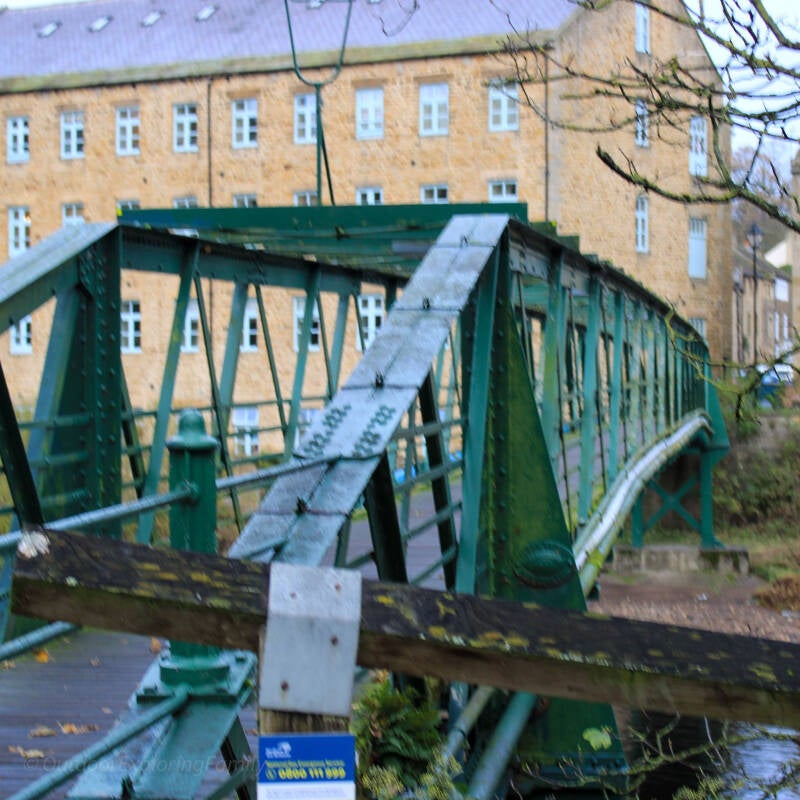
The footbridge that stands at Thorngate today dates from 1882.
This is the bridge many local people know as the Green Bridge. It crosses the River Tees from the bottom of Thorngate to Startforth, close to the site of the earlier crossing and the first iron footbridge destroyed in 1881.
Historic England records the present structure as a Grade II listed footbridge. It carries the original cast inscription:
“WILSON BROS. & CO. ENGINEERS 1882 DARLINGTON”
The bridge is made of wrought iron, with cast iron approach railings and a wooden deck. It has iron trestles supporting the deck beams and lattice parapets, with overhead lattice work and slim wrought iron lamp holders at the ends. The approach railings include fluted cast iron posts with domed finials.
It was built as a footbridge, not a road bridge, and Historic England notes that it was constructed for the mill workers of the nearby mills. That makes sense when you stand there today. Thorngate, Startforth, the Sills and the riverside mills were all part of a working landscape, and this crossing helped people move between home, work, market and town.
The bridge we see now is therefore both a survivor and a replacement.
It is the 1882 successor to the first Thorngate Bridge, but it also continues the older purpose of the crossing: giving people on foot a direct route over the Tees between Barnard Castle and Startforth.
Thorngate Bridge Today
Today, Thorngate Bridge is easy to take for granted. It is crossed by walkers, local residents, families, commuters and people moving between Startforth and Barnard Castle as part of everyday life.
But once you know its story, the Green Bridge feels different.
This quiet footbridge is part of a much older crossing place over the Tees. It carries the memory of the old ford and stepping stones, the first public subscription bridge, the great flood of 1881, the loss of William Thwaites and Richard Gargett, and the rebuilding of a crossing the town still needed.
Thorngate Bridge is not just a shortcut over the river. It is one of Barnard Castle’s most useful and quietly historic links between town, river, work and home.
Explore More Bridges in Teesdale
Thorngate Bridge is one of several historic crossings in and around Barnard Castle. To explore more of the town’s bridge, river and railway history, visit our wider Bridges of Teesdale collection.
You may also enjoy our guides to County Bridge, Percy Beck Bridge, Deepdale Viaduct and Deepdale Aqueduct.