Percy Beck Bridge, Barnard Castle
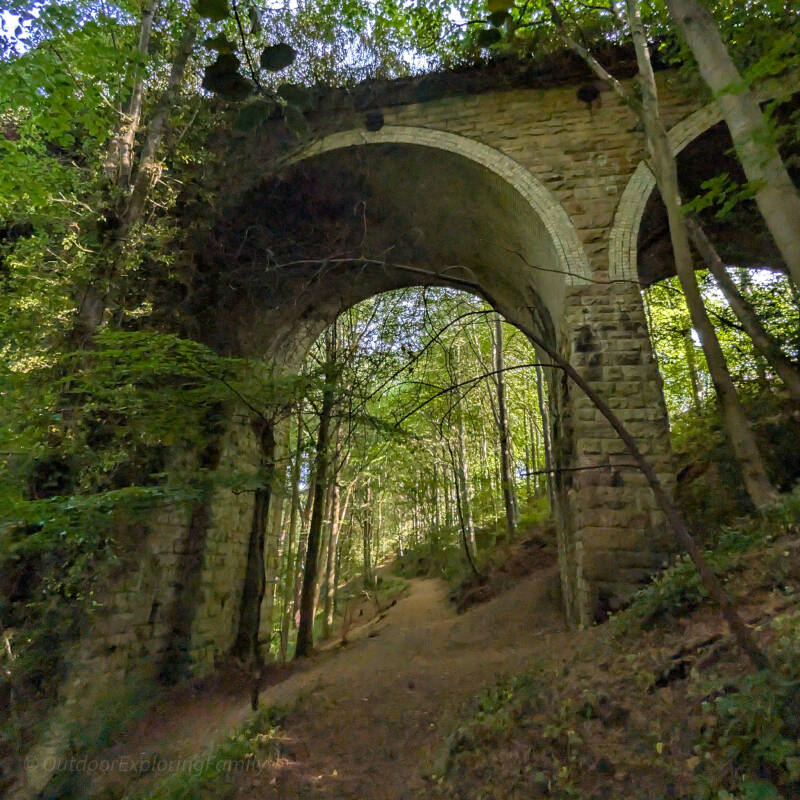
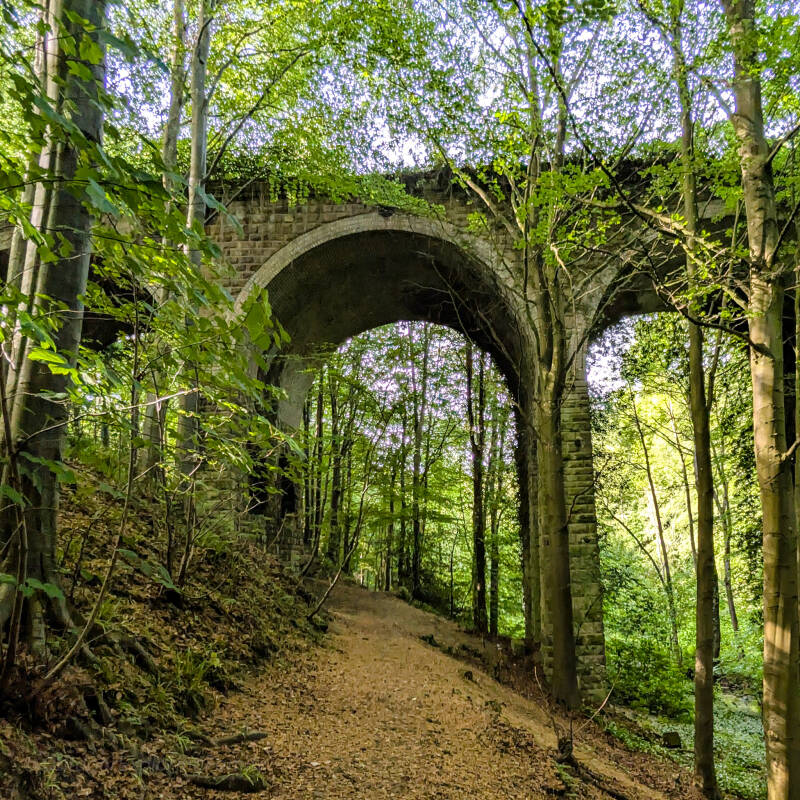
Rising above the woodland paths of Flatts Wood, Percy Beck Bridge is one of Barnard Castle's most impressive surviving railway structures.
Percy Beck Bridge has watched over this quiet woodland valley for more than 160 years. The trains have gone, the tracks have disappeared, and many of Teesdale’s great railway structures were demolished long ago, but this tall stone bridge still rises above Percy Beck as a reminder of the railway age that changed Barnard Castle forever.
It is one of those places that feels even better when you find it on foot. One moment you are walking through the woodland, following the paths through Flatts Wood, and the next a huge Victorian railway bridge appears through the trees. It feels sudden, unexpected and far grander than you might imagine from the quietness of the beck below.
Although it is officially known today as Percy Beck Bridge, historic railway reports often called it Percy Beck Viaduct. Both names tell part of the story. On old maps it appears as a bridge, but in railway language it was often treated as one of the notable viaducts of the South Durham and Lancashire Union Railway.
This was not just a bridge in the woods. It was part of the great Stainmore railway route west from Barnard Castle, carrying trains towards Lartington, Bowes, Kirkby Stephen, Tebay and the wider railway network beyond.
QUICK FACTS
Location: Flatts Wood, Barnard Castle
Official name: Percy Beck Bridge
Historic name: Percy Beck Viaduct
Listed status: Grade II Listed Building
List Entry Number: 1282740
Railway: South Durham and Lancashire Union Railway
Opened with the railway: 1861
Height: Around 70 feet above Percy Beck
Designer: Probably Thomas Bouch
Contractor: D. P. Appleby of Barnard Castle
Access today: Viewed from below on woodland paths through Flatts Wood

WHERE IS PERCY BECK BRIDGE?
Percy Beck Bridge stands in Flatts Wood, on the western side of Barnard Castle near Harmire Road. It carried the old railway line over Percy Beck shortly after trains left Barnard Castle station heading west.
The location is part of what makes the bridge so interesting. It sits close to the town, but it does not feel like a town centre landmark. Instead It sits within the wooded valley , surrounded by trees, sloping paths and the sound of the beck below.
Historic maps show how close the bridge was to Barnard Castle station and Harmire Crossing. Trains leaving the station westbound would cross Percy Beck almost immediately before continuing towards Lartington, Bowes and Stainmore.
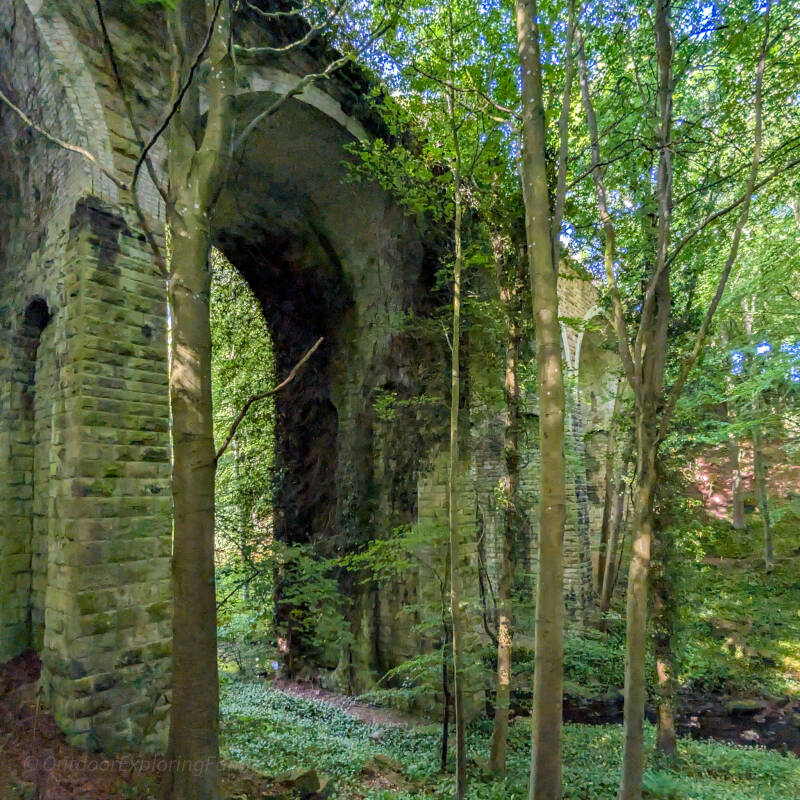
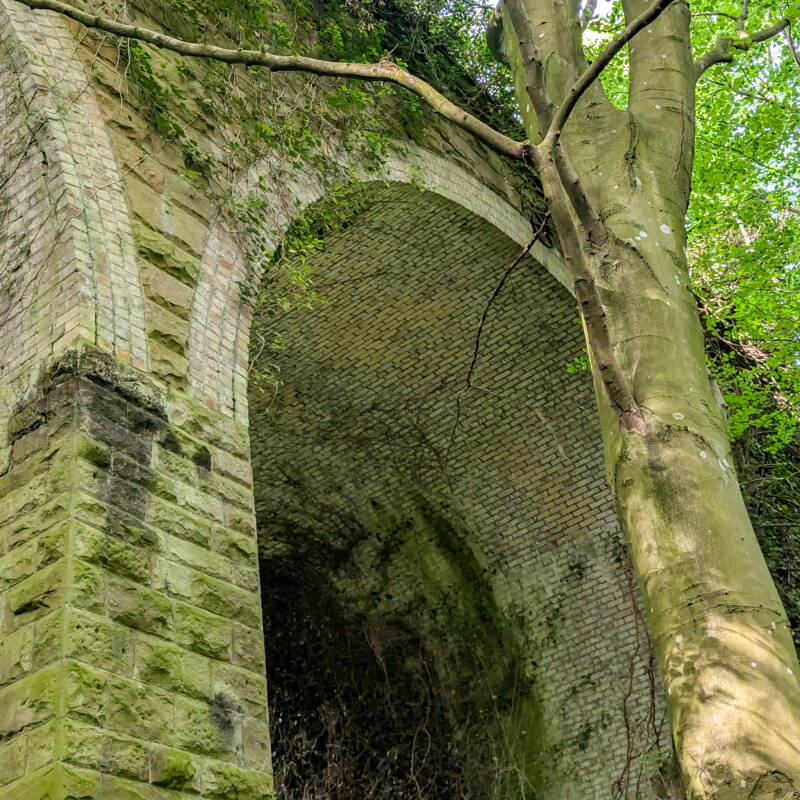
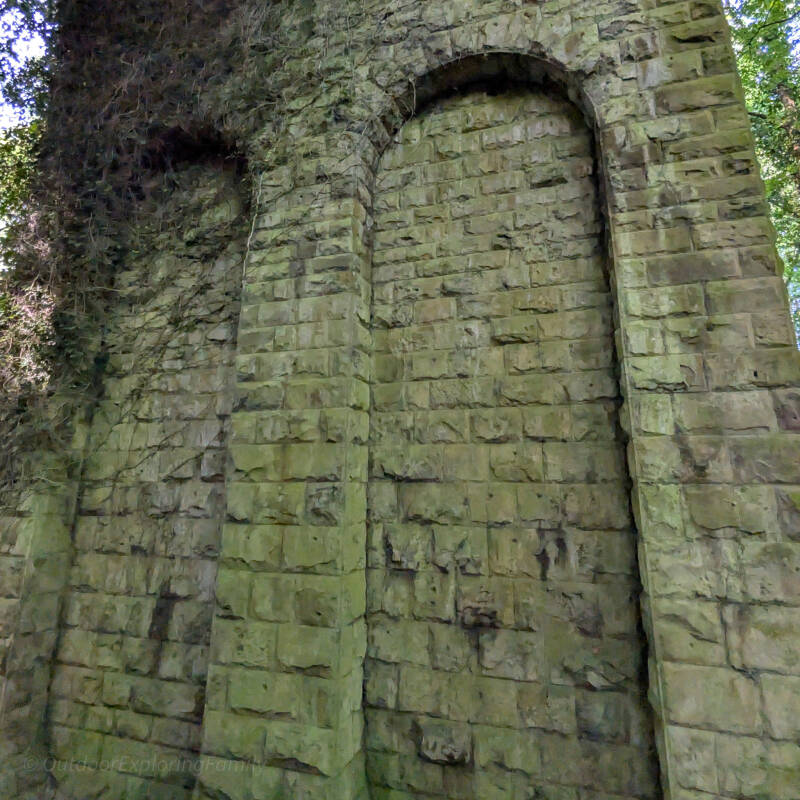
Today, walkers exploring Flatts Wood see the bridge from below rather than from above. That lower view is probably the most atmospheric way to experience it. From the woodland floor, the scale of the bridge becomes clear, with its stone piers and arches rising above the ravine.

A BRIDGE OR A VIADUCT?
One of the most interesting details about Percy Beck Bridge is its name.
Historic maps label it as Percy Beck Bridge. Historic England also lists it as Percy Beck Bridge. Yet many railway reports and local newspaper references called it Percy Beck Viaduct.
This is not really a contradiction. It shows how the structure was understood in different ways.
As an official map feature, Percy Beck Bridge was a bridge over Percy Beck. But to railway writers, engineers and local observers, its height, arches and position above a steep ravine made it feel like a viaduct.
The earliest construction evidence refers to the stone bridge over Percy Beck. Later reports called it Percy Beck Viaduct, especially when discussing it alongside the Tees, Deepdale and Belah viaducts. By 1975, long after the railway had closed, it was still being remembered locally as Percy Beck Viaduct.
For this page, we use Percy Beck Bridge because that is the official listed name, but the older name Percy Beck Viaduct is an important part of its story.
WHY THE BRIDGE WAS NEEDED
Percy Beck is not a large river, but the valley it cuts through the edge of Barnard Castle is steep. That was the challenge.
When the South Durham and Lancashire Union Railway was planned in the 1850s, the line had to leave Barnard Castle and head west towards the River Tees, Lartington, Bowes and the Pennines. Almost immediately, it had to cross the ravine of Percy Beck.
The bridge solved that problem. Standing around 70 feet high, it carried the railway over the wooded valley and allowed trains to continue west without dropping down into the beck and climbing out again.
That is why Percy Beck Bridge can feel surprisingly grand today. The stream below may seem small, but the railway needed a structure strong and high enough to carry heavy trains across the steep sided valley.
In 1880, long after the bridge had been carrying traffic, it was still being described as a major undertaking because of the steepness of the banks, even though Percy Beck itself was a modest stream. That observation captures the bridge perfectly. The water below is small, but the valley and the engineering are not.
THE SOUTH DURHAM AND LANCASHIRE UNION RAILWAY
Percy Beck Bridge was built for the South Durham and Lancashire Union Railway, one of the great railway projects of northern England.
The aim was to create a route from County Durham across Stainmore towards Tebay, linking the North East with the railway network of north west England. The line was important for industry, especially the movement of iron ore, coal and coke, but it also later carried passenger trains, excursions and local services.
The railway west from Barnard Castle opened in 1861. From Barnard Castle it passed through or near Lartington, Bowes, Barras, Kirkby Stephen, Ravenstonedale and Gaisgill before reaching Tebay.
For local people, it changed what was possible. Teesdale was no longer just connected by road and horse drawn traffic. Goods, workers, visitors and families could move across the dale and beyond by rail.
Percy Beck Bridge was one of the first major structures trains crossed after leaving Barnard Castle.
THE 1857 BEGINNING
The story of Percy Beck Bridge belongs to a much bigger moment in Teesdale’s railway history.
In October 1857, ceremonies were held for the foundation stones of the Tees and Deepdale Viaducts. Directors, engineers, contractors and local figures gathered for the occasion, with speeches, banners, music and a dinner at the King’s Head Inn in Barnard Castle.
The Rev. Thomas Witham of Lartington Hall was closely connected with the route because the railway crossed the Lartington estate. The line west of Barnard Castle passed through land that locals still recognise today, linking places such as Harmire, Lartington, Deepdale and the River Tees.
Among those present at the 1857 ceremonies was Thomas Bouch, the engineer of the line. Also involved was D. P. Appleby of Barnard Castle, the local contractor responsible for much of the masonry work.
This is where Percy Beck Bridge enters the story. Appleby’s contract included the stone bridge over Percy Beck, the stone foundations and piers for other railway structures, more than a mile of railway from the junction towards the Tees, and foundation works connected with the great viaducts further west.
It was a huge undertaking, and Percy Beck Bridge was part of that first burst of construction that pushed the railway out of Barnard Castle and towards Stainmore.
THE PEOPLE BEHIND PERCY BECK BRIDGE
Percy Beck Bridge was not the work of one man alone. Like many Victorian railway structures, it was the result of engineers, contractors and landowners working together during one of the greatest periods of railway building in British history.
The bridge is generally attributed to the railway engineer Thomas Bouch, whose work shaped much of the South Durham and Lancashire Union Railway west of Barnard Castle. His route crossed rivers, ravines and the high Pennines, eventually carrying trains across Stainmore towards Tebay and the wider railway network beyond.
Equally important was D. P. Appleby of Barnard Castle. Appleby was far more than an outside contractor arriving for a single project. He had already built Barnard Castle station and became closely associated with many of the railway works around the town. His contracts included the stone bridge over Percy Beck, along with masonry works connected to the Tees and Deepdale structures.
Contemporary writers praised the quality of Appleby's work and described the landscape around Barnard Castle as being filled with monuments to his energy and perseverance. More than 160 years later, Percy Beck Bridge remains one of the few surviving reminders of the work carried out by these Victorian railway pioneers.
Standing beneath the bridge today, it is remarkable to think that the structure above was created not only through engineering skill, but also through the work of local people whose names became part of Teesdale's history.
BUILDING THE BRIDGE
By April 1858, railway works near Barnard Castle were moving quickly. The embankment from the Harmire junction towards Percy Beck had begun, and construction west of the town was pushing towards the Tees.
This detail helps place the bridge in the landscape. Harmire was not just a nearby road name. It was part of the railway story, with the line leaving Barnard Castle, crossing the area near Harmire, and then reaching Percy Beck.
By March 1859, many workmen were employed on the Tees and Percy Beck structures, with Appleby named as contractor. Work was progressing rapidly across the line, and the Deepdale Viaduct had already been crossed by an engine for the first time.
By late 1859, Percy Beck Bridge was finished. The permanent way was then open from Barnard Castle station to the River Tees. This means Percy Beck Bridge was complete before the full railway westwards opened to traffic.
That makes it one of the early completed pieces in the chain of structures that would eventually carry trains from Barnard Castle towards Stainmore.
OPENING THE ROUTE WEST
In October 1860, the Tees Viaduct was crossed by a locomotive for the first time during a directors’ inspection.
The journey gives a wonderful picture of the railway nearly ready for use. A party travelled from the west over Stainmore, down the Greta valley and towards Bowes. Because some works were still incomplete, engines were changed along the way. The party then passed through deep cuttings, crossed Deepdale Viaduct, reached Lartington, and continued through the estate of Rev. Thomas Witham towards the Tees Viaduct.
After crossing the Tees Viaduct, the trains continued towards Barnard Castle and crossed Percy Beck Bridge, described at the time as around 70 feet high above the ravine.
This means Percy Beck Bridge was not just finished on paper. Locomotives were already crossing it before the full public opening of the railway.
The South Durham and Lancashire Union Railway opened in 1861, and Percy Beck Bridge began its working life as part of the Stainmore route.
THE RAILWAY YEARS
For more than a century, Percy Beck Bridge carried trains in and out of Barnard Castle.
Passenger trains used the route, but the railway’s deeper purpose was industrial. It helped move coal, coke, iron ore and other goods between the North East and the north west. It linked Teesdale with larger industrial networks and helped Barnard Castle become a more connected railway town.
Trains leaving Barnard Castle station westbound would pass near Harmire Crossing, cross Percy Beck Bridge, and then continue towards Lartington and Bowes. From there, the line climbed towards Stainmore, a route famous for hard gradients, difficult weather and heavy work for railway crews.
In later years the line also carried excursion traffic. Summer trains connected the North East with western destinations, and the Stainmore route became well known among railway enthusiasts for its scenery, gradients and exposed upland character.
Percy Beck Bridge was only one structure on that route, but it was part of the everyday railway life of Barnard Castle.
BARNARD CASTLE STATION AND THE LOST RAILWAY LANDSCAPE
To understand Percy Beck Bridge, it helps to picture the railway landscape that once surrounded it.
Barnard Castle had more than one station story. The earlier Darlington and Barnard Castle Railway opened in 1856, while the later South Durham and Lancashire Union Railway station opened in 1861 on the west side of Harmire Road.
For a short time, the town had two separate stations. This was awkward for passengers, so by 1862 services were reorganised and the later station became the main through station.
The area around Harmire Road, Montalbo Road, the old station site and the line towards Flatts Wood was once full of railway activity. There were platforms, sidings, signal boxes, goods facilities, a level crossing, an engine shed and a turntable.
Most of that has now disappeared. The station buildings are gone, the track has vanished, and the railway corridor has changed. But Percy Beck Bridge remains, giving people today a rare physical connection to that lost railway landscape.
CLOSURE OF THE LINE
The decline of the railway came gradually.
Passenger services over the Stainmore route west of Barnard Castle ended in January 1962. The remaining railway through Barnard Castle survived for a little longer as part of the Middleton in Teesdale branch.
This reprieve did not last. Passenger services at Barnard Castle ended on 30 November 1964, and goods traffic ceased on 5 April 1965. The tracks were lifted shortly afterwards.
For local people, the closure was not just the end of a transport service. It marked the loss of a railway that had shaped Teesdale’s industry, travel, work and identity for more than a century.
In the years that followed, many of the great structures connected with the line disappeared.
Deepdale Viaduct was dismantled in 1963.
Belah Viaduct was dismantled in 1964.
The Tees Viaduct was demolished in June 1972.
Percy Beck Bridge escaped.
WHY PERCY BECK BRIDGE SURVIVED
Percy Beck Bridge is one of the lucky survivors.
Many of the great iron viaducts of the Stainmore route were costly to maintain after closure and were dismantled. Percy Beck Bridge, however, was a solid masonry structure. Its stone piers, brick arches and shorter span gave it a different future.
By the 1970s, people were already looking back at the lost railway structures with sadness. The great Tees, Deepdale and Belah viaducts had either gone or were disappearing from the landscape. Percy Beck Bridge remained standing above the wooded ravine, quietly surviving while much of the railway around it was removed.
Today that survival makes it especially important. It is not the largest railway structure Teesdale ever had, but it is one of the few remaining places where you can still stand beneath the old Stainmore railway route near Barnard Castle and feel its scale.
THE STRUCTURE TODAY
Percy Beck Bridge is a Grade II listed building.
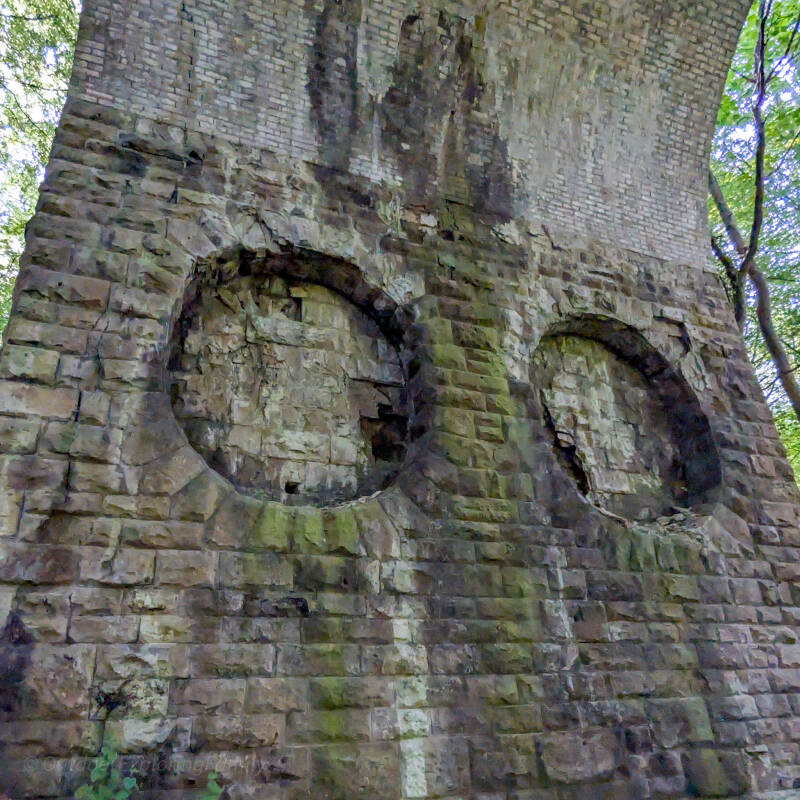
Historic England describes it as a railway viaduct over Percy Beck, with the railway line removed. It is built of rock faced sandstone, with fire brick arches, ashlar dressings and wrought iron ties.
The bridge has four main arches carried on stone piers, with an accommodation arch at each end. The high round arches are built in yellow brick, while the outer masonry has the rugged, rock faced appearance typical of substantial Victorian railway work.
More than 160 years after it was built, the bridge still retains much of its original character, the structure still has a strong and solid presence. From below, the stone piers and arches give a real sense of the work involved in carrying heavy trains across the ravine.
It is easy to overlook from a distance because it is partly hidden by trees, but once you are beneath it the scale is hard to miss.
VISITING PERCY BECK BRIDGE TODAY
Percy Beck Bridge is best seen from the paths through Flatts Wood.
There is something special about reaching it on foot. It does not sit in a busy visitor attraction or beside a large information board. It reveals itself slowly as part of the woodland.
The walk through Flatts Wood has its own calm character, with paths, trees, the sound of Percy Beck and glimpses of Barnard Castle’s quieter edges. Then the bridge appears. For a moment the woodland feels much older and much bigger, as if the railway age has suddenly stepped back into view.
From below, you can appreciate why people once called it a viaduct. The structure rises above the valley with a confidence that feels far greater than the small beck beneath it. It is a reminder that Victorian engineers did not only build for function. They also left behind structures with presence.
WHAT TO LOOK FOR
When you visit, look at the contrast between the quiet woodland and the size of the bridge.
Notice how Percy Beck itself feels small compared with the height of the arches above it. That contrast explains why the bridge was seen as such a significant piece of engineering. The stream was modest, but the ravine was steep, and the railway needed to cross it without losing height.
Look for the different materials too. The sandstone gives the bridge its heavy, grounded appearance, while the yellow brick arches stand out as part of the structure’s Victorian railway character.
Also notice how the bridge sits within the wider landscape. It is close to Harmire Road, not far from the old station site, and part of the route that once headed west towards Lartington and Deepdale.
This is not an isolated ruin. It is a surviving piece of a much larger railway story.
A SMALL TIMELINE OF PERCY BECK BRIDGE
1832
Early proposals begin for railway connections to Barnard Castle, though opposition from landowners slows progress for many years.
1854
Approval is granted for the Darlington to Barnard Castle railway.
1856
The Darlington and Barnard Castle Railway opens, bringing the first railway station to the town.
1857
The South Durham and Lancashire Union Railway receives Royal Assent. Work begins on the ambitious route from Barnard Castle towards Stainmore and Tebay.
October 1857
Foundation ceremonies are held for the Tees and Deepdale Viaducts. D. P. Appleby’s contract includes the stone bridge over Percy Beck and other major masonry works west of Barnard Castle.
April 1858
The embankment from Harmire junction towards Percy Beck is under construction.
March 1859
Work is progressing on the Tees and Percy Beck structures, with many workmen employed and Appleby named as contractor.
Late 1859
Percy Beck Bridge is finished, allowing the railway to reach the River Tees from Barnard Castle station.
October 1860
Locomotives cross Percy Beck Bridge during the inspection and opening events connected with the Tees Viaduct.
8 August 1861
The South Durham and Lancashire Union Railway opens between Barnard Castle and Tebay.
1862
The later Barnard Castle station becomes the main through station, helping connect the routes through the town.
1962
Passenger services over the Stainmore route west of Barnard Castle end.
30 November 1964
Passenger services through Barnard Castle end.
5 April 1965
Goods traffic ends and the railway closes completely.
1972
The Tees Viaduct is demolished. Percy Beck Bridge remains standing.
28 November 1994
Percy Beck Bridge is officially listed as a Grade II building.
Today
Percy Beck Bridge can still be seen from the woodland paths of Flatts Wood, one of the last surviving railway structures of its kind around Barnard Castle.
WHY THIS BRIDGE MATTERS
Percy Beck Bridge matters because it connects so many layers of Barnard Castle’s story.
It connects Flatts Wood with the railway age.
It connects Harmire Road with the old station.
It connects Barnard Castle with Lartington, Bowes and Stainmore.
It connects local names such as D. P. Appleby, Thomas Bouch and Rev. Thomas Witham with the physical landscape we can still walk through today.
Most of all, it survives.
The Tees Viaduct has gone. Deepdale Viaduct has gone. Belah Viaduct has gone. Barnard Castle station has gone. But Percy Beck Bridge remains, standing above the beck and reminding us that the woods around Barnard Castle are full of stories if we take time to look.
A PLACE TO PAUSE
There is a quiet sadness to Percy Beck Bridge, but also something hopeful.
The railway that built it has vanished. The engines no longer climb west from Barnard Castle. The sound of wheels over the arches has been replaced by leaves, running water and woodland birds.
Yet the bridge is still here.
For families, walkers, railway enthusiasts and local people, it is a place where history can be felt without needing much imagination. You stand below it, look up, and the scale of what was built here suddenly becomes clear.
Percy Beck Bridge is not just a forgotten railway structure in Flatts Wood. It is one of Barnard Castle’s great surviving links with the age of steam, industry and Victorian ambition.
Explore More in Teesdale
Percy Beck Bridge is part of our wider Bridges of Teesdale collection, where we explore the old bridges, railway crossings, viaducts and river landmarks found across the valley.
Flatts Wood, Barnard Castle
Discover the wider woodland where Percy Beck Bridge can still be seen today, including peaceful paths, local history and links with the wellbeing walks created for the people of Barnard Castle.
Deepdale Viaduct, Barnard Castle
Read the story of the lost iron giant of Deepdale, another major railway structure on the route west from Barnard Castle.
Deepdale Aqueduct
Explore the Victorian aqueduct that carries a water pipe across the River Tees near Barnard Castle and Lartington.
Deepdale Woods
Explore the woodland valley across the River Tees, with its old railway remains, rifle range history, carved stone face and glacial boulder.
Barnard Castle Town Guide
Discover more places to visit around Barnard Castle, including the castle, riverside walks, independent shops, green spaces and nearby woodland.