Deepdale Aqueduct, Barnard Castle
Deepdale Aqueduct is a Victorian water crossing over the River Tees near Barnard Castle. It is labelled as Tees Aqueduct on the local information board and is also known locally by some as the Silver Bridge, a name that fits its pale metalwork and distinctive position beside the river.
This page tells the story of Deepdale Aqueduct, from its Victorian water supply purpose and public opening in 1894, to the people who helped make it a footbridge into Deepdale.
At first glance, it looks like a footbridge. Look more closely, and you realise it was also built to carry water. Along the walkway, Victorian engineering carried large water mains across the river as part of a wider water supply scheme for the Teesside towns.
But the story of Deepdale Aqueduct is not only about pipes, ironwork and stone.
When the aqueduct was built, local people saw a chance to create something more. Thanks to the cooperation of the Stockton and Middlesbrough Water Board, Monsignor Witham of Lartington, and Lord Barnard, the structure was also opened for public use as a footbridge. That decision gave residents and visitors a new way into the beautiful wooded valley of Deepdale.
In 1894, Barnard Castle celebrated the opening with a public procession, speeches, a banquet at the King’s Head Hotel, music from the band of the 3rd Durham Light Infantry, and evening illuminations beside the river.
More than 130 years later, people still cross Deepdale Aqueduct for the same simple reason: to enjoy the scenery, reach Deepdale, and spend time beside the Tees.
Quick Facts
Name: Deepdale Aqueduct
Also known as: Tees Aqueduct, Silver Bridge
Location: River Tees, near Barnard Castle and Lartington
Listed status: Grade II listed
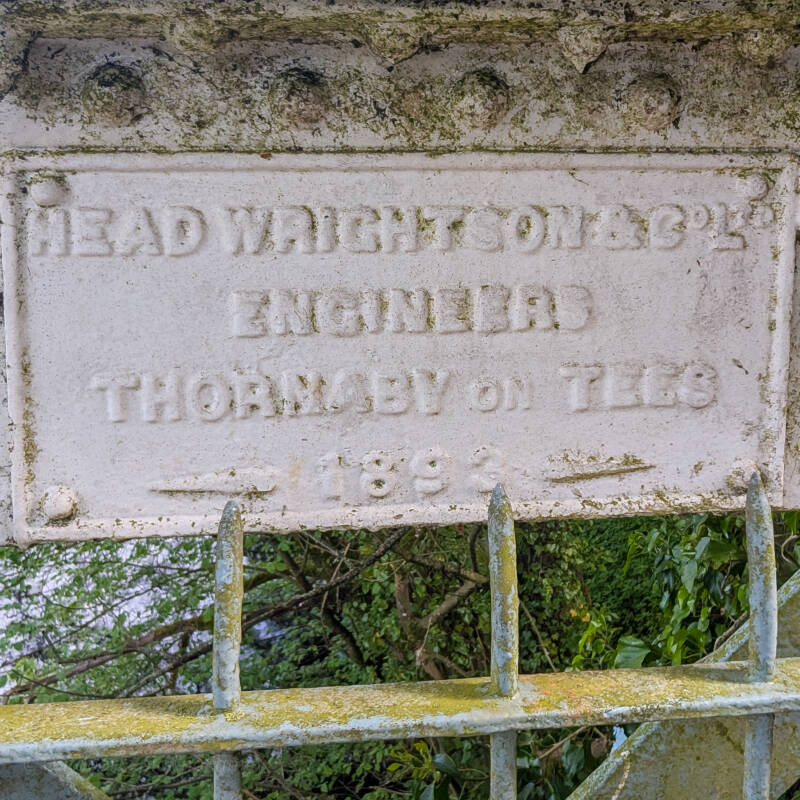
Date built: 1893, shown on the Head Wrightson maker’s mark
Opened for public use: October 1894
Builder: Head, Wrightson and Co., Thornaby-on-Tees
Engineer: Mr Mansergh, C.E., Westminster
Purpose: Aqueduct and public footbridge
Water mains: Three 25-inch pipes
Structure: Cast iron span, planked walkway and stone end sections
Length: Around 45 metres

A Victorian Water Bridge Across the Tees
Deepdale Aqueduct was built during a time when clean water supply was one of the great public works of the Victorian period.
The growing towns of Stockton, Middlesbrough and Thornaby needed reliable supplies of clean upland water. The Stockton and Middlesbrough Water Board developed a large scheme to carry water from the Teesdale area towards the industrial towns of Teesside.
At Deepdale, that water route needed to cross the River Tees.
The answer was not just a pipe laid across the landscape. It was a substantial iron and stone aqueduct, designed to carry three large water mains beneath a public walkway.
Historic England records Deepdale Aqueduct as being dated 1893 and built by Head, Wrightson and Co., engineers of Thornaby on Tees. It describes the structure as an aqueduct and footbridge, with a cast iron bridge span, cast iron columns, a planked walkway and rock faced stone end sections.
This is what makes Deepdale Aqueduct unusual.
It was built as part of a water supply system, but it became part of the walking landscape around Barnard Castle.

Built for Water, Opened for People
Deepdale Aqueduct could have remained a private waterworks structure.
Instead, it became a public footbridge too.
The idea of using the aqueduct as a public crossing was credited at the time to Monsignor Witham of Lartington. He saw that a structure being built for water could also serve the people of Barnard Castle by giving them a better way into Deepdale.
Lord Barnard also supported the arrangement from the Barnard Castle side, helping make the approaches available. The Stockton and Middlesbrough Water Board allowed a bridge built for water supply to be used by the public.
The result was a new right of use across the aqueduct.
This did not mean the public owned the bridge. It remained part of the waterworks system. But it did mean people could cross it and use it as a walking route.
That decision is the heart of the story.
Deepdale Aqueduct was built for water, but opened for people.
Why Deepdale Mattered to Barnard Castle
Deepdale was already one of the beautiful wooded valleys close to Barnard Castle.
The beck runs down through a deep glen towards the River Tees, with woodland, rocky slopes, quiet paths and old landscape features along the way. Further into the valley are places connected with Cat Castle Rocks, Cragg Falls, the Shap granite boulder and the former Deepdale Viaduct.
For Barnard Castle, easier access to Deepdale was about more than a shortcut.
It fitted a wider idea of the town as a healthy, attractive and interesting place to live and visit. By the late 19th century, Barnard Castle was already proud of its school, its museum, its riverside walks, its scenery and its position beside the Tees.
The new aqueduct helped connect the town with the countryside around it.
That is why the opening was celebrated so strongly.
The Opening Day in 1894
The public opening of Deepdale Aqueduct took place in October 1894 and was treated as a red letter day for Barnard Castle.
The town was decorated with bunting and flags. Some of the flags carried the device of Middlesbrough Corporation, including the lion rampant and the motto “Erimus.” It was a reminder that this local crossing was also part of a much larger Teesside water supply scheme.
At half past two in the afternoon, a procession began at the Witham Testimonial.
The band of the 3rd Battalion Durham Light Infantry led the way. Behind them came members and officers of the Court Leet, boys from the North Eastern County School with their masters, members of the Stockton and Middlesbrough Water Board, Alderman T. Hugh Bell, Lord Barnard, members of the Barnard Castle Local Board, the mayors and town clerks of Stockton, Middlesbrough and Thornaby, and members of the public.
The route passed through the heart of Barnard Castle.
From the Witham Testimonial, the procession went down The Bank, through Bridgegate, over County Bridge and along Deepdale Road towards the new aqueduct.
It must have been quite a sight.
A whole town walking out together to mark a new crossing over the Tees.
The People Behind the Aqueduct
Several names are closely connected with the opening of Deepdale Aqueduct.
The Stockton and Middlesbrough Water Board built the structure as part of its water supply scheme. Alderman T. Hugh Bell, chairman of the Water Board, played a leading role in the day’s proceedings.
Monsignor Witham of Lartington was credited with the idea of making the aqueduct useful as a public footbridge as well as a water crossing. He was unable to attend the opening in person because of age and infirmity, but his letter was read during the ceremony.
Lord Barnard represented the Barnard Castle side of the arrangement and accepted the public right of use on behalf of the town.
Other local names appear in the story too. Mr Mansergh, C.E., of Westminster was named as architect and engineer. Mr Stainsby of Galgate, Barnard Castle, acted as inspector of the works for the Water Board. Mr D. D. Wilson was the general manager of the Board.
Later in the day, at the King’s Head Hotel, many familiar local and regional figures gathered, including doctors, clergy, officials, councillors, mayors and representatives from Barnard Castle, Stockton, Middlesbrough and Thornaby.
This was not a quiet opening of a utility structure.
It was a public moment involving some of the most important local names of the day.
How Deepdale Aqueduct Was Built
Deepdale Aqueduct was designed as a serious piece of engineering.
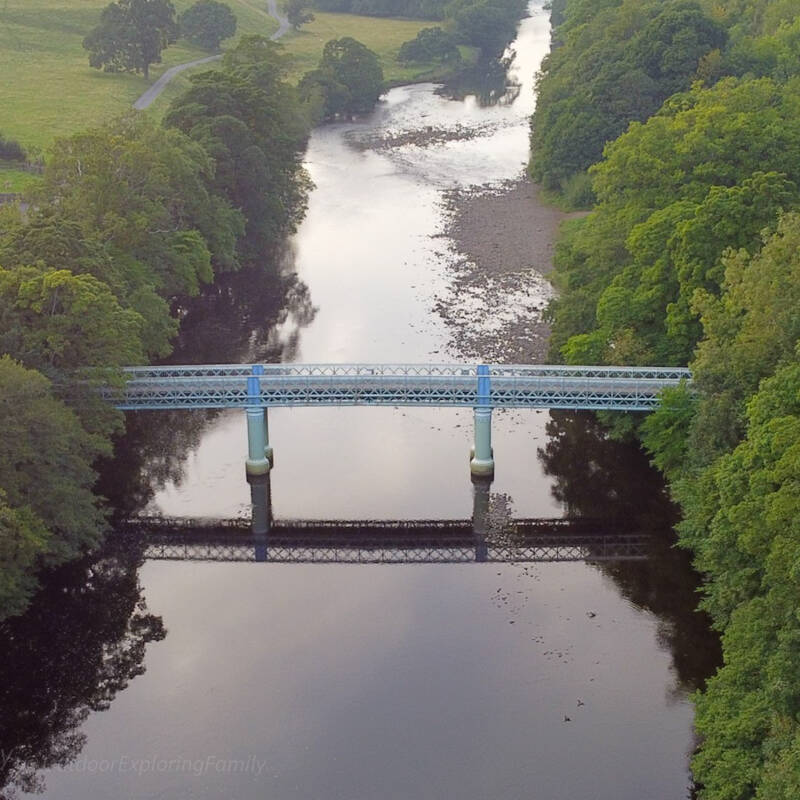
The bridge had three openings carried by continuous lattice girders. These rested on two abutments and two river piers.
The central span measured 57 feet from centre to centre of the piers. Each side span measured 35 feet 6 inches from the centre of the pier to the face of the abutment.
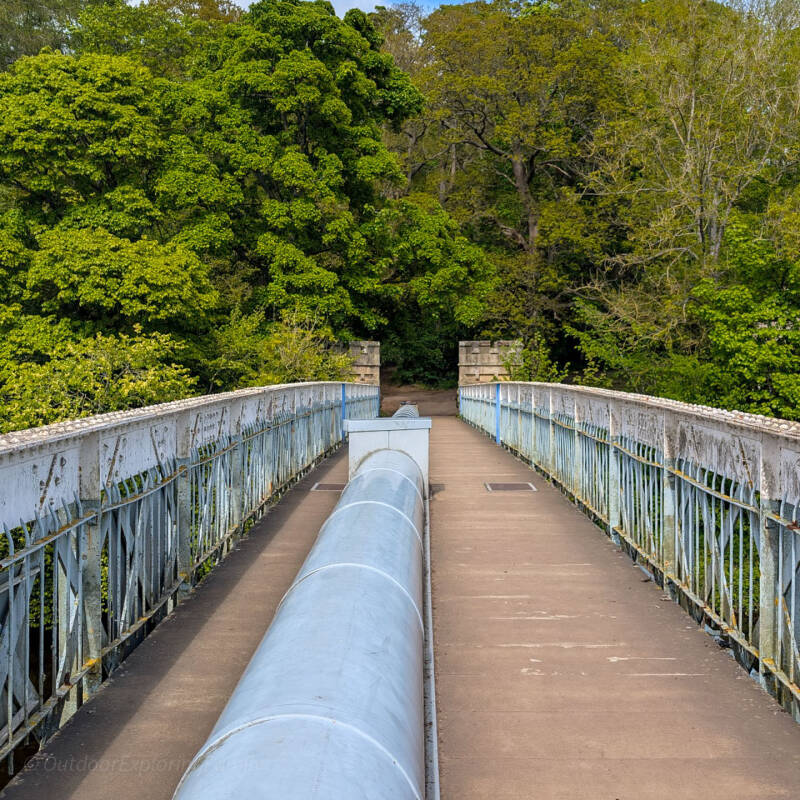
The main girders were set 10 feet apart. A planked footway, around 10 feet wide, was carried through the middle of the structure.
Below the footway were three 25 inch water mains.
The river piers were formed from cast iron cylinders and columns. Each pier had two cast iron cylinders, 6 feet in diameter, with columns above them. The columns were connected by cast iron bracing.
The foundations were taken down to the rock. The Yorkshire pier went 17 feet below summer water level, while the Durham pier went 11 feet below summer water level. Both were fixed into the rock with concrete.
The masonry was carefully finished too. The abutments, turrets, valve wells, wing walls and terminal newels were built in coursed rock faced masonry. Other features, including plinths, girder beds, pipe rests, coping, string courses and corbels, were finished in ashlar masonry.
The pipes passed through dwarf walls and included expansion joints. The water mains were laid on a gradient of 1 in 50.
It was a practical water crossing, but it was not plain.
The aqueduct was built to do a job, but also to stand proudly in the landscape.
The Turrets, Gates and Stonework
One of the most distinctive features of Deepdale Aqueduct is the stonework at each end.
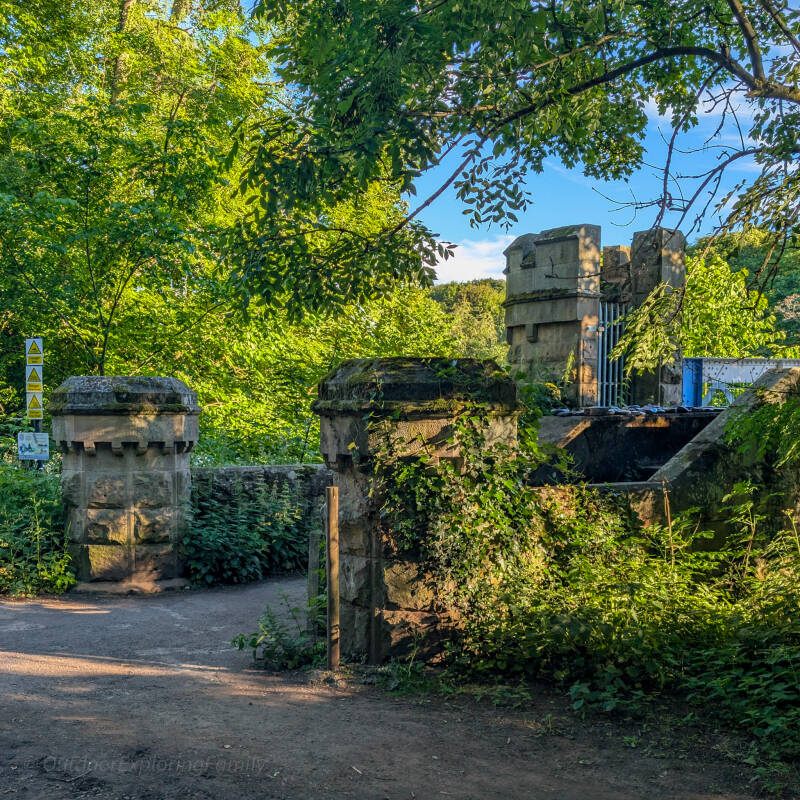
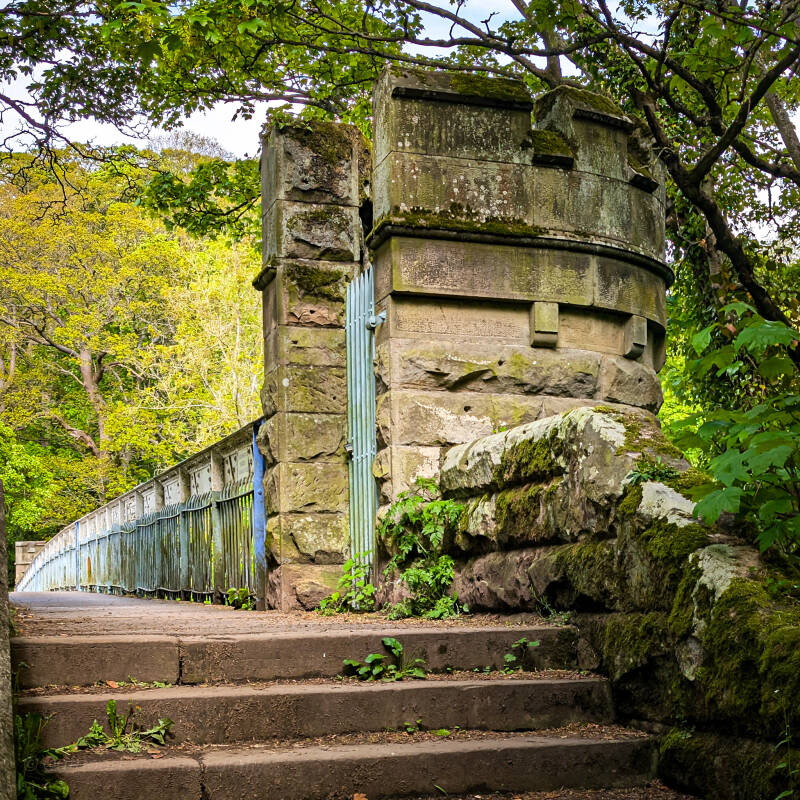
The bridge has decorative stone turrets and gated spaces that give the structure a slightly castellated appearance. Historic England describes octagonal plan end piers with corbelled, chamfered caps, linked by short flights of steps to embattled, semi octagonal towers flanking the walkway.
The original description of the works also refers to turrets, valve wells, wing walls and terminal newels.
Today, the gated stone spaces at the ends of the aqueduct are one of its most curious features. Their exact internal use is not obvious from the outside. They appear to belong to the original water engineering and masonry arrangement, and may have allowed access to features connected with the water mains, valves or inspection points.
What is clear is that the turrets and stonework were part of the original design.
The engineers could have made a much plainer crossing. Instead, they created something with presence, detail and a sense of importance.
Deepdale Aqueduct and Deepdale Bridge
It is easy to confuse Deepdale Aqueduct with Deepdale Bridge because they sit close together in the same landscape.
They are separate structures with different jobs.
Deepdale Bridge carries road traffic over Deepdale Beck.
Deepdale Aqueduct crosses the River Tees nearby, carrying the footway and the water mains.
Historic maps show both names in the area, which can make things confusing at first. The aqueduct was also sometimes described in old reports as a bridge because people used it as a public crossing into Deepdale.
Today, the difference is useful.
Deepdale Bridge belongs to the road crossing over the beck.
Deepdale Aqueduct belongs to the water supply story, the public footbridge and the opening up of Deepdale to walkers from Barnard Castle.
The Banquet at the King’s Head Hotel
After the opening ceremony, the celebration continued back in Barnard Castle.
At four o’clock, a banquet was held at the King’s Head Hotel. More than sixty gentlemen attended, with Lord Barnard presiding.
The guests included Alderman T. Hugh Bell, members and officials of the Water Board, the mayors and town clerks of Stockton, Middlesbrough and Thornaby, County Councillor Barker, local doctors, clergy, civic figures and representatives from Barnard Castle.
The menu gives a wonderful glimpse of the scale of the occasion.
There were soups, sole, turbot with lobster sauce, oyster patties, veal cutlets with mushrooms, haunches of venison, sirloin of beef, goose, boiled and roast turkeys, boiled and roast chickens, saddle of mutton and hams.
The second course included Sir Watkin puddings, jellies, vanilla cream, trifles and pastry.
This was a serious civic meal.
Barnard Castle was not simply opening a footbridge. It was celebrating a new connection between the town, the river, Deepdale and the wider Teesside water scheme.
Chinese Lanterns and Music by the River
The day ended with a beautiful evening scene beside the Tees.
Many townspeople walked down to the Durham entrance of the aqueduct to hear music from the band of the 3rd Durham Light Infantry and see the bridge illuminated.
Chinese lanterns and Vauxhall lights were used to light the aqueduct and its surroundings. From the Scar, the reflections on the river made the scene especially memorable.
The band played during the evening, including a cornet solo of Sullivan’s “The Lost Chord” by Sergeant Hume of Richmond.
The illumination was arranged through the efforts of local men including Mr Lockey and Mr J. W. Myers, with subscriptions given by townspeople.
It is one of the loveliest details in the whole story.
For one evening, a water bridge became a place of light, music and local pride.
Early Safety Concerns
Deepdale Aqueduct quickly became part of public life around Barnard Castle.
By 1901, Barnard Castle Urban District Council was already discussing safety concerns at the crossing. The worry was that the side railings did not give enough protection, especially for children and visitors, and that someone could slip through towards the river.
The council agreed that the issue should be raised with the Tees Valley Water Board.
This small detail tells us something important.
Deepdale Aqueduct was being used. People were crossing it, visiting it and treating it as part of the walking route into Deepdale only a few years after the opening.
It was not just a hidden piece of waterworks infrastructure.
It had become part of everyday movement around the town.
The Water Route from Lartington
Deepdale Aqueduct remained part of the wider water supply system.
A later report from 1917 mentions the first section of pipe track from the filter beds at Lartington to Deepdale Aqueduct being tested at high pressure for the Tees Valley Water Board.
That detail helps place the aqueduct in the wider water route.
It was one link in a larger system of filter beds, pipe tracks, water mains and crossings that helped carry upland water towards the communities that needed it.
This is why Deepdale Aqueduct belongs in more than one story.
It is part of Barnard Castle’s walking history.
It is part of the Teesdale water supply story.
It is part of Victorian engineering.
And it is part of the long relationship between the town, the river and the landscape around it.
What You Can See Today
Today, Deepdale Aqueduct still crosses the River Tees near Barnard Castle and Lartington.
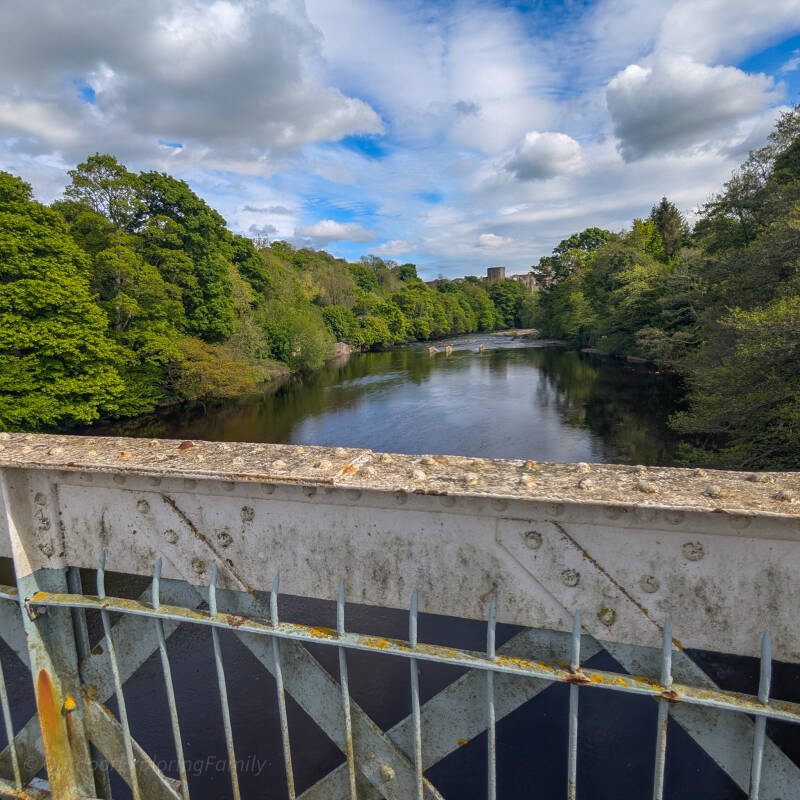
You can see the iron lattice structure, the paired cast iron supports, the walkway and the decorative stone ends. The turrets and gated stonework give the crossing a much grander appearance than many people expect from a waterworks structure.
It is worth pausing before you cross.
This was once a celebrated new structure, marked by a town procession, speeches, a banquet, lanterns and music beside the river.
Now it is quieter.
Walkers use it to reach Deepdale, look down at the Tees and continue into the woods.
That is part of its charm.
A Moment of Calm
Deepdale Aqueduct feels like the starting point for so many peaceful walks around Barnard Castle.
From here, you can head towards Deepdale, follow quiet woodland paths, wander towards Lartington, or link back into the riverside walks around the town. It is one of those places where the landscape seems to open up.
Standing on the aqueduct, you also get a lovely view along the River Tees towards Barnard Castle. The castle rises above the river in the distance, while the water moves quietly below your feet.
That is what makes this crossing special today.
It was built to carry water, but for walkers it does something just as valuable.
It gives you a gentle way out of town and into a slower, quieter landscape.
Explore More Bridges in Teesdale
Deepdale Aqueduct sits close to several other historic crossings and railway remains around Barnard Castle, Startforth and Deepdale. It is part of our wider Bridges of Teesdale collection.
You may also enjoy our guides to Deepdale Viaduct, Percy Beck Bridge, County Bridge and Thorngate Bridge.