Robert Taylor Richardson of Barnard Castle
Many people in Barnard Castle know the Richardson name because of Richardson Hospital, but far fewer know the story of Robert Taylor Richardson himself.
He was much more than the man who left a house to the town. He was a Barnard Castle solicitor, militia officer, Justice of the Peace, county councillor, landowner, trustee and benefactor whose life was closely woven into the civic, medical, charitable and public life of Barnard Castle.
His home, The Starlings on John Street, became part of the town’s healthcare story. His family were connected with the Barnard Castle Dispensary. His land and property were tied to charity, open space, church life and public welfare. His name continued to appear in local debates about healthcare and community facilities long after his death.
This is the story of Robert Taylor Richardson, the man behind one of Barnard Castle’s most important healthcare legacies.
A Barnard Castle family rooted in public service
Robert Taylor Richardson was the son of Thompson Richardson, another important figure in Barnard Castle’s nineteenth century public life.
Thompson Richardson was remembered at St Mary’s Parish Church through a stained glass window installed in his memory in 1892. St Mary’s records describe him as superintendent on the town Board of Health, a benefactor of the North Eastern County School and National Schools, and lawyer clerk to the town magistrates for around fifty years.
That background matters because Robert Taylor Richardson did not suddenly appear at the end of his life as a generous local benefactor. He came from a family already connected with law, education, public health, church life and civic duty in Barnard Castle.
Robert followed a family pattern of local responsibility.
A solicitor in Barnard Castle
Robert Taylor Richardson was already active in Barnard Castle’s legal world by the 1860s.
A Teesdale Mercury notice from 1864 named Robert Taylor Richardson of Barnard Castle as the solicitor acting in a bankruptcy case. Later archive records repeatedly connect him with legal work, property, trusts, charities, land, local administration and public affairs.
The Hanby Holmes archive describes him as the son of Thompson Richardson and as a solicitor in Barnard Castle who later gave up his business as he grew older. The same archive records show how closely his legal and property life became connected with the later Richardson Charity.
This legal background helps explain the detail and complexity of his will. Richardson was not simply a wealthy man making a generous gesture. His will shows a detailed concern with property, trusteeship, legal conditions and long term charitable planning.
Militia officer and honorary Major
Richardson also had a military and county service side to his life.
In 1866, the Teesdale Mercury reported that Robert Taylor Richardson, gent., had been appointed Lieutenant in the 1st Durham Regiment of Militia. By 1883, he was recorded as Captain Robert Taylor Richardson of the 3rd Battalion Durham Light Infantry and was granted the honorary rank of Major.
A Durham Record photograph from around 1868 also lists Lieutenant R. Richardson among officers of the 1st South Durham Militia at Castle Garth in Barnard Castle, with the people index identifying him as Robert Taylor Richardson.
This does not mean he was a battlefield soldier in the modern sense. The militia was part of local county defence and public service. But it does show that Richardson held recognised military rank and moved in the public service circles of County Durham.
It adds another layer to the man: solicitor, landowner, public servant and militia officer.
County councillor for Barnard Castle
Richardson also served in local government.
A 1913 newspaper report said he had represented the Barnard Castle County Council Electoral Division for twelve years. A Teesdale Mercury report from that year described him as “Mr Robert Taylor Richardson, of The Starlings” and recorded his contested election against Charles James Smith of Galgate.
Richardson won by 431 votes to 261, giving him a majority of 170.
The Barnard Castle County Council Electoral Division covered more than the town itself. The report described an area including Barnard Castle, Marwood, Streatlam, Stainton, Westwick, Whorlton, Gainford and Winston.
After the election, Richardson publicly thanked voters for allowing him to continue as their representative on the County Council. His words suggest a man who felt secure in his local support, but who also wanted any bitterness from the contest to fade.
He was also listed as a Justice of the Peace, another sign of the trust and standing he held in local life.
A trusted figure in land and local affairs
Richardson’s public role also reached into older landholding and manorial structures.
A report of the Bowes Manor Court named Robert Taylor Richardson as one of the Lords in Trust for the freeholders of Bowes Manor. At that meeting, Richardson presided over business dealing with quarry stone, moorland valuation, sporting rights, railway access, award plans, herbage, local land management and the appointment of new Lords in Trust.
This matters because it shows him operating in the older legal landscape of Teesdale, where freeholders, moorland rights, quarries, leases, roads and local custom still shaped everyday life.
Richardson was not just a name attached to a hospital. He was one of the people trusted to handle complicated local affairs.
The Dispensary and a family tradition of care
One of the most important parts of Richardson’s story is his connection with the Barnard Castle Dispensary.
The Dispensary helped provide medical support in the town before the modern NHS. It was especially important at a time when many people could not easily afford private medical care or travel long distances for treatment.
Newspaper reports show that Thompson Richardson, Robert’s father, had been connected with the management of the Dispensary before him. Robert Taylor Richardson later succeeded him and continued until old age forced him to give up the role when he was nearly ninety.
It means Richardson’s later gift of The Starlings for healthcare was not a random final act. It came from a lifetime, and a family tradition, of involvement in local medical welfare.
The Richardson family had been linked with Barnard Castle’s healthcare story long before Richardson Hospital existed.
The Starlings on John Street
Robert Taylor Richardson’s home was The Starlings, a house on John Street in Barnard Castle.
Archive records describe The Starlings as the house he bequeathed as a convalescent home. The Hanby Holmes catalogue also records that E. R. Hanby Holmes was involved in administering Richardson’s estate and helping establish the convalescent home.
The house became central to Richardson’s legacy.
His will did not simply leave a single building. Newspaper reports and archive descriptions show that the charity site included his dwelling house in John Street, 6 John Street, a nearby cottage, gardens, allotments, a pleasure ground, land connected with the Crook field and land reaching towards Green Lane.
The exact modern boundaries should still be confirmed from archive plans, but the record clearly shows that Richardson’s charity estate was larger than just the house.
The Starlings was not left merely as an asset to sell. Richardson wanted the property itself to be used for charitable purposes.
That is one of the most human parts of the story. His own home became part of his plan for care, recovery and public benefit.
A will designed to help Barnard Castle
Robert Taylor Richardson died on 6 November 1932.
His will had been written much earlier, on 21 December 1911, with later codicils in 1928. Contemporary newspaper reports described the will as very long and complicated, running to twenty one closely typed foolscap pages.
The public parts of the will show the scale of his charitable intentions.
He left curios, books, silver, pamphlets, glass, china, jewellery and trinkets for the trustees of the Bowes Museum to select from, provided that any accepted items were labelled as his bequest.
He left money connected with Barnard Castle Parish Church, including a sum towards possible chancel alterations and another amount to provide psalters and hymn books with music for the congregation.
He made arrangements connected with the Mechanics Institution.
He was also concerned with support for blind people through the Northumberland and Durham Home Teaching Society for the Blind.
But the heart of the will was his plan for a cottage hospital and convalescent home in Barnard Castle.
Richardson’s Charity
The charity created through Richardson’s will became known as Richardson’s Charity.
The scheme was intended to support two main things.
The first was a cottage hospital at Barnard Castle, connected with the Barnard Castle Dispensary and Nursing Association.
The second was a convalescent home at Barnard Castle. This was intended partly for blind people nominated by the Northumberland and Durham Home Teaching Society for the Blind, and also for patients recovering after treatment at Darlington Hospital and Newcastle Royal Victoria Infirmary.
This shows how carefully Richardson thought about the practical needs of his time.
Barnard Castle was not a large city with major hospitals nearby. Travel for treatment could be difficult. Recovery at home was not always simple. Richardson’s plan aimed to give people somewhere quieter and more supportive to recover.
His home was to be used, not just sold
One of the most important parts of Richardson’s plan was that the charity site was to be used for care, not simply treated as an investment.
The wording reported from his will made clear that the freehold property was to be held for actual occupation for the purposes of the charity. His own dwelling house in John Street was to be retained and altered as little as possible, while still allowing it to serve its new purpose.
That detail says a lot about him.
Richardson was generous, but he was also precise. He had a very clear idea of how his property should be used after his death. He did not just leave money and hope for the best. He left a scheme.
His gift was practical, legal, detailed and deeply rooted in place.
A generous gift with firm conditions
Richardson’s generosity came with conditions.
He strongly opposed the idea of John Street becoming a public road. His will stated that if Barnard Castle Urban District Council passed a resolution before his death to make the street public, the charitable gift of the site and residuary estate could be revoked.
That may sound severe today, but it reveals something important about Richardson’s thinking. He believed the surroundings of the charity mattered.
Later charity correspondence argued that the site was intended for a cottage hospital and convalescent home where people could recover in quiet, almost countrified surroundings, away from traffic and disturbance.
So Richardson was not only thinking about a building. He was thinking about the setting around it.
That makes the story feel surprisingly modern. Long before people spoke widely about the healing value of calm surroundings, Richardson was trying to protect a place where recovery could happen in quieter conditions.
The Richardson family and the hospital dream
The hospital story was also tied to Robert’s sister, Mary Alice Richardson.
Mary Alice Richardson’s will left charitable money that became available after Robert’s death. Her bequests included a conditional gift towards a cottage hospital at Barnard Castle, provided one existed, was being erected, or had begun within a set time after her brother’s death.
This created urgency after Robert died.
Newspaper reports in 1933 asked why more had not already been done to secure the cottage hospital plan. Robert’s own will had left funds and a site, while Mary Alice Richardson’s will also pointed towards the same idea.
Together, the Richardson family’s charitable intentions helped push forward the dream of a local hospital for Barnard Castle.
The Starlings becomes a place of care
After Richardson’s death, The Starlings was adapted for hospital and convalescent use.
Historic hospital records describe The Starlings as the house bequeathed by Richardson as a convalescent home. After his death, it was converted for hospital use, with plans drawn up in 1935 by local architects Wetherall, Dent and Pickersgill. The work included alterations to the house and the addition of two storey wings.
The building was later taken over as an emergency hospital during the Second World War and was transferred to the NHS in 1948. A geriatric unit was added in 1968. The newer Richardson Community Hospital opened in 2007 on land to the north east, and the old hospital was later demolished, with Manor House Care Home built on the site around 2009.
That later building history shows how Richardson’s private charitable gift became part of a much bigger healthcare story.
His home became a convalescent home, a wartime emergency hospital, part of NHS provision and eventually part of the wider Richardson Hospital legacy remembered by Barnard Castle today.
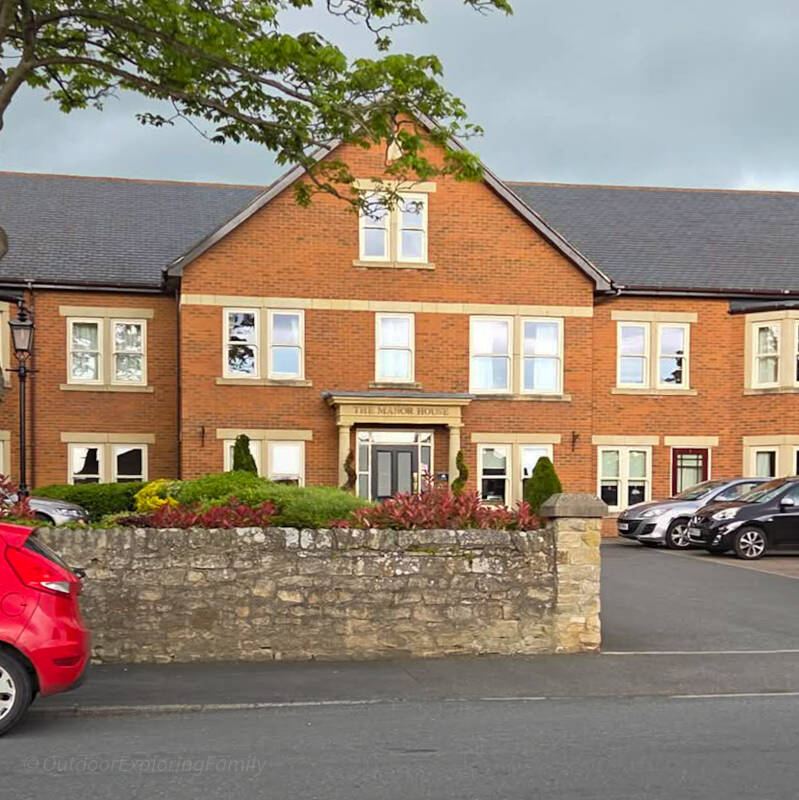
The Manor House, John Street
Now standing on the former Starlings site.
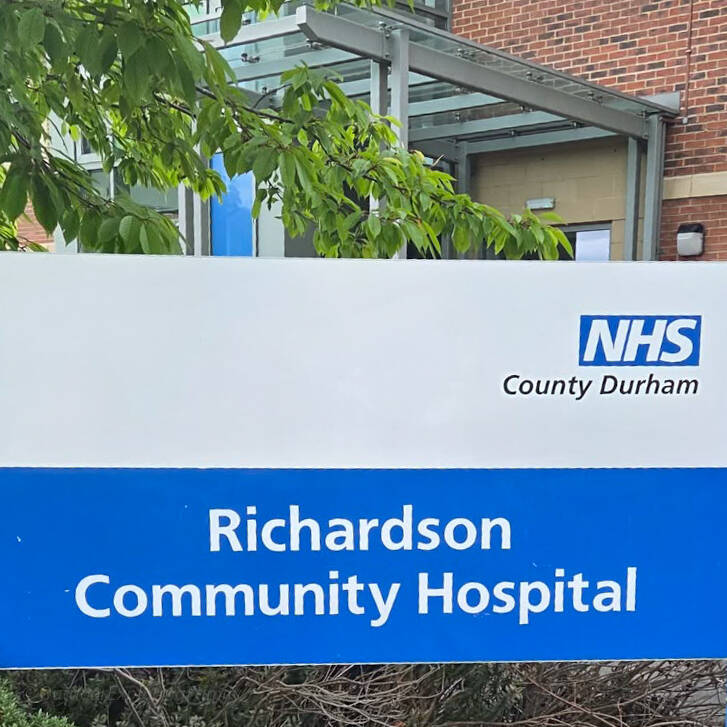
Hospital sign
A simple reminder of his legacy in the town.
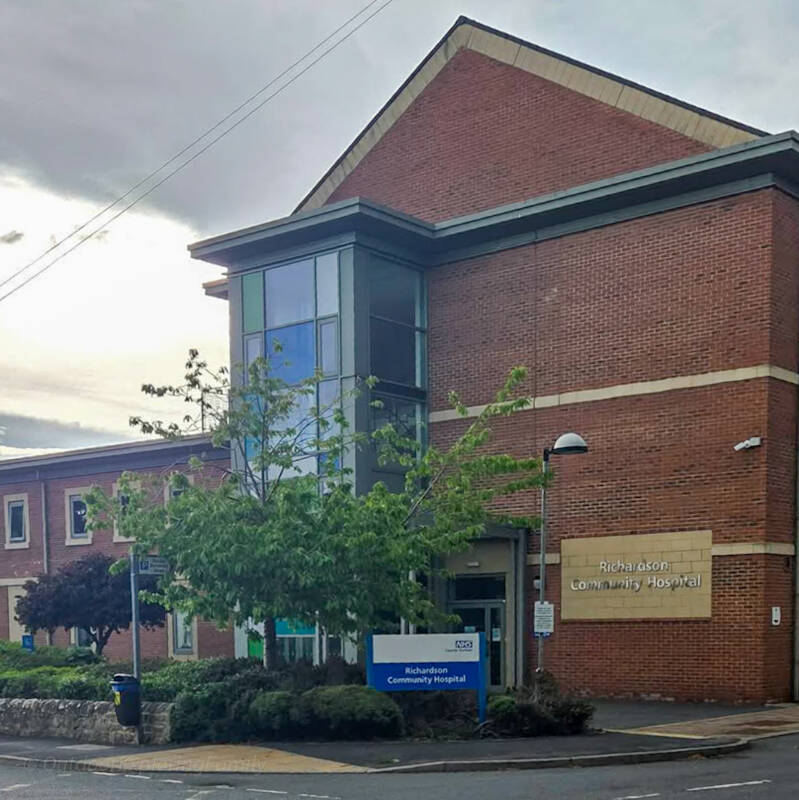
Richardson Community Hospital
The modern hospital carrying the Richardson name.
Remembered by the Friends of Richardson Hospital
Richardson’s name remained part of Barnard Castle’s living memory well into the twenty first century.
In 2003, the Friends of Richardson Hospital produced a Christmas card showing a winter view of The Starlings in John Street. The notice described it as the home of R. T. Richardson and explained that the building had been used during wartime before becoming a convalescent home.
It also credited Robert Taylor Richardson’s generosity with helping Teesdale gain its own community hospital.
That small Christmas card detail is important because it shows how the story lived on locally. The Starlings was not just a vanished building. It was remembered as the starting point of a healthcare legacy.
Open space for future generations
Robert Taylor Richardson’s public mindedness was not limited to healthcare.
In 1923, a newspaper report described him offering around twelve acres of level land for Barnard Castle. The land was valued at about £1,500 and was intended to be used by future generations as a playground.
The proposal caused concern among allotment holders, who feared losing their gardens. But the report described the scheme as one intended for the benefit of future generations and the preservation of open space.
This adds a deeply human side to Richardson’s story. He was not only thinking about patients and institutions. He was thinking about children, recreation and the future shape of the town.
Later archive records show that part of the former Richardson estate came into the hands of the Barnard Castle branch of the National Playing Fields Association. The exact boundaries still need checking against the original plans, so it would be wrong to say for certain which modern green spaces formed part of his land. But the records do show that Richardson’s estate included land around John Street, the Crook field and land touching Green Lane. That makes this corner of Barnard Castle an important part of his wider story, not just the story of The Starlings and the hospital.
Bede Kirk and St Mary’s Church
Richardson’s charitable giving also reached Bede Kirk, a site with a much older story of its own.
In 1923, he created the Bede Kirk Trust, conveying land, a dwelling house and funds to trustees for the benefit of the Church of England in the parish of Barnard Castle.
Bede Kirk has long been associated with an old church or chapel site before its later life as a farmhouse and smallholding on Harmire Road. For many people in more recent times, the same area became better known as the site of the old Barnard Castle police station.
The farmhouse itself was not simply turned into the police station. After Richardson’s trust was created, the land followed a longer path through sale, planning and later development. In 1946, Bede Kirk was advertised for sale as around three and a quarter acres of grass land, including a dwelling house and farm buildings. The advert described it as one of the best building sites in Barnard Castle, with a long frontage to Harmire Road.
A later newspaper report explained that money from the sale of the old farmhouse had been invested, then largely forgotten for decades, before the Bede Kirk Trust was rediscovered in the late twentieth century. By 2006, the fund had grown to around £43,000 and was used towards the redevelopment appeal at St Mary’s Church.
Bede Kirk was separate from the Richardson Hospital story, but it shows the same pattern in Richardson’s life. He used land, property and legal trusts to support Barnard Castle long after his own lifetime.
A man connected with Bowes Museum, church, charity and town life
Richardson’s will and records show a man whose interests stretched across many parts of Barnard Castle life.
He supported the Bowes Museum through gifts of objects selected by the trustees.
He supported St Mary’s Parish Church through funds linked to church improvement and hymn books.
He supported the Mechanics Institution through property arrangements.
He supported the Blind Society through the convalescent home scheme.
He supported healthcare through the Dispensary, the Nursing Association, the cottage hospital plan and the convalescent home.
He supported open space through his playground proposal.
He supported church work through the Bede Kirk Trust.
Taken together, these actions show a man who believed property and wealth should be directed towards practical public use.
What happened after his death
Richardson’s wishes did not unfold simply.
His estate was large, complex and tied to detailed trusts. Reports described his estate as amounting to more than £180,000, a very large sum at the time.
His will, his sister’s will, charity law, land issues, local council plans and hospital management questions all had to be untangled.
In 1938, the charity’s representatives opposed proposals by Barnard Castle Urban District Council to acquire part of the charity site for rehousing linked to slum clearance. Their letter argued that the site was intended for a cottage hospital and convalescent home where patients could recover in quiet surroundings.
This dispute shows how important the land itself was to Richardson’s plan. It was not just a convenient plot. The quiet setting was part of the purpose.
Later, as healthcare changed, the Richardson Home became tied more closely to formal hospital provision. By 1960, newspaper reports described proposals to connect the Richardson Holiday Home more directly with hospital facilities and convalescent treatment in Barnard Castle.
In later decades, Richardson Hospital continued to matter deeply to the town. Local reports from the 1990s and 2000s show continuing debate about hospital land, medical services, redevelopment, community healthcare and the future of the Richardson name in Barnard Castle.
His legacy did not end with his death. It continued through planning, fundraising, hospital care and local memory.
Why Robert Taylor Richardson matters today
Robert Taylor Richardson matters because his story helps explain more than one building.
He helps explain how Barnard Castle cared for people before the NHS.
He helps explain how local charity, family wealth, legal planning and civic duty could shape a town.
He helps explain why The Starlings, John Street, Richardson Hospital, Bede Kirk, St Mary’s Church, Green Lane and local open spaces are all connected by more than coincidence.
He also reminds us that local history is not only about castles, museums and famous visitors. Sometimes it is about the people who quietly worked through committees, trusts, wills, land, buildings and public service to leave something useful behind.
Richardson was not a simple figure. He was generous, but precise. Public spirited, but firm about his wishes. Deeply local, but connected to wider institutions. A solicitor by profession, but a benefactor by legacy.
His greatest achievement was not simply donating a house.
It was turning a lifetime of local connection into a lasting act of care for Barnard Castle.
Explore More in Teesdale
Robert Taylor Richardson’s story reaches beyond The Starlings and Richardson Hospital. Across Barnard Castle, other people, buildings and charities help show how local lives, family wealth and public service shaped the town we know today.
Discover the story of John Bowes and how he and Joséphine Bowes created The Bowes Museum, one of the most remarkable cultural landmarks in the North of England.
Learn about Henry Witham and the story behind The Witham, another important Barnard Castle legacy shaped by education, culture and public improvement.
Read about Reverend Monsignor Thomas Witham of Lartington Hall, a Catholic priest, landowner and supporter of local institutions whose life adds another layer to the story of faith, family and public service in Teesdale.
Read about Thomas Breaks, the Barnard Castle wool merchant whose gift helped create the town’s historic Market Cross, now widely known as the Butter Market.
Or return to the People of Teesdale hub to discover more of the figures, families and stories that helped shape Barnard Castle, Teesdale and the surrounding villages.
Sources and Research
This page has been researched using a combination of archive records, historic newspaper reports and local history sources connected with Barnard Castle and Teesdale.
Key sources include the Teesdale Mercury archives, Durham Record Office catalogue entries, National Archives records, historic charity records, Bede Kirk Trust records, Richardson Charity records, St Mary’s Church history material, historic hospital research, local government notices and surviving legal and property documents connected with Robert Taylor Richardson and the Richardson family.
Additional background research included records relating to Richardson Hospital, The Starlings, Barnard Castle Dispensary, Bede Kirk, local charitable trusts and nineteenth and early twentieth century public life in Barnard Castle.
Where historic newspaper reports, archive descriptions or later commentary contain uncertainty or interpretation, the page has been carefully worded to reflect this.