The Wishing Stones
Welcome to another of our Teesdale Tales, where local folklore, history and the landscape of the dale come together.
Tucked away on Tees Bank, beside the River Tees, stand two weathered stones with a story older than most walkers realise.
There are no signs, no carvings and nothing to explain why they matter. Yet for generations, people have paused here, stepped carefully through the narrow gap and carried a quiet wish with them along the path.
This is the story of the Wishing Stones, one of Barnard Castle’s simplest and most charming old traditions.
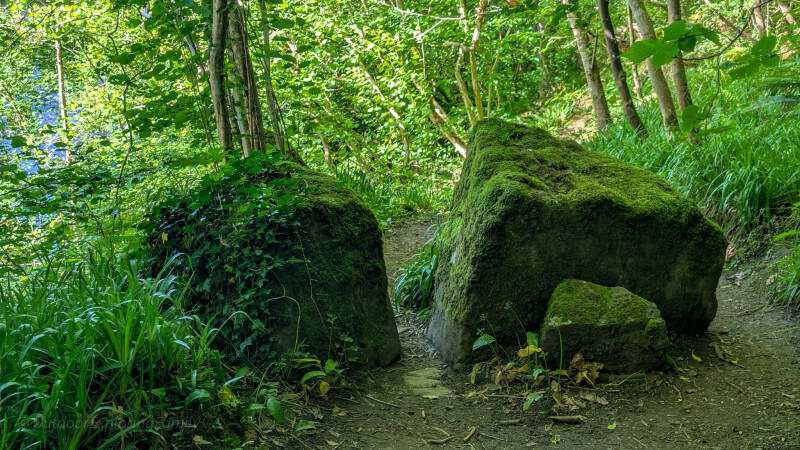
Two Stones Beside the Path
Follow the old riverside path west from the Silver Bridge and, before long, you'll come across two large stones standing either side of the woodland track. They aren't carved or shaped by people, and there is nothing to tell you that you've arrived somewhere special. Time has weathered their surfaces, moss clings to the rock, and the trees around them make the place feel tucked away from the outside world.
To most people they are simply two old stones.
To others, they are the Wishing Stones.
For generations, local tradition has said that if you pass between them without touching either stone while making a wish, that wish may one day come true. It is a wonderfully simple piece of folklore that has survived because people kept sharing it, one walker passing the story to the next.
The stones stand beside what was once one of Barnard Castle's most popular riverside walks. During Victorian times, visitors followed the River Tees through Flatts Wood towards the old Spa, enjoying fresh air, woodland scenery and the peaceful surroundings long before walking became a pastime in its own right.
Even today, it is easy to understand why this place inspired stories.
The River Tees flows quietly below the path, tall trees shelter the woodland from the bustle of the town and the only sounds are running water, rustling leaves and birds moving through the canopy. It is the sort of place where everyday worries seem to fade into the background, where your pace naturally slows and your mind has room to wander.
Perhaps that is the real magic of the Wishing Stones.
Not that they promise to make wishes come true, but that for a few quiet moments they encourage you to stop, look around and believe that anything is possible.
Written Down Over a Century Ago
The Wishing Stones are not a modern invention or a recent name added to the path. They were already part of the old riverside walk through Flatts Wood when Teesdale writer Harwood Brierley described them in 1915, in an article about the Wishing Stones and Lovers’ Leap near Barnard Castle.
Brierley placed the stones about a mile from Barnard Castle, beside the path that follows the River Tees through the woods. His description still feels familiar today. He wrote of two triangular stones standing on either side of the track, leaning slightly away from one another, with the narrow path passing between them. He believed they had fallen from the steep crag above long ago before becoming deeply embedded in the ground.
What makes his account so valuable is that he did not present the Wishing Stones as something newly discovered. He wrote about them as a known landmark on one of Barnard Castle’s old woodland walks, a place people already recognised and stopped beside. By 1915, the name and the tradition were clearly well established.
The old custom was simple. Visitors, especially couples, would pause at the stones, sit for a while or pass between them, and quietly make a wish. Brierley recorded the most important part of the belief too: the wish had to be reasonable and kept closely to yourself.
That small detail gives the story its charm. The Wishing Stones are not a grand legend filled with heroes, ghosts or dramatic events. They are something quieter and more personal: two weathered stones in Flatts Wood, a moment beside the River Tees, and the hope that a private wish might one day come true.
A Place That Invites You to Slow Down
The Wishing Stones stand on what was once one of Barnard Castle's favourite riverside walks.
Long before waterproof jackets, walking apps and downloadable routes, people came here simply to enjoy the countryside. Families, couples and visitors wandered beneath the trees, following the River Tees towards the old Spa, where fresh air and the mineral spring were believed to do both body and mind a world of good.
The path is much quieter today, but it hasn't lost the feeling that first drew people here.
The River Tees is never far away, flowing steadily below the woodland. Mature trees shade the path for much of the journey, while old stone walls, forgotten steps and traces of Marwood Chase remind you that this landscape has been changing for centuries.
It is the sort of place where you naturally slow your pace.
Perhaps that is why the Wishing Stones became part of the walk. They gave people a reason to stop for a moment, gather their thoughts and continue with a little more hope than when they arrived.
Sometimes the oldest traditions are also the simplest.
More Than Just Two Stones
Unlike many stories in Teesdale, the Wishing Stones are not linked to battles, ghosts or famous local characters.
There is no great mystery surrounding who placed them here, and no dramatic tale explaining their origin. Harwood Brierley believed they had tumbled from the steep crags above countless years before becoming firmly embedded in the woodland floor, where they remain today.
Perhaps that is what makes the story so appealing.
The Wishing Stones belong to ordinary people.
They belong to the couples who walked these paths on warm summer evenings, to families exploring the riverside, and to anyone who paused for a quiet moment before carrying on through the woods.
Generation after generation added something to the story, not by changing it, but simply by keeping the tradition alive.
Every person who stopped to make a wish became part of its history.
Visit the Wishing Stones
The Wishing Stones can still be found beside the riverside path through Flatts Wood, around a mile west of Barnard Castle.
They feature on our Lost Spa Walk, a peaceful circular walk that follows the River Tees past the old stone steps, the forgotten Spa, the remains of Marwood Chase and the route of the former Tees Viaduct. It is one of the best ways to experience this quiet corner of Teesdale and discover why the Wishing Stones have remained part of the landscape for so long.
If you do visit, take your time. Stand between the stones, make a wish and keep it to yourself. According to the old tradition, that is the secret.
Explore More in Teesdale
Discover more local folklore on our Teesdale Tales hub, where we're collecting the stories, legends and old traditions that have shaped the landscape of the dale.
Read the legend of Peg Powler, the mysterious river spirit of the River Tees and one of Teesdale's oldest and best-known pieces of folklore.
Follow the Lost Spa Walk to visit the Wishing Stones for yourself, along with the old Spa, Victorian stone steps and other forgotten places hidden beside the River Tees.
Explore Barnard Castle in our town guide, including the castle ruins, riverside walks, independent shops and historic streets.
Start with our Discover Teesdale hub to explore more of the dale, including local walks, waterfalls, reservoirs, history, geology, dark skies and family-friendly days out.