Holy Island History Through Time
Stand almost anywhere on Holy Island and you are looking at a different part of its past. The ruined priory takes you back to the monks, Lindisfarne Castle began life as a fort, the huge lime kilns belong to a surprisingly industrial period and even the road you drive across today is much newer than you might expect.
The story people usually know is the Viking raid of 793, but Holy Island's history is much bigger than one dramatic day. People were using this landscape thousands of years before the monastery was founded, and what followed was nearly 1,400 years of saints, pilgrims, monks, soldiers, fishermen, lifeboat crews, quarrymen and island families.
The easiest way to understand it all is simply to start at the beginning and work our way through.
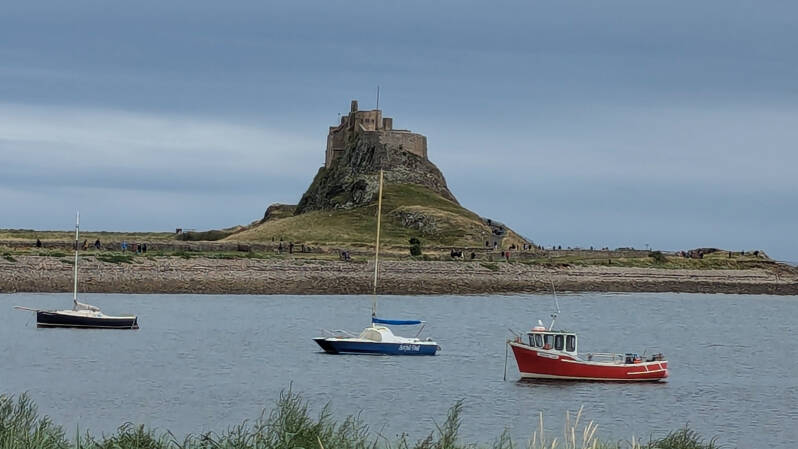
Thousands of Years Ago: Before Holy Island Became Holy
Holy Island's famous written history begins with the arrival of Aidan in AD 635, but people had been here long before him.
Archaeology on the island has uncovered evidence of human activity going back thousands of years. A Mesolithic flint blade was found close to Castle Rock and prehistoric remains have also been discovered beneath later activity on the Heugh. Historic England believes the evidence there shows that people have used this part of the island at different times over roughly the last 8,000 years.
We cannot build the same detailed story around these early inhabitants because very little is known about them. What the finds do tell us is that the island was being visited and used long before Christianity made the name Lindisfarne famous.
Then, in the seventh century, everything changed.
AD 635: Aidan Arrives on Lindisfarne
In AD 635 the Northumbrian king Oswald invited an Irish monk called Aidan to help spread Christianity through his kingdom. Aidan came from the monastery of Iona, off the west coast of Scotland, and Oswald gave him Lindisfarne as the place from which to begin his work.
It was a good position. Bamburgh, one of the great royal centres of Northumbria, was only a short distance down the coast, so Aidan's new monastery stood close to the heart of the kingdom while remaining separated from the mainland by the tides.
A monastery and bishopric were established on Lindisfarne and the island began to grow into one of the most important centres of early Christianity in England. Monks travelled out from here, churches were established elsewhere and Lindisfarne became closely connected with the Northumbrian royal family.
One thing worth understanding when you visit today is that Aidan's original monastery is not the ruined priory you can now walk around. The beautiful stone ruins beside St Mary's Church were built hundreds of years later. The monastery of Aidan belonged to the Anglo Saxon period and much of what we know about it comes from written records, archaeology and objects that have survived.
AD 664: Cuthbert Becomes Prior of Lindisfarne
Aidan began the story, but the person who became most closely associated with Lindisfarne was Cuthbert.
Cuthbert had already been living as a monk elsewhere in Northumbria when he became prior of Lindisfarne in 664. He developed a reputation for his simple way of life, his religious teaching and his willingness to travel through the countryside to meet people living far away from established churches.
Eventually he wanted a quieter life. In 676 Cuthbert left the main community and became a hermit. He first spent time close to Lindisfarne before moving farther out to Inner Farne, one of the Farne Islands visible off the Northumberland coast.
His peaceful life there did not last. Cuthbert was persuaded to become a bishop and eventually became Bishop of Lindisfarne. After only a short period he resigned because of poor health and returned to Inner Farne.
He died there on 20 March 687.
The monks brought Cuthbert's body back across the water to Lindisfarne and buried him inside their church. At the time nobody could have known quite how important that burial would become to the future of the island.
AD 698: Cuthbert Becomes a Saintly Figure
Eleven years after Cuthbert's death, the monks opened his grave.
According to the religious accounts recorded by his community, they expected to find his bones ready to be placed into a smaller container. Instead they believed that his body had remained undecayed. To the medieval Christian community this was powerful evidence of Cuthbert's holiness.
His remains were placed in a new shrine and stories of miracles connected with Cuthbert spread. Pilgrims began travelling to Lindisfarne and his reputation grew far beyond Northumbria.
This changed the importance of the monastery. Lindisfarne was no longer simply somewhere monks lived and worshipped. It had become the home of the shrine of one of the most important saints in northern England.
More than thirteen centuries later, Cuthbert is still one of the names most closely connected with Holy Island.
Around AD 710 to 725: The Lindisfarne Gospels
This was also a great period of learning and craftsmanship on Lindisfarne.
During the early eighth century the extraordinary book we now call the Lindisfarne Gospels was created. It contains the four Gospels of Matthew, Mark, Luke and John in Latin, decorated with incredibly detailed patterns, lettering and illustrations.
A note added to the book centuries later names Eadfrith, Bishop of Lindisfarne, as its maker, and modern research places its creation in the early eighth century.
You do not need to know anything about medieval manuscripts to appreciate how remarkable that is. Every page was made by hand in a world without printing presses, electric lighting or modern drawing equipment, yet the detail survives for us to see more than 1,300 years later.
The story of the book continued after it left Lindisfarne. In the tenth century a priest called Aldred added an Old English translation between the lines of Latin, making the manuscript important not only for its artwork and Christianity but for the history of the English language as well.
The Lindisfarne Gospels are now held by the British Library, but they remain one of the strongest surviving connections with the community that once lived here.
AD 793: Vikings Attack Lindisfarne
Then came the date that made Lindisfarne famous for a very different reason.
On 8 June 793 Viking raiders attacked the monastery. People were killed, valuables were taken and one of the most important Christian places in Anglo Saxon England was violated.
The shock travelled across Europe. Lindisfarne was not an unknown settlement on the edge of the North Sea. It was the home of Cuthbert's shrine and a place with powerful religious connections, which made the attack seem even more terrible to the Christian writers who recorded it.
The raid is often described as the moment the Viking Age began in Britain. There had been an earlier recorded encounter with Scandinavian raiders in southern England, so it is better not to call Lindisfarne simply the first Viking raid on England. What happened here in 793 was nevertheless one of the defining early Viking attacks and became one of the best known events of the period.
There is another important part of the story that often gets lost.
The Vikings did not attack in 793 and bring Lindisfarne's monastery to an immediate end.
The religious community continued afterwards. Archaeological finds, including later carved stones, show that Christian burial and activity survived on Lindisfarne through the difficult years that followed.
The raid was devastating, but it was not the end of Holy Island's Christian story.
AD 875: The Monks Finally Leave Lindisfarne
By the ninth century Viking armies had become a much greater threat across Northumbria.
The monks had already spent periods away from the exposed island, and in 875 the community finally decided to leave Lindisfarne. They took with them the coffin containing Cuthbert's remains along with other relics and treasures connected with the monastery.
What followed was an extraordinary journey through northern England.
After several years of travelling, the community settled at Chester le Street. Cuthbert's remains stayed there for around a century before danger once again forced the community to move.
In 995 they finally settled at Durham.
That is why the stories of Holy Island and Durham are so closely connected. The magnificent cathedral that stands over Durham today developed around the shrine of the same Cuthbert whose body had originally been buried here on Lindisfarne.
Cuthbert's remains are still at Durham Cathedral.
The departure of his community did not mean everybody disappeared from Lindisfarne. Archaeology shows that Christian burial continued on the island, but the great age of the original monastery was over.
AD 1069 to 1070: Cuthbert Briefly Returns
Almost two hundred years after the monks had left Lindisfarne, Cuthbert's remains briefly came back.
William the Conqueror's brutal campaign against resistance in northern England, now generally known as the Harrying of the North, made Durham unsafe. The community fled and returned temporarily to Lindisfarne carrying Cuthbert's relics with them.
Their stay was short and they were back in Durham during 1070, but it renewed an old connection.
Before long, monks connected with Durham would once again be living permanently on Holy Island.
The 1100s: The Priory We See Today Begins to Rise
A new monastic community connected with Durham was established on Lindisfarne after the Norman Conquest, although the exact date is uncertain.
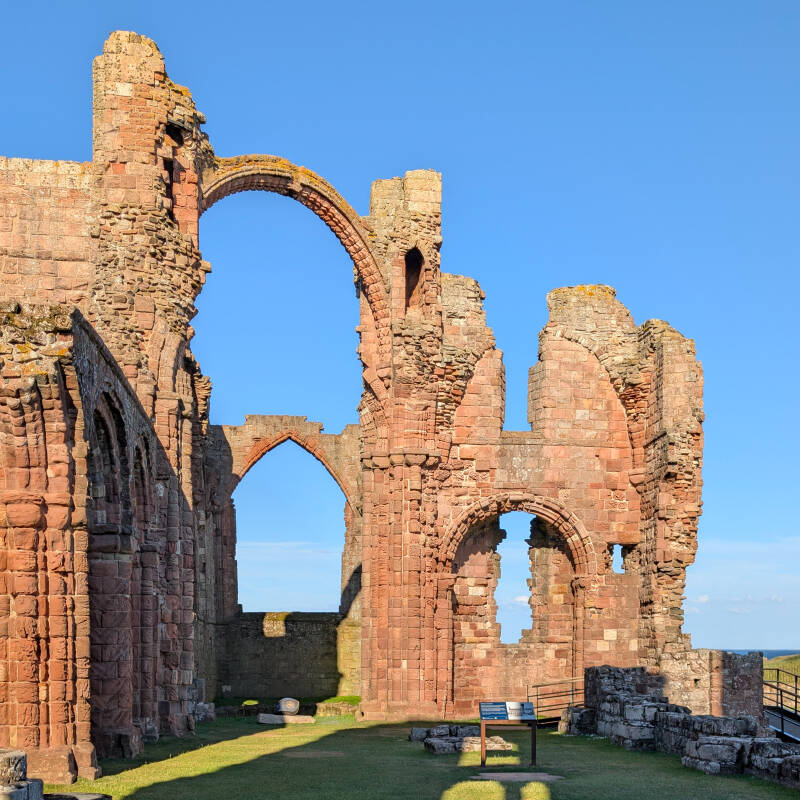
A Durham monk was active here by 1122 and the great stone priory church was built by around 1150. This is the beginning of the Lindisfarne Priory whose ruins visitors explore today.
The link with Durham was deliberately strong. The new church echoed parts of the architecture of Durham Cathedral and an empty tomb marked the traditional place where Cuthbert had once been buried before his remains were taken away.
Pilgrims continued to come.
Imagine arriving here in the Middle Ages after crossing the tidal sands. Instead of the roofless ruins we see now, there would have been a working monastery with a church, cloister, living quarters, kitchens, workshops and other buildings clustered together close to the shore.
Holy Island had become an important religious place once again.
The 1300s: Monks Living on a Dangerous Border
Life on Holy Island was never completely separated from events happening beyond it.
During the long periods of conflict between England and Scotland, the island's position close to the border left it exposed. The priory suffered from the wider instability and during the fourteenth century parts of the monastic site were fortified.
It creates an unusual picture of medieval Holy Island. This was still a place where monks worshipped and pilgrims came looking for a connection with Cuthbert, but defensive walls and military concerns had become part of everyday life too.
That mixture of religion and defence would become even more obvious in the following centuries.
1537: Lindisfarne Priory Closes
The medieval monastery survived until the reign of Henry VIII.
In 1537 Lindisfarne Priory was closed as part of the suppression of religious houses taking place across England. After centuries of monastic life, the monks were gone.
Normally we might expect a monastery like this simply to have been stripped for stone and gradually disappear, but Holy Island occupied a strategically important position on the Northumberland coast. The Crown found new uses for parts of the former monastic site and buildings.
During the 1540s new defences were built around the harbour and former monastic buildings were adapted for military storage and supplies.
Holy Island was changing again. The age of the monastery had ended and the age of forts, soldiers and coastal defence was beginning.
1540s to 1671: Lindisfarne Castle Takes Shape
Once the priory had closed, Holy Island's position became important for a very different reason. The sheltered harbour was useful to ships and the island sat close to the Scottish border, so the Crown began strengthening its defences during the reign of Henry VIII.
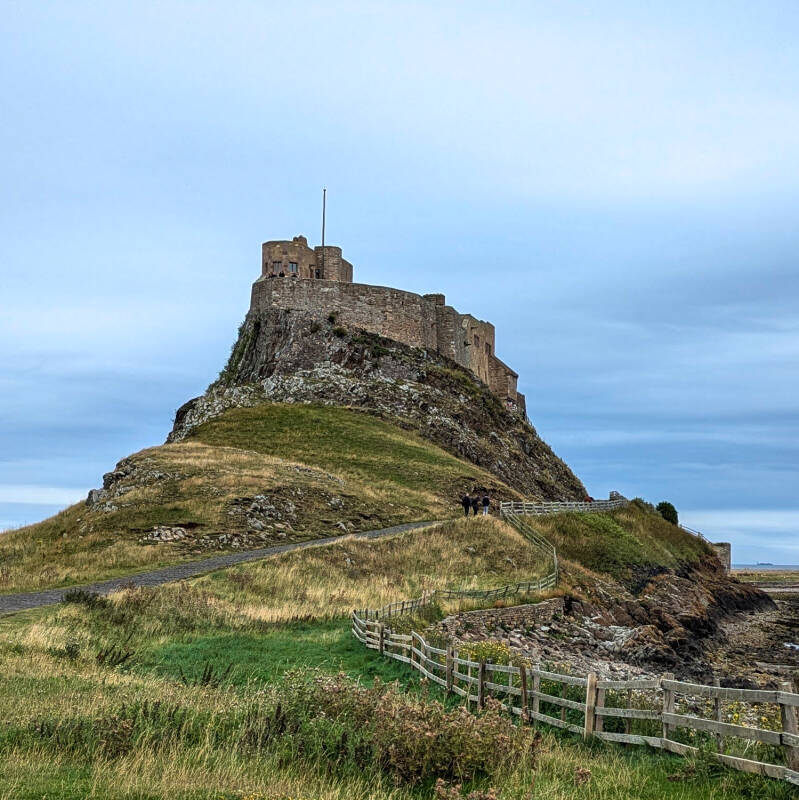
By 1545 there were three defensive positions, or bulwarks, on Holy Island. One is thought to have stood on or close to Beblowe Crag, the rocky hill where Lindisfarne Castle stands today. At this point there was nothing like the castle we recognise now. A survey in 1561 described the defence on Beblowe as little more than a platform protected by an earth wall, much of which had already collapsed.
Work continued over the following years. A new earth wall around 12 feet high had been built by 1567, but the biggest change came in 1570, when construction of the present castle began. The new fort had upper and lower defensive areas, with its strongest gun position high on the western side. Cannon could be placed here to protect the harbour and the approaches from the sea.
This was never intended to be the grand country-house type of castle its name might suggest. It was a working Tudor fort built for soldiers and guns. Stone from the recently dissolved Lindisfarne Priory was reused in its construction, physically joining two completely different chapters of Holy Island's history.
Government troops were stationed at Lindisfarne Castle from the mid-sixteenth century until 1893, and at one point it mounted 21 cannon. It remained important during periods of conflict with Scotland, through the Civil Wars and during the Jacobite rising of 1715.
The island's defences continued to develop too. In 1671 another stone fort was built on the Heugh, above the village. It worked alongside Lindisfarne Castle to protect the harbour below, and remains of that fort can still be seen when exploring the Heugh today.
So the castle that dominates Holy Island today did not appear all at once. Its story began with simple Tudor defences in the 1540s, developed into a much stronger stone fort from 1570 and continued changing for centuries afterwards.
The full story of the building, including its later transformation from military fort into an Edwardian holiday home, is covered in our Lindisfarne Castle guide.
The 1700s and Early 1800s: A Working Island Community
It would be easy to tell Holy Island's story entirely through monks, kings and soldiers, but that would miss the people who actually made their lives here.
Fishing was deeply woven into island life. The surrounding sea provided work and food, but it could also be extremely dangerous. Holy Island sits beside shipping routes and a coast of rocks, sandbanks and rapidly changing conditions, so helping vessels and people in trouble became another part of the island's story.
Organised lifeboat provision on and around Holy Island reaches back into the early nineteenth century, before the organisation that became the modern RNLI had taken over the station. The RNLI assumed responsibility for Holy Island's lifeboat in 1865, and generations of islanders served as crew members, launchers and helpers.
One of the surviving buildings from that story is the Old Lifeboat House, built in 1884. It gives us a much more personal side to Holy Island's past because this was not history happening to distant kings. These were local families going out onto a dangerous sea to help other people.
Holy Island's final lifeboat station closed in 1968, bringing a very long chapter of organised lifesaving on the island to an end.
1860: Holy Island Becomes Industrial
The huge stone structures near Lindisfarne Castle can look almost as old as the castle itself, but they belong to a completely different period.
In 1860 permission was given for the development of the large Castle Point lime works. Limestone was quarried on the island and moved towards the kilns using a network of wagonways. Coal was brought in, the limestone was burnt and the finished lime could then be shipped away.
This was proper industry rather than a small village operation. The 1861 census recorded 35 men employed at the kilns, including quarrymen, lime burners, labourers and carters.
For a time the landscape around the castle would have been busy with workers, wagons, quarried stone, ships and burning kilns. It is a side of Holy Island that feels completely removed from monks and pilgrims, yet much of it survives.
The main commercial operation struggled and was being wound down during the following decade, although lime burning continued on a smaller scale. The National Trust believes the Castle Point kilns were last fired in 1900 by an island farmer making fertiliser.
Today the kilns are one of the most impressive surviving pieces of Holy Island's industrial history, and we tell their full story in our Holy Island Lime Kilns guide.
1893: Military Life at the Castle Ends
After more than three centuries, the government's permanent garrison at Lindisfarne Castle came to an end in 1893.
The old fort had outlived the military purpose for which it had been developed. Instead of being abandoned completely, however, it was about to enter perhaps the strangest period in its history.
Within a few years a building created for soldiers and guns would be turned into a private holiday home.
1901: Edward Hudson Comes to Holy Island
In 1901 Edward Hudson, founder of Country Life magazine, took on the lease of Lindisfarne Castle.
Hudson brought in architect Edwin Lutyens to transform the old fort. Rather than trying to turn it into a conventional country house, Lutyens worked with the thick walls, odd levels, passages and military character of the building to create something completely individual.
Garden designer Gertrude Jekyll was also brought into the project. Her summer flower garden was planted in 1911 inside an existing walled enclosure below the castle.
Much of what visitors experience inside Lindisfarne Castle today comes from this period. The exterior still looks like a fortress standing above the sea, but step inside and parts of it belong very clearly to its life as an Edwardian retreat.
There is something wonderfully Holy Island about that. Even the castle has more than one identity.
1913: Lindisfarne Priory Is Protected
By the time Hudson was transforming the castle, people had been visiting the ruined priory for generations.
The medieval buildings had suffered badly after the monastery closed. Drawings show that much more of the church survived into the eighteenth century, but major sections later collapsed. Antiquarians, landowners and archaeologists gradually began recording, excavating and protecting what remained.
In 1913 Lindisfarne Priory was taken into State care.
That protection helped preserve one of the most important historic sites on Holy Island, and the priory is now cared for by English Heritage.
It means the ruins we walk through today are not simply picturesque remains beside the sea. They form part of a nationally important archaeological site containing evidence from different periods of Lindisfarne's religious history.
1944: Lindisfarne Castle Passes to the National Trust
Another major piece of Holy Island's heritage was protected in 1944 when Lindisfarne Castle was given into the care of the National Trust.
The National Trust now looks after the castle, Gertrude Jekyll's garden and important parts of the surrounding landscape, including the remarkable remains of the Castle Point lime works.
Within a few decades both the priory and castle had moved from vulnerable historic buildings into long term conservation.
The next big change to Holy Island would not involve either of them.
It would change how almost everybody reached the island.
1954: The Holy Island Causeway Opens
This date always surprises us.
The road causeway across to Holy Island opened in 1954.
For most of Holy Island's long history there was nothing resembling the road visitors drive across today. Islanders, monks, pilgrims and other travellers crossed the tidal sands or arrived by boat, and the old route across the sands is still marked by the familiar line of poles.
The construction of the causeway made vehicle access much easier, but it did not change the basic rule that has controlled life here for centuries.
The tide still decides when you can cross.
At high tide the road disappears beneath the sea and Holy Island is properly cut off from the mainland again. It is one of those rare places where a modern road has been added without removing the natural rhythm that shaped the island in the first place.
Anyone visiting today should always use the current official safe crossing times. Our Holy Island tide times and causeway guide covers the practical side of planning the journey.
1964: Lindisfarne National Nature Reserve Is Established
By the middle of the twentieth century it was not only Holy Island's buildings and archaeology that were being recognised as important.
Lindisfarne National Nature Reserve began in 1964 and now protects a much larger area of coastline around the island. Mudflats, saltmarsh, dunes, rocky shore and tidal water make this one of the most important natural areas on the Northumberland coast.
That protection added another chapter to the island's story. Lindisfarne had long been shaped by its relationship with the sea and tides, but there was now increasing recognition that the landscape itself, and the wildlife depending upon it, needed protecting too.
For visitors it means the history and natural landscape are almost impossible to separate. The same coast crossed by medieval pilgrims, used by fishermen and watched by soldiers is now protected for its wildlife as well.
1968: Holy Island's Lifeboat Era Ends
In 1968 Holy Island's lifeboat station finally closed.
By then organised lifeboat provision on and around the island stretched back for well over a century and Holy Island families had been connected with countless launches, rescues and years of service.
The boats are gone, but parts of that history remain around the harbour and village. The surviving 1884 boathouse is one of the easiest places to connect the modern island with generations of people whose lives were tied to the sea.
Our Old Lifeboat House guide explores that story in much more detail.
Holy Island Today
That brings us back to the island we can explore now.
What we love about Holy Island is that its history has not been gathered together into one building and separated from everything else. It is spread across the landscape.
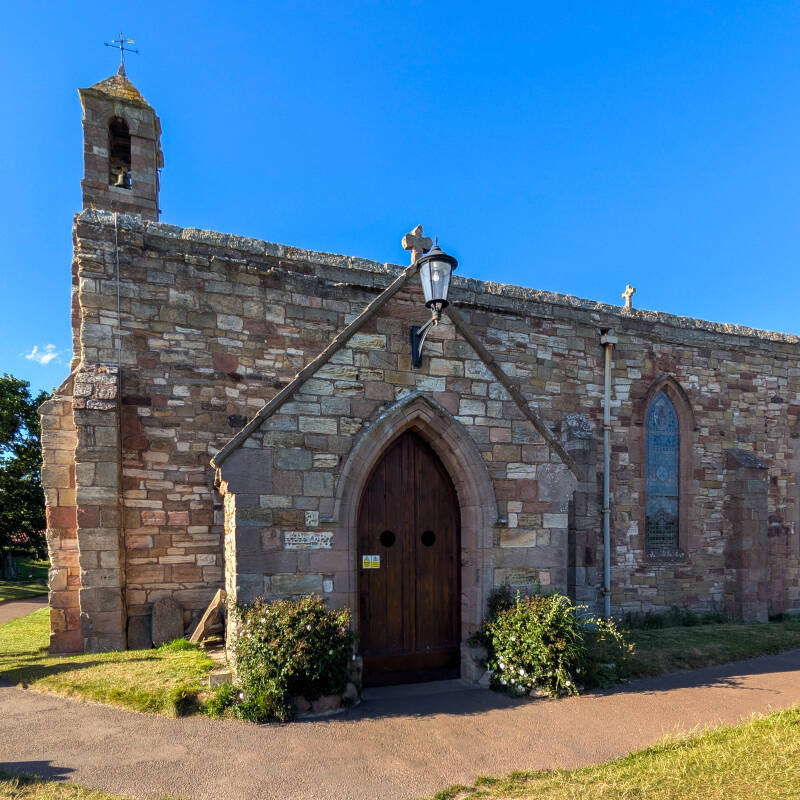
You can stand beside Lindisfarne Priory and think back to Aidan arriving in 635, even though the ruins themselves belong to the monastery built centuries later. Walk onto the Heugh and you are standing among layers of archaeology and old defences. Follow the harbour towards Beblowe Crag and the story changes from monks to soldiers at Lindisfarne Castle, then changes again when you reach the Victorian lime kilns.
Around the village and harbour are reminders of fishing families and lifeboat crews. Beyond them are old quarry workings, wagonways and a coast that people have depended upon for generations.
Even leaving the island becomes part of the story. Drive back across the causeway and you are using a road that only opened in 1954, laid across the same tidal landscape people had been finding their way through for centuries.
Holy Island is still a living community, which is important to remember. It is not an abandoned historic site or an outdoor museum. People live and work here while visitors, pilgrims and families continue to arrive whenever the tide allows.
Nearly 1,400 years have passed since Aidan established his monastery on Lindisfarne. In that time Holy Island has been a centre of Christianity and learning, the home of Cuthbert's shrine, the target of Viking raiders, a medieval pilgrimage destination, a defended border outpost, a fishing community, an industrial workplace and eventually one of Northumberland's best known places to visit.
Very few places allow you to follow so much of their history simply by walking around them.
That, more than any one date or famous event, is what makes the history of Holy Island so special.
Explore More of Holy Island
Holy Island's history makes even more sense when you can explore the places connected with it. Our complete Holy Island visitor guide gives you the wider picture, while our guides to Lindisfarne Castle, the Holy Island Lime Kilns, Holy Island Lookout Tower and the Old Lifeboat House take a closer look at individual places. You can also follow our Holy Island circular walk, use the interactive Holy Island map, or see the island today through our live Holy Island webcams.