Lindisfarne Castle, Holy Island
Lindisfarne Castle is one of those places that draws your eye almost as soon as you arrive on Holy Island. Sitting high on its rocky crag at the eastern end of the island, it looks every bit like an old medieval castle watching over the sea. The real story is quite different. Lindisfarne Castle began life as a Tudor military fort built to protect the harbour, before being transformed centuries later into a private holiday home for Edward Hudson, the founder of Country Life magazine.
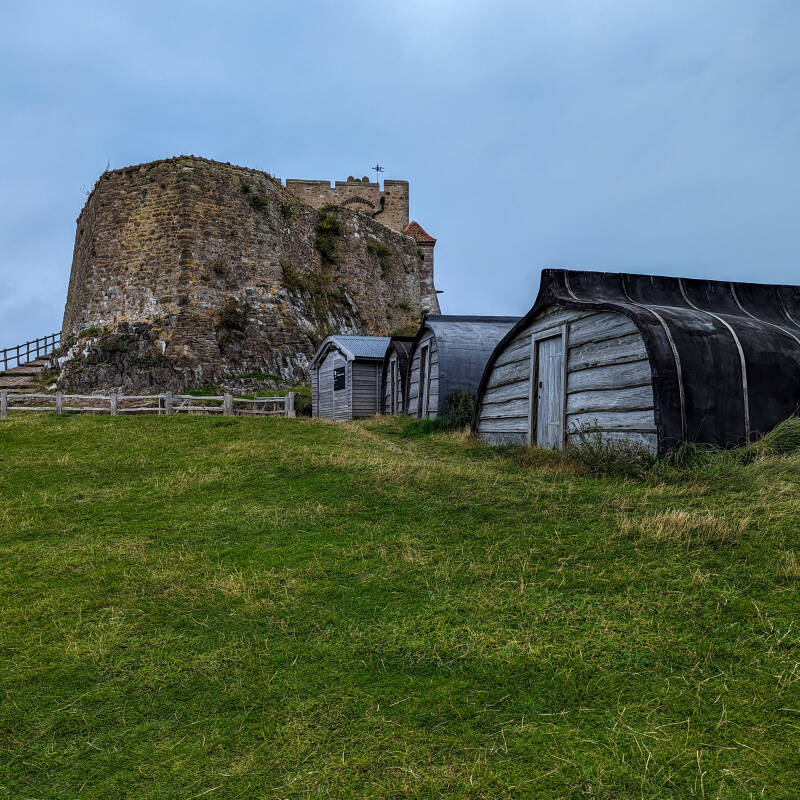
For us, the walk out to the castle is just as much a part of the visit. It is around one mile from the main Holy Island visitor car park, following an easy route through the village and then beside the coast, with the castle getting closer as you go. Once there you can explore the castle when it is open, climb up through its unusual rooms to the old batteries, visit Gertrude Jekyll's walled garden and wander around Castle Point, where the old lime kilns and upturned boat sheds add another side to the story of Holy Island.
Quick Facts
Location: Holy Island, Northumberland, TD15 2SH
What is it: Tudor coastal fort later turned into a holiday home
Managed by: National Trust
Walk from car park: Around 1 mile each way, about 20–25 minutes
Parking: Main Holy Island visitor car park
Entry: Admission applies; check current National Trust prices
Opening: Varies with tides and date; check before visiting
Dogs: Grounds on short leads; assistance dogs only inside
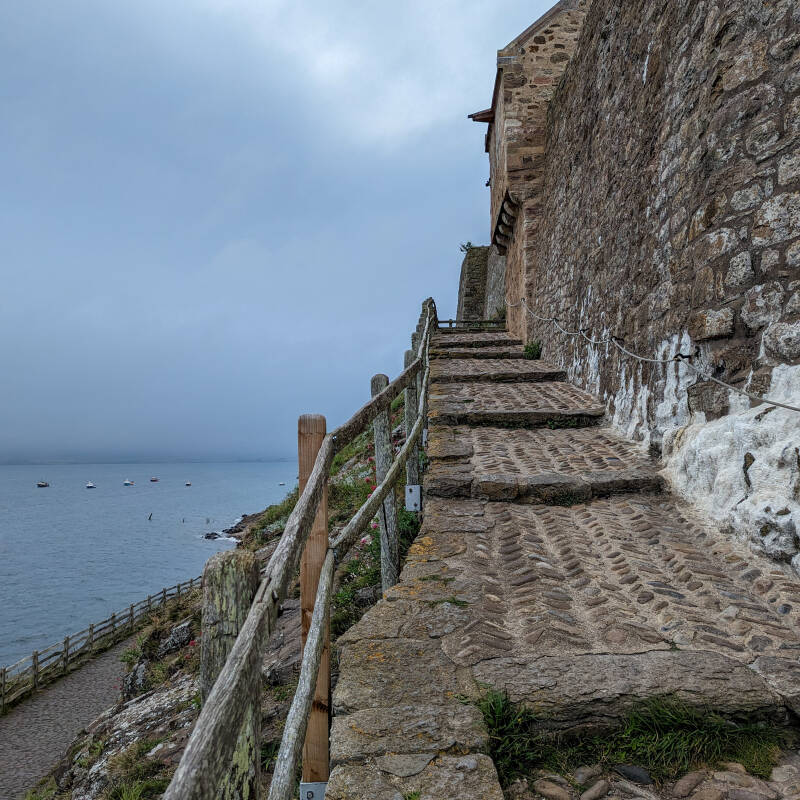
Accessibility: Steep cobbled ramp and steps; drop-off at castle field gate
Important: Check official Holy Island causeway crossing times

Walking to Lindisfarne Castle from the Main Car Park
The walk to Lindisfarne Castle is simple to follow and you do not need to make the journey complicated. From the main Holy Island visitor car park, head left towards the village. At the end of the road turn left again and follow the main road down through the village towards the castle.
One of the places you will pass is Pilgrims Gelato, which is always a favourite stop for us when we visit Holy Island. Continue through the village and head out towards the castle. Before long you will also pass Window on Wild Lindisfarne. It is well worth stopping for a look rather than simply walking past. Inside are information boards about the island's wildlife and a large viewing window looking across the surrounding habitat.
From here there is very little navigation to worry about. Follow the well marked route towards Lindisfarne Castle with open fields on your left and the sea on your right. The castle becomes the obvious landmark ahead and seems to grow out of the rocky coastline as you get closer. It is an easy walk and our mapped route from the main car park comes in at around one mile, with a normal walking time of roughly 20 minutes. We would allow a little longer because there are plenty of reasons to stop and look around along the way.
The easy walk should not be confused with the final approach into the castle itself. Once you reach Castle Point, access to the building is up an uneven cobbled ramp and steep steps. This is the part where sturdy footwear makes a difference, particularly if the ground is wet.
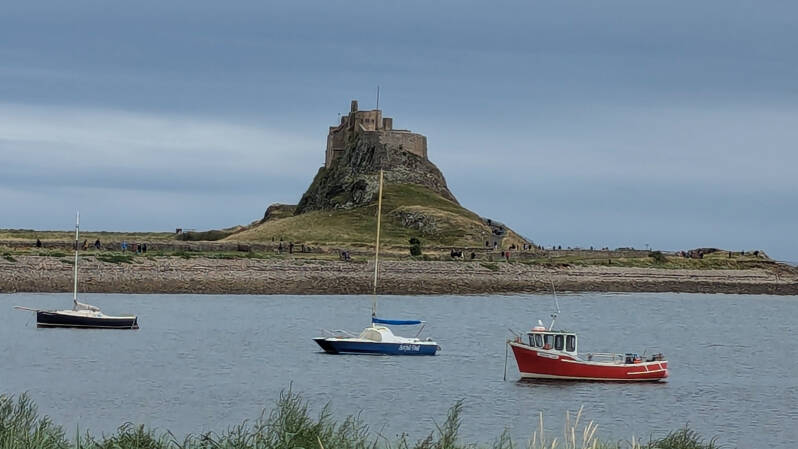
What Is Lindisfarne Castle?
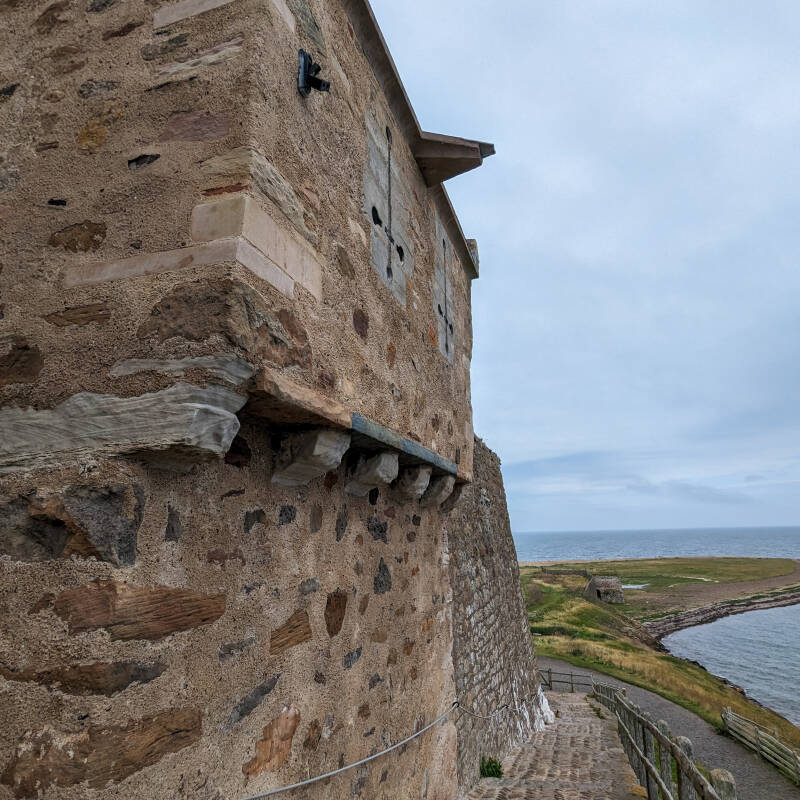
One of the most interesting things about Lindisfarne Castle is that it was never really the medieval castle its appearance might suggest. Its origins are in the Tudor period, when the position overlooking Holy Island's harbour became part of England's coastal defences. The National Trust's own heritage record describes it more accurately as a fort, built to defend the harbour from an attack coming from the sea.
The government garrisoned Lindisfarne Castle from the 1550s until 1893 and, at one point in its military life, it mounted 21 cannon. The surviving Upper and Lower Batteries are reminders that the building was designed around guns and defence rather than knights, banquets and medieval castle life.
Its position makes much more sense once you know that story. From the top you can see a huge stretch of coastline and sea, while the natural harbour lies below. What today gives visitors some of the best views on Holy Island once gave soldiers a commanding position from which to watch the approaches to the island.
Can You Go Inside Lindisfarne Castle?
Yes, Lindisfarne Castle is open to visitors on selected days and is cared for by the National Trust. There is an admission charge to enter the castle, while National Trust members can visit under the usual membership arrangements. Opening hours can be quite different from those at a normal National Trust property because life on Holy Island is controlled by the tide, so check the castle's current opening times before setting off.
This is not a huge stately home filled with endless rooms. The attraction is the unusual mixture of old military fort and later holiday house. There are stone passages, changes in floor level, low doorways, narrow spaces and darker areas, mixed with rooms redesigned in the early twentieth century. It feels very different from walking around a conventional castle.
There are several levels inside and the building involves plenty of steps. If mobility is a concern, the National Trust provides a detailed access statement and a virtual 360 degree tour which is useful for seeing the spaces before deciding whether the visit will be suitable.
What Will You See Inside Lindisfarne Castle?
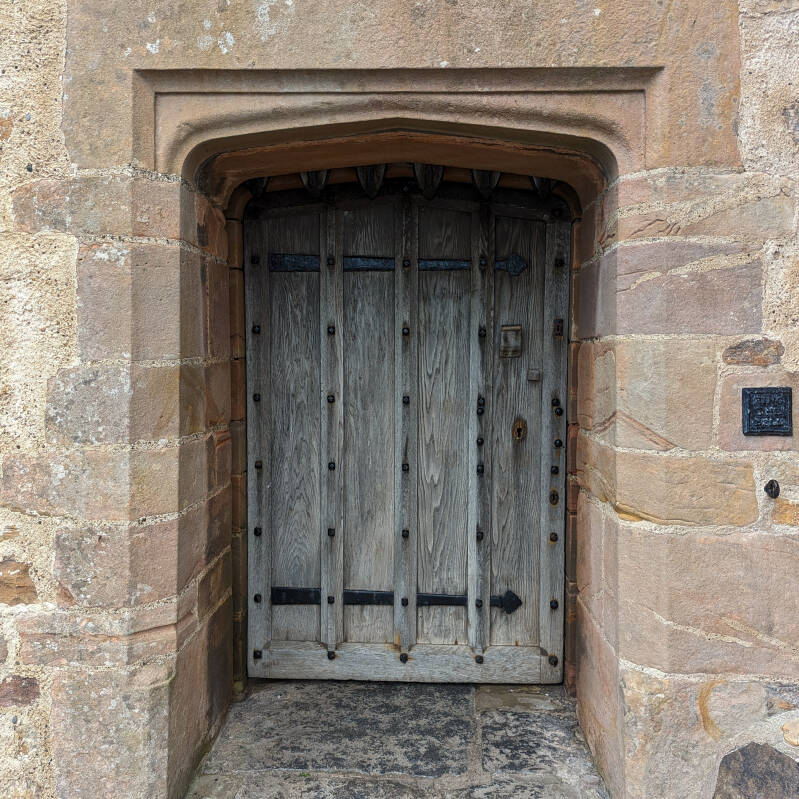
The strange layout is one of the things we enjoy most about the building. Instead of a neat line of grand rooms, you move through spaces created at very different times in the castle's life. Parts of the original Tudor fort remain, including old doorways and vaulted passages, while many other areas were changed when the building became a private home.
The Entrance Hall was altered by Edwin Lutyens in 1912, with columns designed to give the space something of the feel of the nave of Durham Cathedral. Elsewhere you will find the Ship Room, old military spaces reused as living rooms and bedrooms, and the Long Gallery, which Lutyens created in 1904 to connect two parts of the old fort that had previously been separated by an area open to the weather.
One small feature worth looking out for is the castle's wind indicator. Installed in 1913, it is both decorative and practical, showing the direction of the wind outside. It is a simple detail, but it feels perfectly suited to a house sitting in such an exposed position above the North Sea.
Keep going upwards and you eventually reach the Upper Battery. This is where the military purpose of the castle becomes particularly easy to understand. The battery once mounted 11 cannon and today gives visitors a wide view across the coast and surrounding countryside.
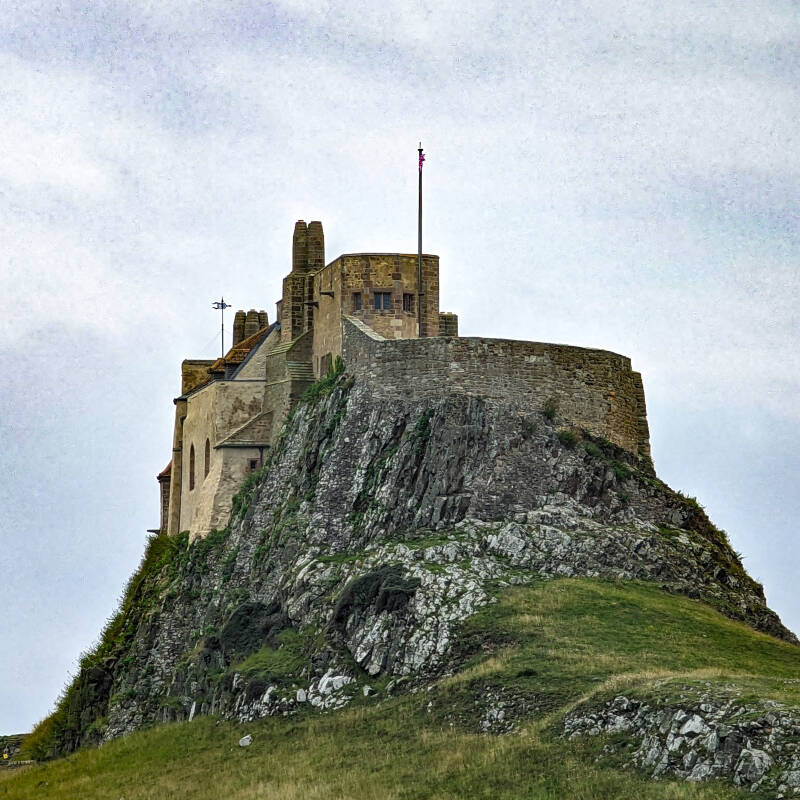
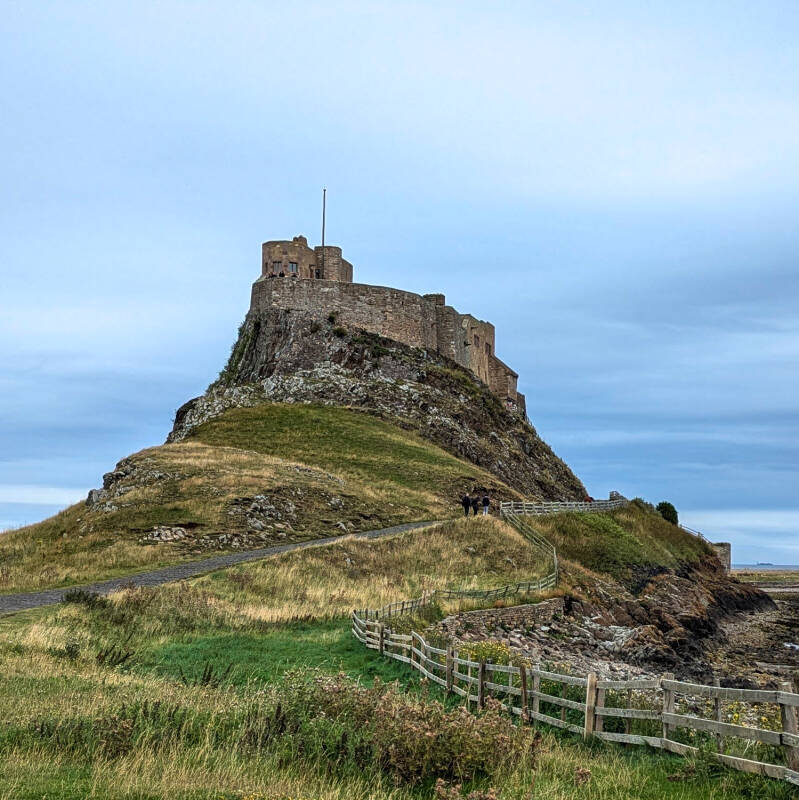
The Views from Lindisfarne Castle
The view is one of the biggest reasons to go inside. On a clear day the National Trust says you can see the Farne Islands, Bamburgh Castle, the Cheviot Hills, Berwick upon Tweed and the navigation beacons standing out across the water opposite the castle.
It is also a good place to stop and put the whole island into perspective. From down in the village, Lindisfarne Castle can look like a small building perched on an isolated rock. From the batteries you realise just how important that position once was. Sea, harbour, coastline and open land spread out around you, and it becomes easy to understand why a military fort was built here.
From Tudor Fort to a Country Life Holiday Home
The next part of Lindisfarne Castle's story is probably the most unexpected. After centuries as a military site, Edward Hudson took on the castle in 1901. Hudson was the founder of Country Life magazine and rather than seeing an old windswept fort, he saw the possibility of creating a private holiday home.
He commissioned the architect Edwin Lutyens to transform it. Historic England records the conversion into a house in 1902, although Lutyens continued making changes for years afterwards. Instead of trying to hide the old fort completely, he worked with its awkward rooms, thick walls and changing levels. Small spaces were given large pieces of furniture, passages twisted through the building and low doorways were retained or created alongside taller rooms.
That mixture is still what makes Lindisfarne Castle so unusual today. You are not simply visiting a Tudor fort and you are not simply visiting an Edwardian country house. The two have been woven together, which explains why the inside can feel so different from the castle you thought you were approaching from the village.
Did the Vikings Attack Lindisfarne Castle?
This is an easy part of Holy Island's history to mix up, but the Vikings never attacked Lindisfarne Castle because the castle did not exist at the time.
The famous Viking raid on Lindisfarne took place in AD 793 and was an attack on the early monastery and church associated with St Cuthbert. Lindisfarne Castle appeared many centuries later as part of the island's Tudor defences. The Viking story belongs with Lindisfarne Priory, while the castle tells a much later story of coastal defence, soldiers and artillery.
The castle did see real conflict of its own. It was strategically important during the Scottish wars of the sixteenth century and later saw action during the Civil Wars and the Jacobite Rising of 1715. During the 1715 rising, Northumbrian Jacobite supporters Lancelot Errington and his nephew Mark briefly seized the castle before it was retaken. It is a small episode compared with the famous Viking raid, but it is a brilliant reminder that this unusual looking building really was once a working military fort.
The People Who Looked After the Castle
The story becomes much more human once Edward Hudson turned the fort into his holiday home. One family in particular became closely connected with Lindisfarne Castle for generations.
Jack Lilburn had worked as a fisherman on Holy Island before he and his wife Hannah became caretakers and housekeepers at the castle. Hannah looked after the house while Jack dealt with maintenance and practical jobs such as bringing in coal and firewood. Jack also collected Hudson's visitors, including Edwin Lutyens and garden designer Gertrude Jekyll.
Getting visitors to an island house was not always straightforward. Before the modern causeway, journeys depended even more heavily on the sands and tides. When conditions required it, Jack would carry visitors through shallow water to a boat and row them across from Ross Sands. Their children later continued the family's connection with the castle, meaning the Lilburn family remained part of life here long after Hudson's original transformation.
It is one of those stories that is easy to imagine while standing inside. The building might have been a fashionable holiday retreat for wealthy visitors, but keeping a house running on an exposed tidal island took local knowledge and a lot of practical work.
Gertrude Jekyll's Garden
Do not finish at the castle door and immediately turn back towards the village. The walled garden nearby is another important part of the visit and is closely linked with the transformation of the castle into Edward Hudson's holiday home.
Edwin Lutyens worked on the structure and layout of the garden while Gertrude Jekyll created the planting. Her summer flower scheme was planted in 1911 and the National Trust continues to care for the garden using her design. The planting was intended to be particularly colourful during the summer, when Hudson would have been using the castle.
There is another clever detail that is easy to miss. The geometric layout uses false perspective to help the garden appear larger when viewed from the castle above, with Jekyll's planting helping to strengthen the effect. It means the garden was not simply somewhere to grow flowers. It was designed as part of the experience of looking out from the castle.
The garden changes through the year, but summer is when it really comes into its own. If you are visiting in July or August, it is worth allowing time to wander through rather than treating it as a quick extra on the way back.
Visiting Lindisfarne Castle with Children
Lindisfarne Castle works well as part of a family day on Holy Island because getting there already feels like a small adventure. The walk from the village is short enough for most children, there is plenty of open space around Castle Point and the building itself has narrow passages, steps, old batteries and unusual rooms rather than endless formal displays.
The National Trust provides space to leave buggies and larger bags, and there is currently a free family trail available at the property. The important thing to remember is that the castle itself contains a lot of steps and uneven surfaces, so it is not somewhere you will be pushing a buggy around once inside.
We would also leave enough time after the castle for the nearby lime kilns and shoreline. Trying to rush out, visit the castle and walk straight back misses a lot of what makes this end of Holy Island worth exploring.
Visiting with a Dog
Dogs are welcome in the grounds around Lindisfarne Castle, but they need to be kept on short leads. There are livestock in the fields and important ground nesting birds around Castle Point and the lime kilns, so keeping dogs under close control is particularly important here.
Only assistance dogs are allowed inside Lindisfarne Castle itself. If you are visiting with a dog and someone in your group wants to explore inside, it is worth planning for this before reaching the entrance.
Accessibility at Lindisfarne Castle
The walk from the main visitor car park to Castle Point is around one mile each way. For anyone who cannot manage that distance, the National Trust provides a drop off point immediately outside the gate into the castle field.
The building itself is much more challenging. Access is on foot up a steep cobbled ramp and steps, with further uneven surfaces, steps, low doorways and narrow or darker spaces inside. Seating is available at several points in the castle, but anyone with mobility concerns should read the National Trust's current access statement before visiting.
There is one toilet at Lindisfarne Castle. For anyone who needs more accessible facilities, it is sensible to check the wider Holy Island facilities before starting the walk out to Castle Point.
How Long Should You Allow for Lindisfarne Castle?
If you simply walked from the main car park to the castle and straight back again, the return walk would take around 40 to 50 minutes for most people. In reality, we would allow considerably longer.
For the walk, a visit inside and a little time around Castle Point, we would allow around one and a half to two hours. If you also want to explore Gertrude Jekyll's garden, the lime kilns, upturned boat sheds and shoreline properly, give yourself longer. Holy Island is much better when you are not constantly watching the clock.
The one clock you do need to watch is the tide. Always work backwards from the official safe causeway crossing times and make sure you have plenty of time to return to the mainland safely.
Is Lindisfarne Castle Worth Visiting?
For us, yes. It is not because Lindisfarne Castle is enormous or packed with hundreds of rooms. In fact, part of what makes it interesting is that it is quite the opposite.
You walk towards something that looks like a dramatic medieval fortress and discover a Tudor gun fort that eventually became a private holiday home for the founder of Country Life. Inside, old military spaces sit alongside the work of Edwin Lutyens, while outside you have huge coastal views, Gertrude Jekyll's garden and the remains of Holy Island's industrial past close by.
Even if you decide not to go inside, we would still make the walk out to Castle Point. The changing views of the castle as you approach, the shoreline, the garden, the lime kilns and the chance to explore this quieter end of Holy Island make it one of the parts of the island we would not miss.
What Else Is Near Lindisfarne Castle?
Castle Point has enough around it to spend far longer here than you might expect. Close to the castle are the huge nineteenth century lime kilns, once part of Holy Island's industrial lime works. Nearby are the distinctive upturned boat sheds, another feature that has become closely associated with Lindisfarne.
You can also explore the coast around the headland and visit Gertrude Jekyll's garden before making your way back towards the village. This makes the walk to Lindisfarne Castle particularly good because several completely different parts of Holy Island's story are packed into a relatively small area.
Before You Visit Lindisfarne Castle
The most important thing to check before any trip to Holy Island is the tide. The island is connected to the mainland by a tidal road causeway which is covered by the sea twice each day. Never rely on crossing times from an old screenshot, previous visit or printed article. Check the current official Holy Island safe crossing times provided by Northumberland County Council before travelling.
Lindisfarne Castle's opening times also change through the year and can be shaped by the tides. Check the National Trust's Lindisfarne Castle page on the day of your visit for current opening times and admission prices.
Once those two things are sorted, the rest is easy. Park in the main visitor car park, enjoy the walk through the village and out beside the sea, and take your time as the little castle on the rock gets closer. It is one of the most recognisable sights on Holy Island, but the story waiting inside is much stranger and more interesting than it first appears.
Explore More of Holy Island
Lindisfarne Castle may dominate the view across this side of the island, but there is plenty more to explore around it. Our complete Holy Island visitor guide covers the wider visit, while nearby you can discover the Holy Island Lime Kilns, Holy Island Lookout Tower and the Old Lifeboat House. You can also follow our Holy Island circular walk, explore centuries of change through the Holy Island history timeline, use our interactive Holy Island map, or take a look through the live Holy Island webcams.