Holy Island Lookout Tower on The Heugh
Holy Island has plenty of places that immediately grab your attention, but the Lookout Tower is one of those smaller stops that is well worth seeking out while you explore. Standing on The Heugh, the rocky ridge just above Holy Island village, this unusual stone tower was once used by the Coastguard. Today it is open to visitors, free to enter, and you can climb the stairs to the glazed lookout at the top for a wonderful 360-degree view across Lindisfarne and the surrounding coast. Current island visitor information confirms that entry is free, although opening times can vary.
You do not need to plan a separate walk to reach it either. The Heugh rises immediately above the village, close to Lindisfarne Priory, St Mary’s Church and the harbour, so the tower fits naturally into a day spent wandering around this side of the island. Once you have climbed to the top, it is worth staying for a while rather than simply taking a photograph and heading back down. The wide view helps you understand just how small Holy Island is, how closely it is surrounded by water and why this particular spot was once chosen for watching the coast.
Quick Facts
Location: The Heugh, Holy Island of Lindisfarne, Northumberland
What is it? A former Coastguard observation tower, now a public viewpoint
Entry: Free
Access: Reached on foot from Holy Island village; the upper viewing room is reached by stairs
At the top: A glazed lookout with 360-degree views across Holy Island and the Northumberland coast
Views: Bamburgh Castle, the Farne Islands and the mainland can be seen in clear conditions
Opening: Open to the public, although local visitor information advises that opening times can vary
Nearby: Lindisfarne Priory, St Mary’s Church, Holy Island Harbour and the war memorial

Who Looks After the Holy Island Lookout Tower?
The Holy Island of Lindisfarne Community Development Trust operates the Lookout Tower alongside several other community assets on the island. The island’s current visitor information describes the tower as free to enter and open to the public, but specifically notes that opening times can vary, so it is best seen as somewhere to include while exploring rather than relying on a fixed daily opening time.
Visiting the Lookout Tower
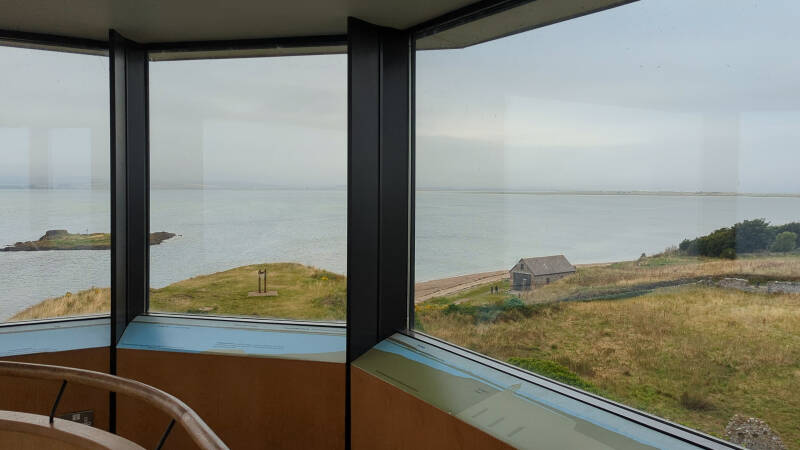
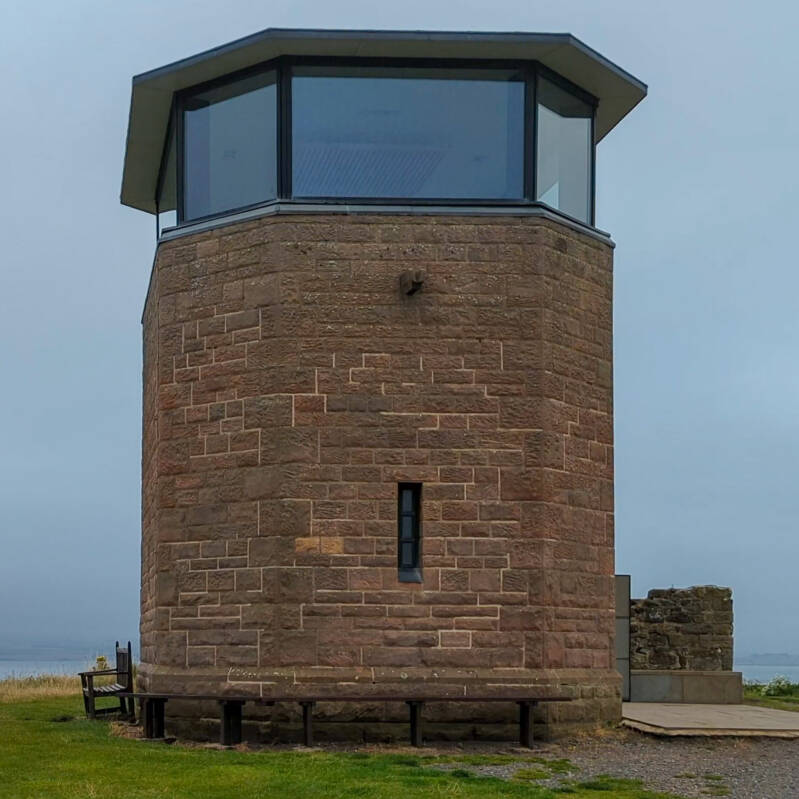
From below, the tower can look slightly puzzling. The lower part is a solid stone building, while the top is wrapped in glass and looks much newer. Once you know its story, the contrast makes sense. This was originally a working Coastguard observation tower, but it was later restored and adapted so that the same position once used for watching the coast could be enjoyed by visitors.
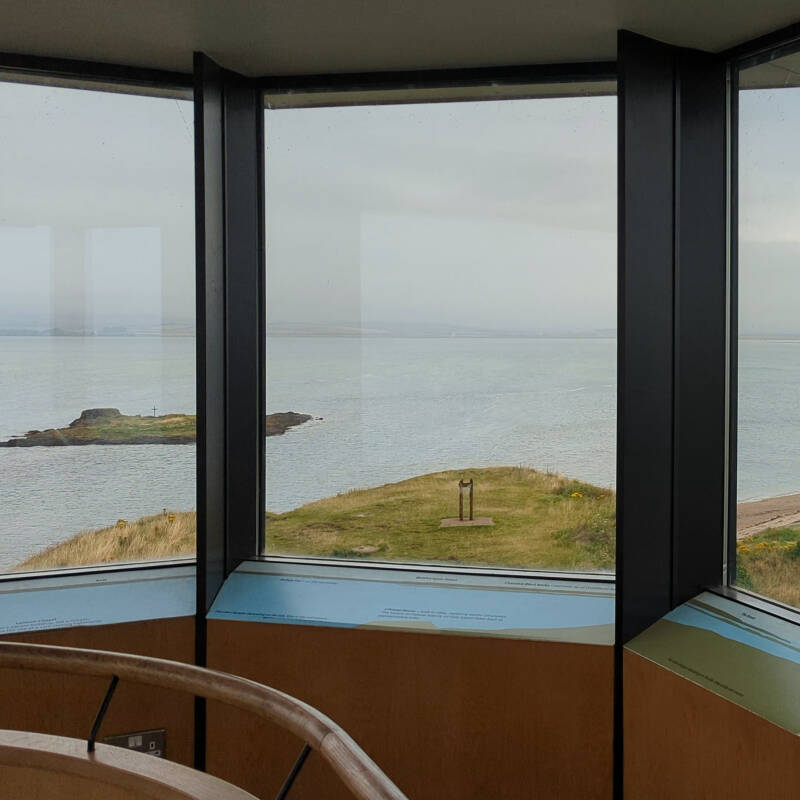
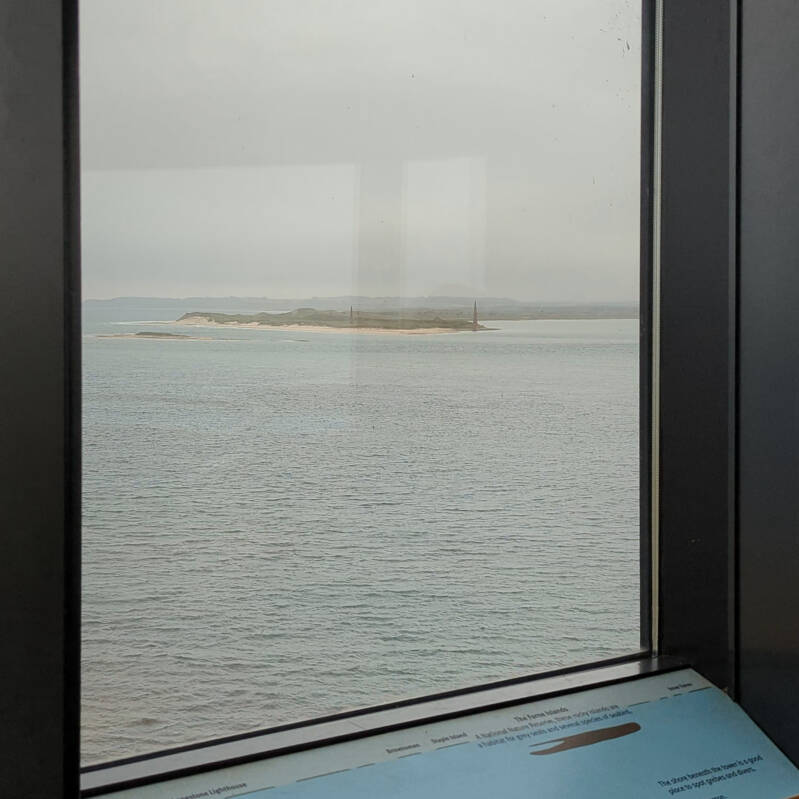
When the tower is open you can go inside and make your way up the internal staircase to the glazed viewing room. The restoration was deliberately designed to give an almost uninterrupted panorama, and the structural engineers behind the project describe the upper room as providing 360-degree views over the island, the surrounding nature reserve and estuary and towards the Farne Islands. Current Holy Island visitor information also highlights views towards the mainland and Bamburgh Castle.
It is the sort of stop that suits Holy Island particularly well because there is no need to rush it. Stand for a while and look back across the village, then out over the water and along the Northumberland coast. Down at ground level it is easy to move from the village to the priory, harbour and castle without really seeing how everything fits together. From the Lookout Tower the wider shape of the island and the huge open landscape around it become much easier to appreciate.
How to Find the Lookout Tower
The Lookout Tower stands on The Heugh, the rocky ridge immediately above the southern side of Holy Island village. The local pronunciation is given as roughly “Hee-uff”. It can be reached directly from the village by going through the turnstiles beside the Crown & Anchor and following the path towards The Heugh. There is another approach from St Cuthbert’s Beach, but the island’s own visitor information describes that climb as steep, so the village-side approach is likely to be the more comfortable choice for many visitors.
If you are arriving by car, there is no need to try to drive towards the tower. Visitors are directed to the main Holy Island car park on the approach to the village, with driving and parking within the village restricted. From there Holy Island is best explored on foot, and the Lookout can simply be worked into your wander around the village, church, priory and harbour.
This is one of the things we like about it. You are not walking miles out of your way for a single viewpoint. It sits among several of the most interesting places on this side of Lindisfarne, so you can climb the tower, explore The Heugh and then carry on towards the harbour or back towards the priory without turning the visit into a separate expedition.
What Can You See From the Top?
The view is the main reason to climb the tower today, and it is also the key to understanding why a Coastguard lookout stood here in the first place. Current Holy Island visitor information describes a full 360-degree view towards the island, mainland, Bamburgh Castle and the Farne Islands, while the engineers responsible for the restoration also highlight the surrounding estuary and Lindisfarne National Nature Reserve.
Closer to you, the position on The Heugh gives a completely different perspective on the places you may already have been exploring. The war memorial itself overlooks Lindisfarne Castle and the harbour, with the Farne Islands beyond, and the priory lies immediately beside The Heugh. It is a good place to stop and get your bearings before carrying on around the island.
The view will naturally change with the weather. On a clear day your eye is drawn well beyond Holy Island towards the Northumberland coast, while mist or haze can make the island feel much more separated from the mainland. Either way, the tower gives you a sense of Lindisfarne’s exposed position that is much harder to appreciate while walking between buildings at village level.
Why Was There a Coastguard Lookout Here?
The Lookout Tower was not built as a tourist viewpoint and it was never a lighthouse. It was a Coastguard observation tower. The architect and structural engineer involved in its later restoration both describe it as a former 1950s Coastguard tower, placing its working origins in the middle of the twentieth century. Rather than giving an exact construction year that the available published records do not establish, it is safest to leave it at that.
The purpose is much easier to understand once you are standing at the top. Before the modern communications and rescue-coordination systems used today, coastal lookouts formed an important part of Coastguard work. The National Archives records Coastguard duties that included assisting vessels in distress, operating lifesaving apparatus and taking part in lifeboat work, while the Maritime and Coastguard Agency describes the service’s development from coastal lookouts to the modern network used today.
In practical terms, a tower like this gave the Coastguard an elevated place from which the surrounding coast and sea could be observed. Holy Island is surrounded by tidal water and broad open stretches of coast, so the value of the position becomes obvious when you climb up yourself. Visitors now go up there because the view is beautiful; the original lookout existed because having a clear view of the coast mattered as part of the Coastguard’s work.
How the Old Coastguard Tower Became a Viewpoint
By the beginning of the twenty-first century the old working lookout needed a new purpose. Icosis Architects were appointed by Natural England in 2009 to look at improving the Lookout Tower and another visitor project on Lindisfarne. At that stage, the architect described the former Coastguard tower as not safe for public access.
The restoration was completed in 2013, and the tower you see now is therefore a mixture of the old Coastguard structure and a much newer visitor viewpoint. The original rooftop lookout cabin was removed and replaced by the fully glazed steel-framed room at the top. The stone structure below was repaired, a new internal steel staircase was installed and original details including windows and the iron-studded timber door were retained.
It is a really fitting second life for the building. The tower was created around the need to see clearly across the coast, and that view is still the reason people climb it today. The job has changed completely, but the thing that made this little tower useful in the first place has not.
Take Time to Explore The Heugh
Do not treat the Lookout Tower as the only reason to come up here. The Heugh is a small area, but there is a surprising amount to notice along the ridge, and much of it can easily be missed if you simply head from the village towards the castle.
Close to the tower are the remains of a nineteenth-century structure built on what is thought to have been the site of a chapel known as the Lantern Chapel. Farther along The Heugh are foundations uncovered in 2017 and identified as those of a seventh-century Anglo-Saxon church. The island’s visitor information notes the possibility of an association with St Aidan, but that is not established firmly enough for us to present it as fact.
You will also come to the Holy Island War Memorial, which is hard to miss in its exposed position overlooking the sea. Historic England confirms that it was designed by Sir Edwin Lutyens, unveiled in 1922 and later had names added to commemorate islanders who died during the Second World War. It is Grade II* listed, and its position gives views towards Lindisfarne Castle, the harbour and the Farne Islands.
Another feature worth noticing is the tall metal shipping beacon. Unlike some of the older remains around The Heugh, this has a practical purpose connected with the harbour. Holy Island visitor information explains that boats can line up the triangle at the top of the beacon with the church bell tower to help avoid a shingle bar as they enter. It is a lovely little detail to know before you walk past it because suddenly what looks like a simple metal marker makes much more sense.
Continue further along the ridge towards the castle and you eventually reach the remains of the fort on The Heugh. Historic England records that this stone fort or gun battery was built in 1671 and worked with the fortification at Lindisfarne Castle to help control and protect the island’s harbour during a period when the Dutch Wars created a genuine threat around the English coast. It is also historically recorded as Osborne’s Fort or Steel End Fort.
What Else Is Nearby?
The Lookout Tower works particularly well as part of a wider wander around this end of Holy Island. Lindisfarne Priory and St Mary’s Church sit immediately beside The Heugh, while the harbour lies below towards the east. From the harbour you can continue towards the upturned boat sheds and follow the island towards Castle Point and Lindisfarne Castle, or turn back into the village without having made a long detour. The relationship between the priory, harbour, castle and The Heugh is also reflected in Historic England’s description of the nearby war memorial, which places all of them within the same immediate landscape.
For us, this is a much nicer way to see Holy Island than simply moving from one headline attraction to the next. Climb the tower, look around The Heugh, notice the beacon and old remains, wander down towards the harbour and give yourself time to see the smaller things between the better-known landmarks. There is a lot packed into a relatively small part of Lindisfarne, and exploring it slowly is when the island starts to make much more sense.
Is the Holy Island Lookout Tower Worth Visiting?
Yes, especially if you are already exploring the village, priory or harbour. It costs nothing to enter, it is reached on foot from the village and the climb gives you a completely different view of Holy Island from the one you get at ground level. The only important thing to remember is that the viewing room is reached by stairs and current local information says opening times can vary.
What makes it worth seeking out is not simply the photograph from the top. Before you climb it, the tower can look like an odd little building on the ridge. Afterwards, you understand why it stands where it does, why the view once mattered to the Coastguard and how cleverly the old structure has been given a new use. It is exactly the sort of place that rewards taking your time and looking a little more closely while you explore Holy Island.
Before You Visit Holy Island
Holy Island is reached by a tidal causeway and the road is covered by the sea outside the safe crossing periods. Always check the official Northumberland County Council safe crossing times for the day of your visit before setting off and make sure you have enough time to return safely. The published crossing windows change from day to day, so they should never be guessed from ordinary tide times or from the time you crossed on a previous visit.
Explore More of Holy Island
The Lookout Tower is easy to include while exploring the village and harbour, but there is much more to see around the island. Start with our complete Holy Island visitor guide, then discover Lindisfarne Castle, the Holy Island Lime Kilns and the Old Lifeboat House. Our Holy Island circular walk joins several of these places together, while the Holy Island history timeline, interactive Holy Island map and live Holy Island webcams can help you explore even further.