Holy Island Lifeboat Museum and the Old Lifeboat House
The Holy Island Lifeboat Museum is one of those little places on Lindisfarne that we always enjoy visiting. It is not a big museum and you do not need hours to explore it, but that is not really why we come here. We like it because it feels real.
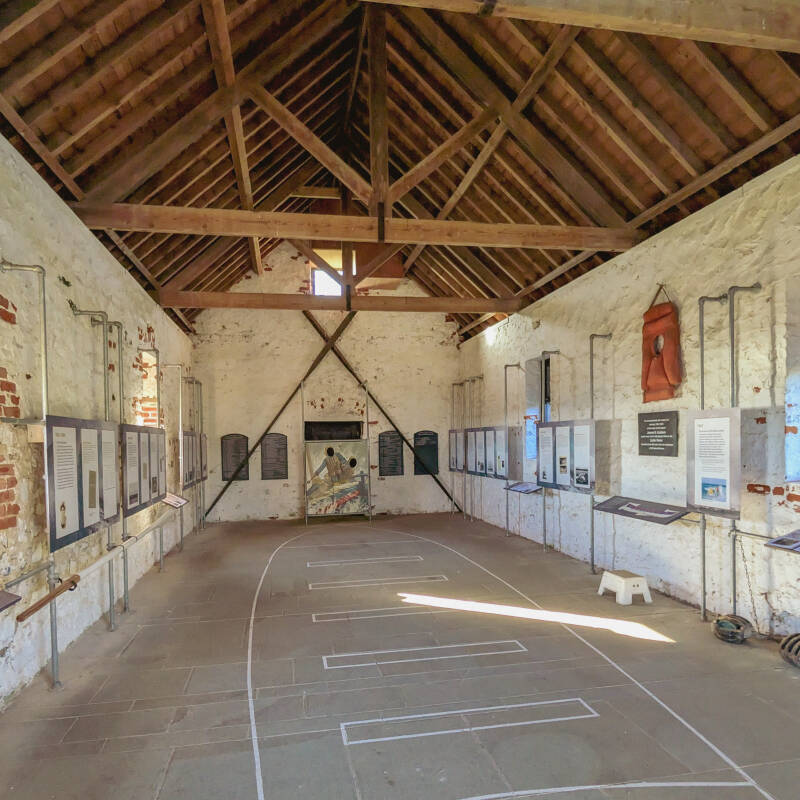
Inside the old stone lifeboat house are stories of rescues, bravery, loss and the islanders who went out to sea when somebody needed help. The outline of the Lizzie Porter lifeboat is marked across the floor, while photographs and displays around the walls introduce some of the boats and people connected with Holy Island’s long lifesaving story.
The setting is a big part of it too. The building stands close to the south western shoreline, looking across towards St Cuthbert’s Island. There are seats beside the water and we normally spend a bit of time here. It is a lovely place to slow down, look out across the sea and reflect on what this quiet little building once meant to the people who lived here.
Quick Facts
What is it? An 1884 former lifeboat house, now a small museum
Location: Jenny Bell’s Well, west shore of Holy Island
Historic station: Holy Island No. 1 Lifeboat Station
Lizzie Porter: Based here from 1909
Inside: Lifeboat history, rescue stories and the Lizzie Porter floor outline
Admission: Currently free to visit
RNLI station closed: 1968
Today: Operated by the Holy Island of Lindisfarne Community Development Trust

Where is the Holy Island Lifeboat Museum?
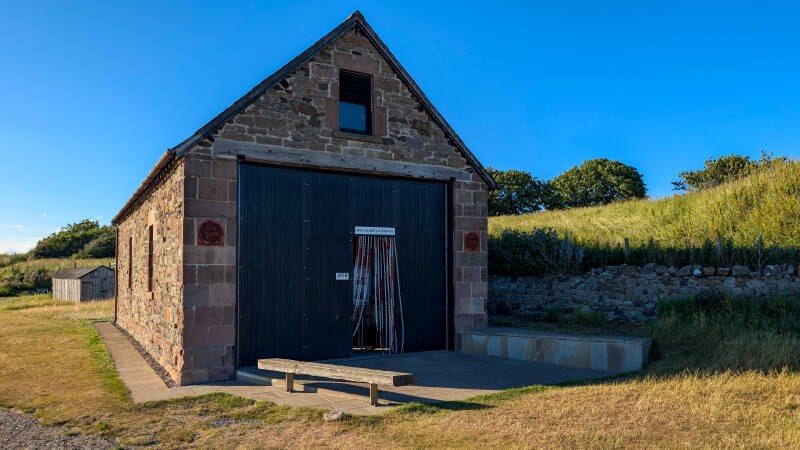
The Old Lifeboat House stands at Jenny Bell’s Well on the south-western side of Holy Island, close to St Cuthbert’s Beach and facing across the water towards St Cuthbert’s Island. It is only a short walk from St Mary the Virgin Church and Lindisfarne Priory, but it feels quite different from the busier harbour and castle side of the island.
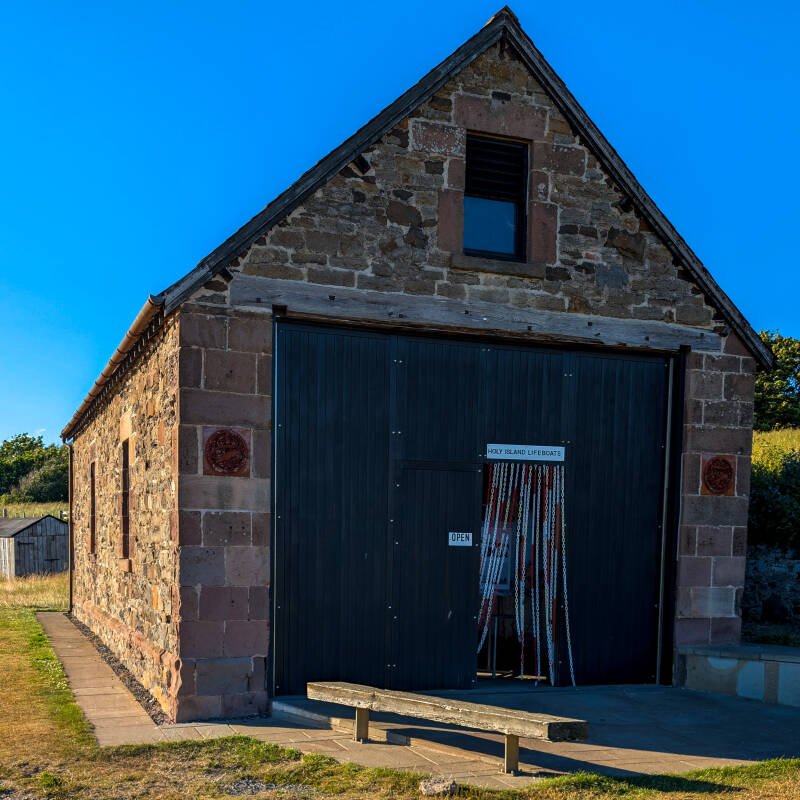
From the church and Priory area, head towards the western shoreline. The museum is the small stone building with large timber doors facing towards the shore. The sea is only a few steps away and St Cuthbert’s Island is clearly visible across the water.
Jenny Bell’s Well is actually the old name for this little part of the shoreline, rather than a name created for the lifeboat station. Historic Ordnance Survey maps mark the well with the Lifeboat Station immediately beside it. Exactly where the name came from seems to have been lost to time, but the site may be much older than the lifeboat house itself. An archaeological study found a possible connection with a well mentioned in the medieval accounts of Lindisfarne Priory, although this has never been proved. Archaeological finds have also been discovered close to Jenny Bell’s Well, adding another layer of history to what at first looks like a very simple stretch of shore.
Most visitors arriving by car use the main visitor car park at Chare Ends, near the entrance to the village. There is separate parking on Green Lane for Blue Badge holders and coaches.
More Than Just an Old Boathouse
The lifeboat house you see today was built in 1884, but people on Holy Island had been going out to help vessels in trouble long before then.
That is not surprising when you look at the island’s position. The surrounding waters are full of sandbanks, rocks, reefs and shallow channels, and for generations local fishermen and pilots knew these waters incredibly well. The museum records rescues being carried out from Holy Island from at least 1802, and possibly earlier.
The RNLI took over the Holy Island lifeboat service in 1865. Its records show that the existing station was renovated, a new 32-foot lifeboat and carriage were supplied, and the boat was named Grace Darling.
So while you will sometimes see Grace Darling described as Holy Island’s first lifeboat, the island’s lifesaving story had already been going for many years. 1865 was really the start of the RNLI chapter on Holy Island.
The 1884 Old Lifeboat House
By 1884, Holy Island’s No. 1 lifeboat was ready to be replaced. The first RNLI lifeboat based here, Grace Darling, had already been involved in saving 94 lives and had been badly damaged during a rescue.
Her replacement was given the same name, Grace Darling. This second Grace Darling was 34 feet long, rowed with ten oars and was paid for from money left to the RNLI by Ann Egdell of Alnwick.
The lifeboat house at Jenny Bell’s Well was built in the same year, at a cost of £285. It is the building that still stands here today and is now the last surviving one of the five lifeboat station buildings once used around Holy Island.
What we like about it is how easy it is to understand what the building was for. It is long, plain and practical, with big doors facing straight towards the shore. There was no need for anything fancy. This was a working lifeboat house, built for one job: getting the boat and its crew out towards the sea as quickly as possible when somebody needed help.
Lizzie Porter
The lifeboat that really brings the building to life today is Lizzie Porter.
She arrived at Holy Island’s No. 1 station in 1909 and was a pulling-and-sailing lifeboat. There was no motor to carry her crew around the island. They relied on oars, sails, local knowledge and their own strength.
Her name came from Elizabeth Porter of Halifax, whose legacy paid for the new lifeboat. The RNLI recorded that the money was left specifically for a boat to be called Lizzie Porter and sent to Holy Island. She was formally named on the island in October 1909.
Islandshire Archives records Lizzie Porter as the last rowing lifeboat on Holy Island and credits her with saving 77 lives during her service from the island.
There is a really simple feature inside the museum that makes that history much easier to picture. Look down and you will see the outline of Lizzie Porter marked across the floor, along with the positions of the crew benches.
Standing inside that outline gives you a completely different sense of the boat. What looks like a fairly spacious empty building suddenly feels much smaller when you see how much of the room the lifeboat occupied.
It is one of our favourite parts of the museum because you do not need a long explanation. You can stand there, look at the large doors ahead of you and imagine the boat being prepared to leave this same building when the alarm was raised.
The Night Holy Island Came Out to Help
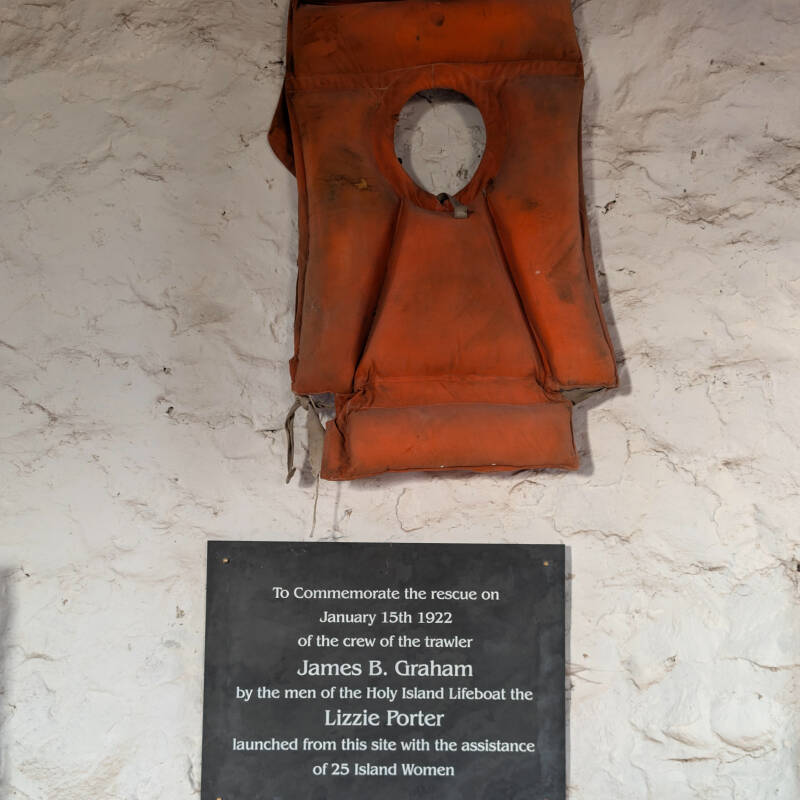
Of all the stories connected with the Old Lifeboat House, the rescue of the James B. Graham is the one that probably stays with us most.
On the evening of 15 January 1922, a south-easterly gale was hitting Holy Island. There were heavy seas, bitter cold and blinding snow when a flare was spotted shortly before eight o’clock near False Emmanuel Head on the northern side of the island.
The Hartlepool trawler James B. Graham was stranded on the rocks with nine men aboard.
The Coastguard took its lifesaving apparatus across the island, but the vessel was too far from shore for the rocket line to reach it. Meanwhile, men and women from the village had gathered to launch Holy Island’s No. 1 lifeboat, Lizzie Porter.
The tide was low and the wheels of the lifeboat carriage sank deep into the soft mud. The RNLI’s own account of the rescue says 60 people were needed to help launch the boat. Men and women from Holy Island waded waist-deep into the freezing water and helped get Lizzie Porter afloat.
Just 40 minutes after the alarm had been raised, she was away.
The crew still had nearly four miles to travel around the island before reaching the wreck. When they finally arrived, rocks and the iron remains of an earlier wreck made getting close to the trawler extremely dangerous. The crew tried more than once and had to wait for the tide to rise before making another attempt.
Eventually Lizzie Porter was carefully worked between the rocks and all nine men were rescued. The lifeboat returned to her station at around two o’clock in the morning.
Coxswain George Cromarty was awarded a bar to his existing RNLI Silver Medal. Second Coxswain William Wilson and Bowman Thomas A. Stevenson received RNLI Bronze Medals.
The women who helped launch the lifeboat were not forgotten either. The RNLI sent an individual letter of thanks to each of the 25 women who took part. One of those letters, sent to Sarah Walker, survives in the Holy Island archive.
When you stand inside the museum today and see Lizzie Porter marked on the floor, it is worth remembering that this was the boat they were struggling to move through the mud and freezing water that night.
Twenty-Nine Men and Two Cats
There are plenty of other rescue stories connected with Lizzie Porter, but one in particular is hard not to remember.
On 28 September 1916, the steamship Cydonia was driven onto the Castlehead Rocks during severe weather. Islandshire Archives records that Lizzie Porter was launched from the lifeboat house on the foreshore facing St Cuthbert’s Island.
Despite strong winds and heavy seas, the lifeboat crew reached the wreck and rescued 29 men and two cats.
Attempts were later made to salvage the Cydonia, but another storm left her a wreck on the rocks. Parts of the wreck remain associated with Castlehead today.
It is a lovely connection between different parts of Holy Island. You can stand in the old boathouse where Lizzie Porter was kept and know that the boat once left this shore to help people stranded on the far side of the island.
Why Were There Different Lifeboat Stations?
Holy Island’s lifeboat history can become confusing because the surviving museum was not the only lifeboat house on Lindisfarne.
The museum explains that five different buildings were used to house the island’s lifeboats between 1839 and 1968. For part of that history there were also two boats operating at the same time, known as Holy Island No. 1 and No. 2.
RNLI records confirm that by 1875 there was a No. 1 boat dating from 1865 and a No. 2 boat dating from 1868. The No. 2 boat was initially stationed at Ross Links, while the station arrangement changed again in later years.
The important thing when visiting the museum is simply to remember that not every Holy Island lifeboat rescue was launched from this particular building. The Old Lifeboat House at Jenny Bell’s Well formed one part of a wider lifesaving service around the island.
The Lifeboat Service Boards Near Lindisfarne Priory
If you are visiting Lindisfarne Priory, look out for the weathered black lifeboat service boards nearby.
They record individual services carried out by Holy Island’s lifeboats, including dates, the names of vessels that needed help and, for a number of entries, the number of people saved.
Some of the boards are headed for Holy Island No. 1, while others record the separate No. 2 lifeboat. They are therefore a record of the wider Holy Island lifeboat service rather than a list of rescues carried out solely from the building that is now the museum.
The lettering is weathered and some of the entries take a little effort to read, but we think they are worth stopping for. When you see rescue after rescue recorded together, the scale of what the island’s crews were doing becomes much easier to appreciate.
The Move to Motor Lifeboats
By the 1920s, Holy Island’s lifeboat service was changing. Boats such as Lizzie Porter relied on oars and sails, but the RNLI was moving towards larger motor lifeboats.
In 1925, the motor lifeboat Milburn arrived on Holy Island and the service moved to a new boathouse at the harbour. The old 1884 lifeboat house at Jenny Bell’s Well had reached the end of its working life as the No. 1 station. Islandshire Archives records the later harbour boathouse as being in use from 1925 to 1968.
Milburn was later replaced by Gertrude, the final Holy Island lifeboat. A surviving Holy Island Coastguard record states that Gertrude was permanently withdrawn on 1 April 1968, bringing Holy Island’s RNLI lifeboat service to an end.
The RNLI harbour boathouse no longer survives. Holy Island does still have an active HM Coastguard Rescue Team, but that is a separate service and its present station should not be confused with the old RNLI lifeboat station.
The little 1884 lifeboat house at Jenny Bell’s Well is the historic RNLI boathouse that survives today, which makes it an important reminder of the island’s long lifeboat story.
What Can You See Inside?
The Lifeboat Museum is small and simple, and we think that suits it.
Information panels around the walls tell the story of the island’s early rescues, the different lifeboat stations, the boats themselves, the crew and the roles people had aboard. There are photographs, records of gallantry medals and the names of families connected with Holy Island’s lifeboats over many years.
The outline of Lizzie Porter across the floor is the feature we remember most, but the displays are worth taking the time to read. They turn what could easily be seen as just an old stone shed into somewhere filled with individual people and stories.
You probably will not spend hours inside. That is not the point of it. Give yourself enough time to look properly, read a few of the stories and picture what this building must have been like when the lifeboat was still sitting inside.
Then step back through the doors and look at the shoreline.
It all makes considerably more sense.
The Old Lifeboat House Today
The Old Lifeboat House was restored in 2015 and is now owned and operated by the Holy Island of Lindisfarne Community Development Trust. It forms part of a small collection of community heritage sites around the island, maintained with the help of local volunteers.
The Lifeboat Story is currently free to visit, with donations helping to support the upkeep of these community sites. It is a small, informal museum rather than somewhere you need to plan hours around, and we think that suits it perfectly.
If seeing inside the building is especially important to your visit, it is sensible to check the latest local information before travelling, as arrangements on Holy Island can change and every visit to the island also needs to be planned around the safe causeway crossing times.
Is Holy Island Lifeboat Museum Worth Visiting?
For us, definitely, although perhaps not for the reason you might expect.
It is not somewhere we would describe as a huge attraction and it is not about how much there is to do inside. What makes it special is how close you feel to the story.
You can stand within the outline of Lizzie Porter, read about the men who rowed her into dangerous seas and the women who waded into freezing water to help launch her, then walk a few steps outside and see the same shoreline in front of you.
There are stories of bravery here, but there is sorrow too. Holy Island’s relationship with the sea was not always gentle, and the museum helps you understand something of the danger that generations of island families lived alongside.
We normally finish our visit sitting on the seats beside the shore. Everyone spreads out, St Cuthbert’s Island is across the water and the old lifeboat house sits quietly behind us.
It is a good place to stop.
Not because there is something else you need to tick off a list, but because sometimes the best thing to do on Holy Island is simply sit for a while, look at the sea and think about the people who were here before you.
That is what we like most about the Old Lifeboat House.
Planning Your Visit
Holy Island is reached by a tidal road causeway, so your visit must always be planned around the official safe crossing times published by Northumberland County Council.
The Council warns that local weather conditions can alter the predicted safe periods and advises drivers to allow an additional 30 minutes. Do not use ordinary tide times as a substitute for the official causeway crossing information.
The main visitor car park is at Chare Ends, on the approach to Holy Island village. There is also separate parking on Green Lane for Blue Badge holders and coaches.
From the village, the Old Lifeboat House is easily combined with St Mary the Virgin Church, Lindisfarne Priory, The Heugh and a wander along the western shoreline.
Explore More of Holy Island
The Old Lifeboat House adds another piece to the story of Holy Island and its relationship with the sea. For the wider island, head to our complete Holy Island visitor guide, or explore Lindisfarne Castle, the Holy Island Lime Kilns and Holy Island Lookout Tower. You can also follow our Holy Island circular walk, discover more through the Holy Island history timeline, find places on our interactive Holy Island map, or check conditions with our live Holy Island webcams.